Why Australia banning live animal exports may be a net loss for animal welfare
- Written by: Elizabeth (Liz) Jackson, Associate Professor of Supply Chain Management & Logistics, Curtin University
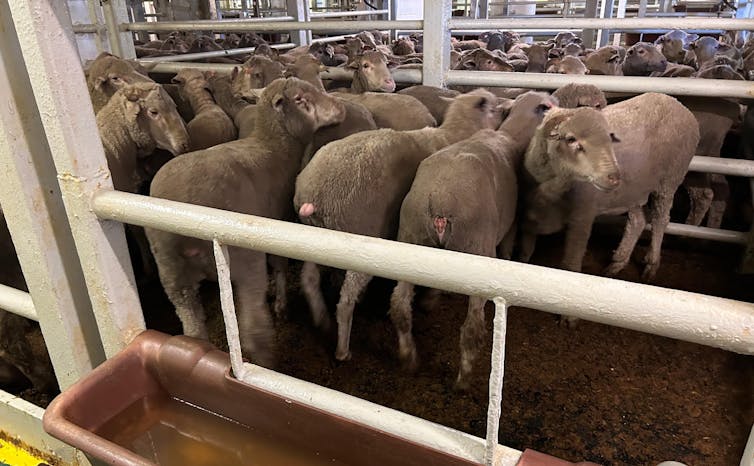
Australia’s government wants to end live animal exports. A panel of four experts has been appointed and given a $5.6 million budget to come up with a plan to phase out the trade, worth $92 million a year.
Chaired by the former head of the Murray Darling Basin Authority, Phillip Glyde, the panel is expected to report by the end of September. What it proposes remains to be seen. The only thing that’s certain is that Prime Minister Anthony Albanese has promised the ban won’t happen in his first term, and that a lot more funding will be needed if no one involved in the trade is to be left worse off.
The thornier question is whether the ban – something animal welfare activists have campaigned for decades – will be a net gain for global animal welfare. It’s likely to mean more animals being shipped from nations with lower standards.
Read more: Veganism: why we should see it as a political movement rather than a dietary choice[1]
Scandals, bans and reforms
Australia is the world’s seventh-biggest exporter of live animals by value. In 2022 it accounted for about 4.7% of the global trade, mostly shipping sheep[2] to the Middle East and cattle to Asia. These markets either lack reliable refrigeration and cold-chain facilities for processed meat or have a cultural preference[3] for freshly slaughtered meat adhering to specific practices, like halal.
Currently there is a ban on sheep being shipped to the northern hemisphere in summer[4], after 2,400 sheep died on a journey to the Middle East in 2017. There have also been temporary suspensions to individual countries over the past two decades.
Exports to Indonesia were suspended for six weeks in 2012, following an ABC Four Corners expose[5] of cruelty to cattle in abattoirs.
Trade to Egypt was suspended in 2013 and 2006, again over cruelty to cattle in abattoirs. Shipments to Saudi Arabia were suspended between 2003 and 2005, after 58,000 sheep were stranded at sea for three months[6] after Saudi authorities refused to let them disembark due to an outbreak of the viral disease scabby mouth[7].
These scandals, however, have led to significant reforms in the industry, with the federal government imposing stringent obligations on exporters for trade to resume.
As a result, Australia can boast that it leads the world[8] in animal welfare practices.
It is only country that requires exporters to safeguard the welfare of animals from the paddock to the point of slaughter in abattoirs in other countries. This is a rare example of the principle of extended producer responsibility being practised. The World Organisation for Animal Health recommends this but does not require it.
Regulating treatment in importing nations
Two sets of Australian regulations oversee the treatment of animals being shipped for slaughter overseas. From the farmgate to the ship is covered by the Australian Standards for the Export of Livestock[9]. These were introduced in 2021.
Treatment in importing countries is covered by the Exporter Supply Chain Assurance System[10] (ESCAS). These rules were instituted in 2011, following the expose of mistreatment in Indonesian abattoirs.
They require exporters to ensure all handlers and facilities (ports, transport vehicle, feedlots and abbatoirs) in importing countries to comply with both local and Australian welfare guidelines.
To gain an export licence from the Department of Agriculture, Fisheries and Forestry, exporters must demonstrate they have control over every link in the supply chain[11] from when animals leave the ship to the point at which they are slaughtered.
Animals must be inspected before, during and after their journey by accredited animal health professionals. Facilities and animal-handling techniques are audited[12] at least once a year. Auditors are appointed by the exporter but have to be independent, have no conflict of interest and be appropriately qualified.
Imperfect but ‘unique and innovative’
The system is not perfect. A 2021 review[13] of ESCAS by the federal Inspector-General of Live Animal Exports identified a number of regulatory gaps and ways to make the system more efficient. In particular it noted that loss of control and traceability, sometimes with poor animal welfare outcomes, still occurs at low but chronic levels.
Nonetheless it still described the system as “a unique and innovative regulatory practice solution” that had largely achieved its broad objectives, and made eight recommendations to fix problems (the department agreed to four of these, and “agreed in principle” to the other four.)
Reporting non-compliance
One measure of how well the system is working is the number of reports of Australian livestock being mistreated or being in non-accredited facilities. Anyone can make these reports, which are publicly available[14], along with the investigations arising.
For example, in 2021 the animal rights group Animals Australia reported non-compliant slaughter of sheep in Jordan. The Department of Agriculture, Fisheries and Forestry agreed[15], and that the control arrangements of the exporter, Livestock Shipping Services, had failed.
Read more: What the High Court decision on filming animals in farms and abattoirs really means[16]
The federal minister for Agriculture, Murray Watt, described the live export industry in June 2020 (when he was shadow minister for Northern Australia) as “a world leader with regard to animal welfare[17]”.
Nothing has changed since.
References
- ^ Veganism: why we should see it as a political movement rather than a dietary choice (theconversation.com)
- ^ shipping sheep (oec.world)
- ^ have a cultural preference (www.agriculture.gov.au)
- ^ northern hemisphere in summer (oia.pmc.gov.au)
- ^ ABC Four Corners expose (www.abc.net.au)
- ^ 58,000 sheep were stranded at sea for three months (lawaspect.com)
- ^ scabby mouth (farmerhealth.org.au)
- ^ leads the world (www.agriculture.gov.au)
- ^ Australian Standards for the Export of Livestock (www.agriculture.gov.au)
- ^ Exporter Supply Chain Assurance System (www.agriculture.gov.au)
- ^ every link in the supply chain (www.iglae.gov.au)
- ^ are audited (www.agriculture.gov.au)
- ^ 2021 review (www.iglae.gov.au)
- ^ are publicly available (webarchive.nla.gov.au)
- ^ agreed (www.agriculture.gov.au)
- ^ What the High Court decision on filming animals in farms and abattoirs really means (theconversation.com)
- ^ a world leader with regard to animal welfare (www.openaustralia.org.au)
Authors: Elizabeth (Liz) Jackson, Associate Professor of Supply Chain Management & Logistics, Curtin University