Why Reserve Bank Governor Philip Lowe wants to damage the economy further
- Written by: Peter Martin, Visiting Fellow, Crawford School of Public Policy, Australian National University
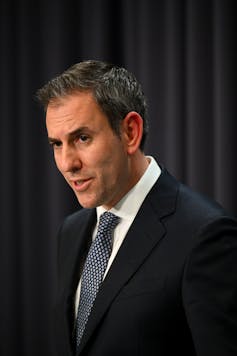
Reserve Bank Governor Philip Lowe and his board have pushed up interest rates yet again – for the twelfth time in 14 months – because they want to damage the economy further.
Home prices have been climbing for three straight months[1] – in March, April and May – instead of continuing to fall as they had been since the Reserve Bank of Australia (RBA) began pushing up rates in May 2022, a point the bank notes in its latest statement[2].
Employment, which in November the RBA predicted would grow 1.4%[3] this financial year, is instead growing at an annual pace of 2.9%[4]. In April, Australians worked more hours than ever before[5].
These aren’t signs of a depressed economy, and the Bank wants to depress the economy further to ensure it gets inflation down to where it wants it to be.
The governor’s written agreement[6] with the treasurer requires him to deliver an inflation rate of 2–3% on average, over time.
Some of us are doing well, most are not
Parts of the economy are slowing. The statement refers to a “substantial slowing in household spending” (and Wednesday’s national accounts[7] are likely to be grim) but the RBA’s concern is that the slowdown is uneven.
It says while some households are “experiencing a painful squeeze”, others have “substantial savings buffers”.
Those experiencing the squeeze are the 35%[8] of households that are mortgaged. The 31% who rent aren’t doing too well either. By contrast, many of the 31% that own outright are doing well indeed.
Since the RBA began pushing up rates in May 2022, the typical interest rate on a new mortgage has doubled – climbing from 2.7% to 5.4%, adding roughly $1,000 per month to the cost of servicing a $600,000 mortgage. The latest decision will add a further $90. And yet home prices are turning back up.
Lowe wants to be sure
The RBA has pushed rates to a new ten-year high[9] – and hinted strongly it will push them up again, saying “further tightening” might be required – not because it doesn’t think the economy isn’t slowing overall, but because it wants to make sure it keeps slowing enough to keep inflation heading down.
Inflation was 7%[10] in the year to March, and 6.8%[11] in the year to April. The RBA wants to get it down to its forecast of 6.3%[12] for the year to June and to its forecast of 3% two years after that, and while it looks as if things are on track, it isn’t yet sure.
If it has to, it is prepared to push Australia’s unemployment rate up from 3.7% to 4.5% by late next year, putting perhaps an extra 100,000 people out of work. That’s what its board minutes[13] predict.
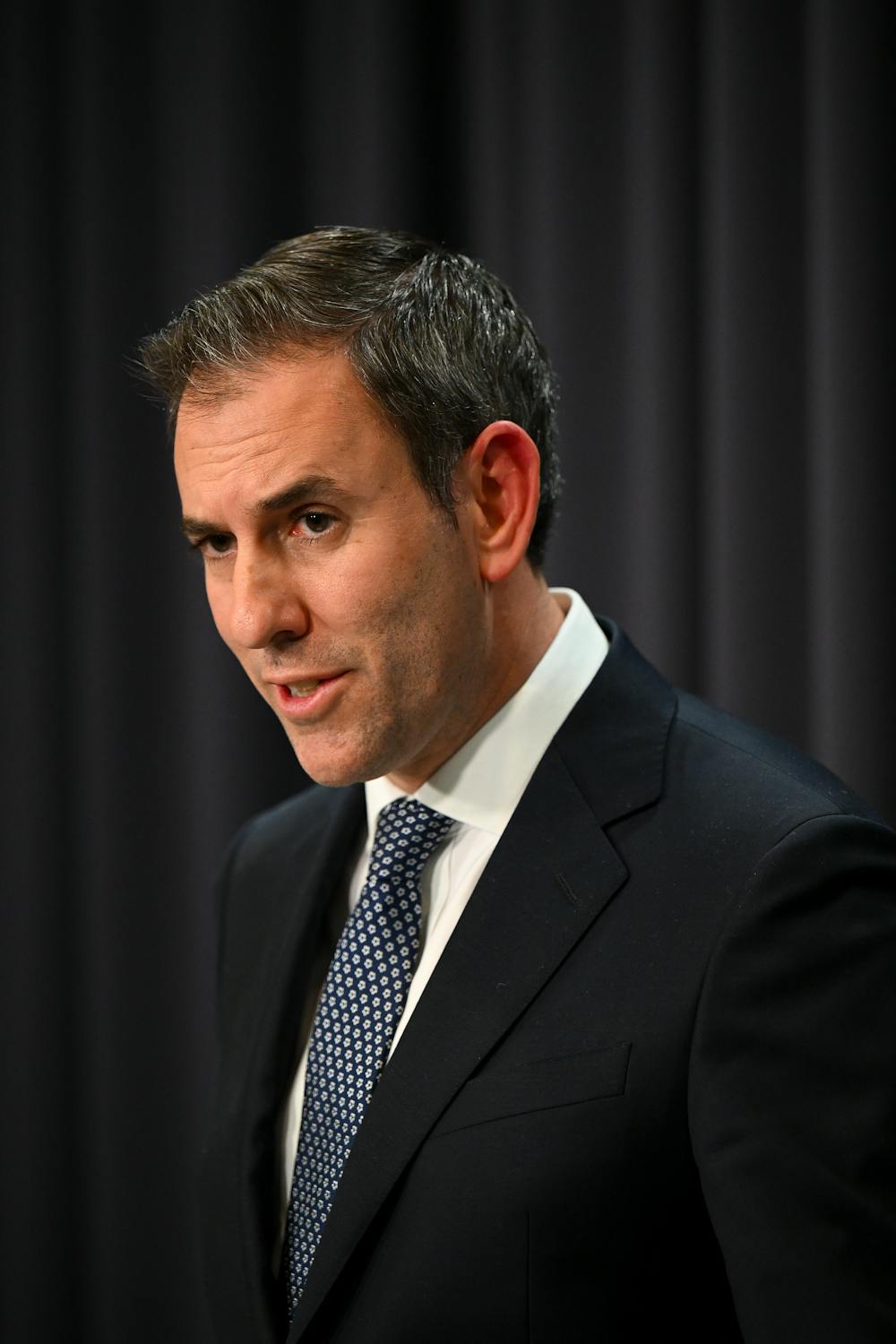
It’s a decision that Treasurer Jim Chalmers says many Australians will find “difficult to cop[14]”. The RBA’s job, in Chalmers’ words, is to “squash inflation without crunching the economy”.
He could have added that Lowe is running out of time. Unless he gets an extension, his six-year term as RBA governor ends in September.
That gives him just three more board meetings to make sure inflation is heading back towards the RBA’s target of 2-3% before he hands over to his successor.
Lowe will get the official reading on inflation for the year to June on July 27. If it hasn’t fallen to the 6.3% the RBA expects, he is likely to increase rates again in August.
Minimum wage untroubling
Something that doesn’t seem to be giving Lowe much grief is Friday’s Fair Work Commission national minimum wage decision, trumpeted by the trade union movement as an above-inflation increase of 8.6%[15].
What the union movement didn’t say, but Lowe knows well, is that it is an increase hardly anyone will get. The only people who get the misleadingly named national minimum wage are those not already covered by awards, enterprise agreements or individual agreements – at a guess only 0.7%[16] of the workforce.
So hard are these people to find[17] the Commission says it is “difficult to identify in practical terms any occupations or industries” in which they are engaged.
Read more: Don't blame Australia's lowest-paid workers if interest rates rise again[18]
What their wage rise will contribute to inflation will be next to nothing. The first part (an increase of 2.7%) changes the award wage they are linked to from what the commission now regards as an inappropriate classification of “C14”, which was originally a metal industry training wage, to “C13”, which is a non-training wage.
5.75%, but only for some
The second part of the increase applies to everyone on awards, some 20.5% of the workforce, which probably extends to 25% if you take into account other workers whose pay is linked to awards. It’s an increase of 5.75%[19], much less than inflation, and on Commission’s calculations should add only 0.6 percentage points to it.
Given that a wage increase of zero wasn’t tenable (even the employers[20] asked for 3.5%) it means the wage increase a (low-paid) portion of us get in July won’t much impede the Bank’s attempts to bring down inflation.
The Commission believes employers can afford it. It says profits have “generally been healthy” in the private sector industries whose workers most rely on awards, singling out the accommodation, food services and retail industries, which employ one-third of workers on awards and have enjoyed “substantial increases in profits”.
Expectations are what matters
The wages of the rest of us who don’t rely on awards are largely determined by bargaining power and what we expect, as are the prices businesses charge, and it is here that the Reserve Bank is worried.
It wants to dent bargaining power by making sure it dents spending and employment, and it wants to make sure above everything else that high inflation doesn’t become entrenched in “expectations”, a point Lowe mentions twice[21] in his eight-paragraph statement.
He says if high inflation does become entrenched in expectations, it will become “very costly to reduce later” requiring even higher interest rates and even higher unemployment.
References
- ^ three straight months (www.corelogic.com.au)
- ^ notes in its latest statement (www.rba.gov.au)
- ^ 1.4% (www.rba.gov.au)
- ^ 2.9% (www.abs.gov.au)
- ^ more hours than ever before (www.abs.gov.au)
- ^ written agreement (www.rba.gov.au)
- ^ national accounts (www.abs.gov.au)
- ^ 35% (www.abs.gov.au)
- ^ new ten-year high (www.rba.gov.au)
- ^ 7% (www.abs.gov.au)
- ^ 6.8% (www.abs.gov.au)
- ^ 6.3% (www.rba.gov.au)
- ^ board minutes (www.rba.gov.au)
- ^ difficult to cop (www.aph.gov.au)
- ^ 8.6% (www.australianunions.org.au)
- ^ 0.7% (www.fwc.gov.au)
- ^ hard are these people to find (www.fwc.gov.au)
- ^ Don't blame Australia's lowest-paid workers if interest rates rise again (theconversation.com)
- ^ 5.75% (www.fwc.gov.au)
- ^ employers (www.fwc.gov.au)
- ^ twice (www.rba.gov.au)
Authors: Peter Martin, Visiting Fellow, Crawford School of Public Policy, Australian National University