Australia Post releases stamp in honour of Sir Douglas Nicholls
- Written by: The Times
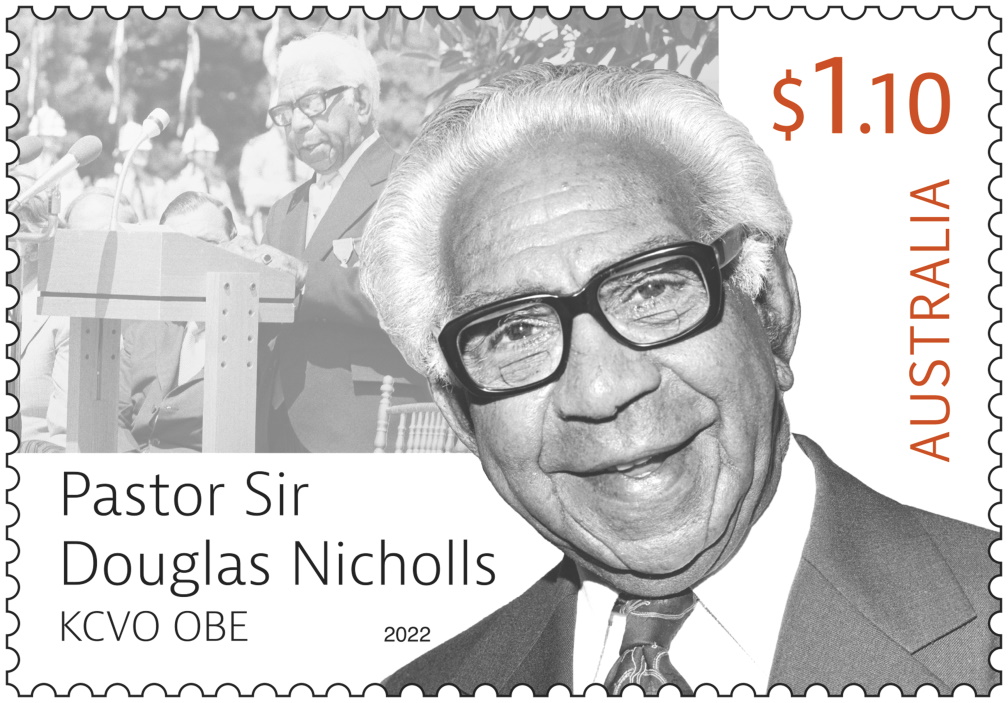
Australia Post has released a new stamp in honour of footballer, pastor, Aboriginal rights campaigner and state governor Pastor Sir Douglas Nicholls KCVO OBE. The Yorta Yorta man was born on 9 December 1906 at the Cummeragunja Aboriginal Mission, on the New South Wales banks of the Murray River.
Australia Post Group Philatelic Manager Michael Zsolt said the release marks the 50th anniversary of the knighting of Sir Doug, the first Aboriginal Australian to be knighted, and coincides with National NAIDOC Week, which celebrates and recognises the history, culture and achievements of Aboriginal and Torres Strait Islander peoples.
“NAIDOC week provides an opportunity for us to learn about First Nations cultures and histories. The release of this important stamp celebrates Pastor Sir Doug Nicholls and highlights his significant contribution to society,” he said.
Doug Nicholls first came to prominence when he joined the Fitzroy Football Club in the VFL, in which he was the only Aboriginal player in the league at the time. He played 54 games for Fitzroy until 1937, when a troublesome knee ended his football career.
Playing for Fitzroy also brought Nicholls to the heart of Melbourne’s Aboriginal community. Following the death of his mother, he re-embraced Christianity, was ordained as a preacher in 1945 and became the inaugural pastor of the first Aboriginal Church of Christ in Australia, at Fitzroy’s Gore Street Mission.
Nicholls became a passionate advocate for Aboriginal rights and welfare. Nicholls and his wife, Gladys (née Bux), worked with young Aboriginal people arriving in Melbourne, establishing both The Gladys Nicholls Hostel, as well as a gathering and recreational place for the community, The Douglas Nicholls Centre.
Nicholls’ significant work as an advocate and bridge-builder included his involvement in forming the Federal Council for Aboriginal Advancement in 1958, its mandate being to achieve “equal rights for all Australians”, and his work in the lead up to the highly successful 1967 Referendum.
Renowned for his modesty, Sir Douglas Nicholls was much decorated during his eventful life for his achievements in social justice work and addressing Aboriginal disadvantage. In 1957, he was awarded an MBE for “services to Aboriginal people” and, in 1968, he became the first Aboriginal Australian to be awarded an OBE for this work.
In 1972, he became the first Aboriginal to receive a knighthood, bestowed for “distinguished services to the advancement of the Aboriginal people”, and in 1976 he became Governor of South Australia. The Queen bestowed a second knighthood on Nicholls when he hosted her on the 1977 royal tour, the prestigious Knight Commander of the Royal Victorian Order.
Sir Doug Nicholls died in Mooroopna, Victoria, in 1988, and was honoured with a state funeral. His name lives on through the Sir Doug Nicholls Oval in Northcote, Sir Doug Nicholls Indigenous Round (AFL) and Nicholls, a Canberra suburb, and through the lives of his family and community who continue his legacy.
Bev Murray, a grandchild of Pastor Sir Doug and Lady Gladys Nicholls, and the instigator of a request to Australia Post for a stamp, said: “My grandparents were incredible people, and I am proud to walk in their footprints and continue their great work in advancing the rights of our people and supporting the most vulnerable I am very grateful to Australia Post for remembering my grandparents’ incredible achievements ; they are two amazing Elders who should never be forgotten.”
Pamela Pedersen, daughter of Pastor Sir Doug and Lady Gladys Nicholls stated: “Dad would be very humbled about getting his image on a stamp, and I know mum would think it would an amazing honour for the whole Nicholls family. My dad came from very humble beginnings and ended up being knighted. He was much loved and respected across Australia and I am so happy that his name lives on.”
The Pastor Sir Douglas Nicholls KCVO OBE stamp and associated collectables are on sale now at participating Post Offices, via mail order on 1800 331 794 and online while stocks last.
For more information visit auspost.com.au/stamps or australiapostcollectables.com.au