RSV Nuyina launches new era in Antarctic science
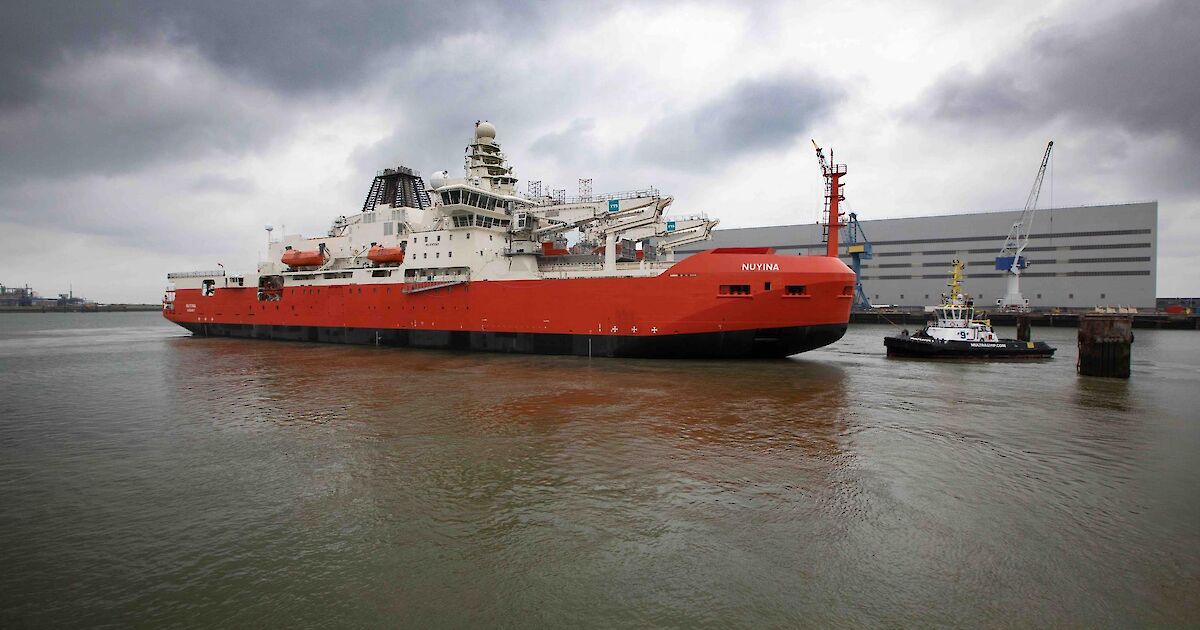
The Morrison Government has set the stage for a new era in Australian Antarctic science and discovery, with the launch of RSV Nuyina (noy-yee-nah) ahead of her scheduled maiden voyage to the southern continent on Monday.
The Prime Minister joined His Excellency General the Honourable David Hurley AC DSC (Retd), Her Excellency the Honourable Barbara Baker AC, Federal Environment Minister Sussan Ley and Tasmanian Premier Peter Gutwein for the launch in Hobart this morning.
The ship’s name Nuyina means southern lights in palawa kani, the language of Tasmanian Aborigines, and represents a $1.9 billion investment over 30 years in world leading research across the Southern Ocean and Antarctica.
“From aboard the RSV Nuyina, scientists will be able to research uncharted areas of the deep ocean and study the upper reaches of the atmosphere,” the Prime Minister said.
“The Nuyina is the most advanced polar research vessel in the world, and continues a proud Australian history of Antarctic exploration and science.
“Already she is drawing the attention of the international scientific community and that means good news for jobs in Tasmania as the gateway to Antarctica.”
Minister Ley said that RSV Nuyina, with its ‘moon pool’, containerised laboratories and unique underwater species collection systems has the potential to unlock key secrets about the Southern Ocean and its ecosystems.
“One of the exciting things about the RSV Nuyina is its capacity to carry out extended scientific sea voyages of up to 90 days,” Minister Ley said.
“It is also the quietest ice breaker in the world, which means it can research the ocean with minimal disturbance.
“What we are able to learn from the researchers on this ship will have a direct impact on the security of the marine life we depend on.”
RSV Nuyina is due to depart on Monday with 67 expeditioners and crew, to refuel Casey research station, transport helicopters to Davis research station and undertake commissioning activities for marine science.
Over the next two years RSV Nuyina will undertake a range of commissioning work and will be supported this summer by two other chartered vessels, the ice-strengthened heavy cargo ship Happy Dragon and a smaller icebreaker Aiviq.
RSV Nuyina
- Length: 160.3 metres; beam: 25.6 metres; draught: 9.3 metres; displacement: 25,500 tonnes
- Icebreaking: 1.65 metres at 3 knots
- Speed: 12 knots economical, 16+ knots maximum
- Range: > 16,000 nautical miles
- Endurance: 90 days
- Cargo fuel capacity: 1,900,000 litres / 1,671 tonnes (Special Antarctic Blend to service Antarctic stations)
- Container capacity: 96 (Twenty Foot Equivalent Unit)
- Cargo weight: 1,200 tonnes
- Passengers: 117
- Crew: 32
- Designed to handle waves up to 14 m high, and hurricane-like wind speeds up to 12 on the Beaufort scale.
- Designed to operate in air temperatures ranging from −30° to 45° Celsius and water temperatures from −2° to 32° Celsius.
- Cruising speed is 12 knots (about 22 km/h), with a maximum sustained speed of 16 knots (30 km/h) in open water.
- Three permanent scientific laboratories.
- Can accommodate an additional 20 containerised laboratories for specialised research projects that will evolve over coming decades.
- ‘Moon pool’ gives direct access to the ocean through the hull of the ship allowing the deployment of submersibles even when the ship is surrounded by ice.
- ‘Wet well’ system allows underwater biological samples to be captured from deep below the ship without damaging the specimens in the process.
- The Nuyina can accommodate two medium sized or four small helicopters.
- The ‘aft’ heli-deck is the size of around 7 cricket pitches.
- 6 Embarked Support Vessels (1 Science Tender, 2 Landing Barges, 2 Personnel Transfer Tenders and 1 Stern Tender).
- More than 650km of electrical and data cables have been installed.