Scott Morrison pursues commercialisation of Australian research with $2 billion new money
- Written by: Michelle Grattan, Professorial Fellow, University of Canberra
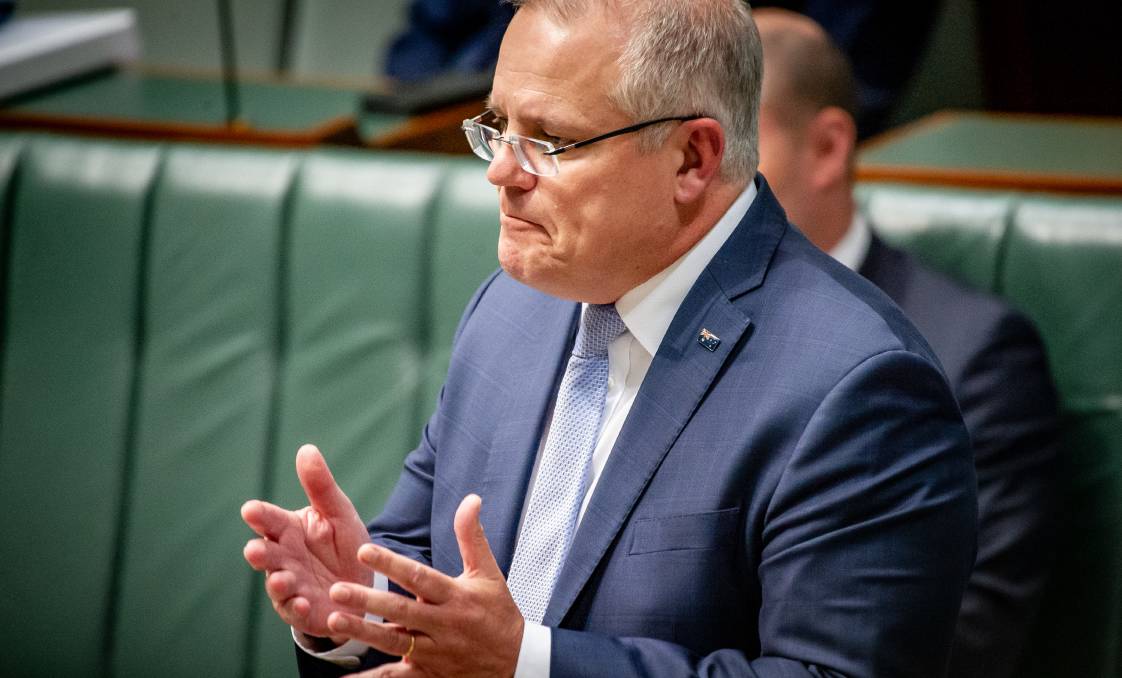
Scott Morrison will continue to tip out large dollops of money when he addresses the National Press Club on Tuesday, with his theme “building national resilience”.
He will announce the government will fund a $2.2 billion Research Commercialisation Action Plan, which includes about $2 billion in new money
The centrepiece is a 10-year $1.6 billion competitive program – called Australia’s Economic Accelerator – directed at the so-called “valley of death”. That is where research is not advanced towards commercialisation because of risk. The package also includes
-
$150 million to expand CSIRO’s Main Sequence Ventures program. This assists start-ups and promotes commercial opportunities for research
-
$296 million for 1800 industry-focused PhDs and 800 fellowships, funded over 10 years
-
the previously announced $247 million Trailblazer Universities programme for selected institutions to work with industry on national manufacturing priorities.
Last week Morrison opened the purse strings to announce $1 billion over nine years for the Great Barrier Reef, as the government seeks both to fend off international attempts to declare the reef formally “in danger” and to shore up its vote in north Queensland.
With Newspoll this week showing the government trailing Labor 44-56% and his personal approval plummeting, the Prime Minister is facing a massive test of his own resilience as he pursues re-election.
Targeted spending, provided for in the December budget update’s multi-billions for unannounced decisions, will be a major part of the government’s strategy.
Morrison will stress that his latest commitment “is not an election promise – these are funded programmes already in the budget, incorporated into the mid year budget update”.
It’s a tradition that both leaders appear at the start of the year at the NPC and Anthony Albanese delivered his address last week.
In his speech Morrison will canvass the storms, floods and Omicron wave that disrupted people’s summer, pointing to lessons that build into the government’s plans for the economy and the health system.
He will say the government is taking its manufacturing strategy to the next level, “by fusing it with greater investment in our world-class university research capabilities”.
The strategy is directed to areas “where Australia has significant comparative advantage and capacity to harness new opportunities,” Morrison says in an excerpt of the speech released ahead of delivery.
These include medical products, food and beverage, recycling and clean energy, resources technology and critical minerals processing, defence and space.
Morrison says 85% of Australian research is rated at or above world standard. “Yet we continue to underperform in achieving commercialisation outcomes.”
Better linkages are needed between Australian industry and university researchers, he says.
Importantly, “we need to find and develop a new breed of researcher entrepreneurs in Australia”.
“The government’s University Research Commercialisation Plan will align research priorities with our Modern Manufacturing Strategy. It will focus research effort on the same six National Manufacturing Priorities.”
Morrison announced the first element of this plan, the Trailblazer Universities program late last year, to promote commercialisation between selected universities and industry partners. This initiative is underway, with eight university proposals shortlisted.
Morrison says that in driving commercialisation, “the key policy challenge concerns the so-called ‘valley of death’ – where early-stage research is frequently not progressed to later stages of development because of the risk and uncertainty about commercial returns.
"We know this is not insurmountable. Other countries have made a better fist of solving this problem.”
He says Australia’s Economic Accelerator is “designed to attract projects at proof-of-concept or proof-of-scale level of commercial readiness”. They will need to have high potential.
“The fund will allow Australian innovators to access funding opportunities for each stage of their project – provided they can continue to prove project viability and commercial potential.
"Industry involvement and engagement is required at every stage.”
In the first two stages projects will compete against a diminishing number of other projects.
“Stage 1 allows us to capture a large number of ideas from innovators and industry partners. Stage 2 requires more skin in the game from industry.”
The third stage will operate through CSIRO’s Main Sequence Ventures, “for high-value opportunities to be taken to market”.
The government is also trying to change the “culture” in research. Presently, only 40% of Australia’s researchers work in private industry, Morrison says – well below the OECD average.
“This together with low mobility between industry and the university sectors leads to culture and capability gaps that reduce the ability of Australian businesses to innovate.
"To tackle this issue, the government will invest in a new suite of industry PhD and research fellowships schemes to create Australia’s new generation of research entrepreneur,” Morrison says.
“This $296 million investment aims to fundamentally reshape the workforce of Australia’s universities and career options, encouraging mobility and collaboration between university researchers and industry.”