Taliban's religious ideology – Deobandi Islam – has roots in colonial India
- Written by: Sohel Rana, PhD Student, Indiana University
Following the Taliban’s rapid taking of power in what it describes as a reestablished “Islamic Emirate of Afghanistan[1],” fears of a certain kind of Islamist ideology being brought back have led a large number of Afghans to flee, or fear for their lives[2].
The Taliban were known for their oppressive rule. They ruled Afghanistan from 1996 to 2001, at which point they were pushed out of power by U.S. and British troops[3]. Under the Taliban rule, religious minorities and other Muslims who did not share their fundamentalist understanding of Islam were not tolerated. The Taliban also severely restricted[4] the rights of women and girls.
As scholars who research ethno-religious conflicts[5] in South Asia, we have studied the origins of the Taliban’s religious beliefs. The roots of this ideology – Deobandi Islam – can be traced to 19th century colonial India.
Colonialism and Islam
Deobandi Islam emerged in India in 1867[6], 10 years after a major Indian nationalist uprising against the rule of the British East India Company.
Two Muslims clerics, Maulana Muhammad Qasim Nanautawi and Maulana Rashid Muhammad Gangohi, were behind the setting up of the Deobandi school[7]. Their aim was to indoctrinate Muslim youth with an austere, rigid and pristine vision of Islam. At its heart, Deobandi Islam was an anti-colonial movement designed to revitalize Islam.
This school of Islamic thought had a very particular understanding of the faith[8]. The Deobandi brand of Islam adheres to orthodox Islamism insisting that the adherence to Sunni Islamic law, or sharia, is the path of salvation. It insists on the revival of Islamic practices[9] that go back to the seventh century – the time of the Prophet Muhammad. It upholds the notion of global jihad as a sacred duty to protect Muslims across the world, and is opposed to any non-Islamic ideas.
The first madrassa[10] – or Islamic school – to educate Muslim youth in the Deobandi tradition was set up in the north Indian state of present-day Uttar Pradesh toward the end of the 19th century.
The Deobandi school system spread over the next several decades and attracted Muslim youth in different parts of the Indian subcontinent. For instance, the Deobandi tradition became the most popular school of Islamic thought[11] among the Pashtuns, an ethnic group living in an area on either side of the Afghanistan-Pakistan border.
Pashtun leaders played an instrumental role in establishing and expanding the Deobandi curriculum[12] and tradition in the Pashtun belt across the Durand line[13], the colonial border separating British India from Afghanistan.
Funding and enrollments
After British India was partitioned in 1947 between India and Pakistan, many prominent Deobandi scholars migrated to Pakistan[14], setting up a large number of madrassas.
With the independence of India and Pakistan, the school placed its full attention on training the students within this fundamentalist Islamic tradition[15].
In the years and decades after the independence of Pakistan, Deobandi madrassas spread across Pakistan, and one of their principal causes of political activism became India’s treatment of Muslims[16] in the Indian-controlled portion of Jammu and Kashmir.
According to one estimate, by 1967 there were as many as 8,000 Deobandi schools worldwide[17] and thousands of Deobandi graduates mainly in India, Pakistan, Bangladesh, Afghanistan and Malaysia.
At first, the Deobandi madrassas tended to be poorly funded. One event that greatly boosted the growth of enrollment in Deobandi madrassas was the Soviet invasion of Afghanistan in 1979[18].
The CIA’s covert involvement in the war fueled Islamic militancy and inadvertently helped organize and orchestrate a resistance[19] movement mostly composed of ardent religious fighters. A substantial number of these Afghan fighters were drawn from the Deobandi madrassas, especially the Pashtuns, who played a leading role in the resistance.
During that time, the Deobandi madrassas also gained financial assistance[20]. This assistance, as scholar Thomas Hegghammer[21] writes, came mainly through American aid dollars meant for Pakistan and money from Saudi Arabia.
Saudi leaders, in fact, used the influence of their money to push their own interpretation of Islam – Wahhabism – at the Deobandi madrassas[22]. Wahhabism is a deeply conservative form of Islam that believes in a literal interpretation of the Quran. At this point, the Deobandi madrassas moved far away from their religious roots[23].
Ties of kinship
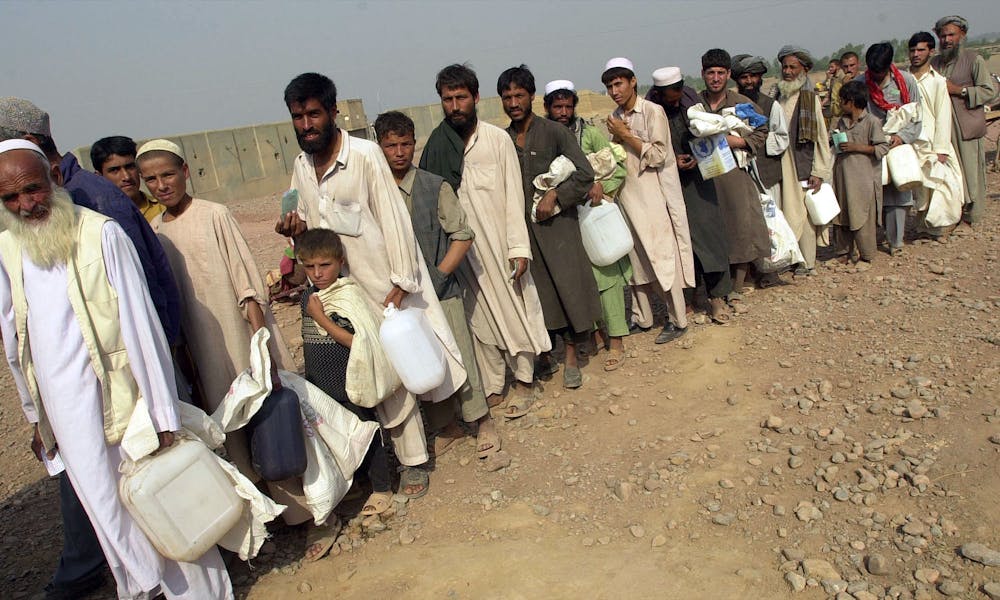 Afghans have fled upheaval in their country for more than 40 years, often landing in refugee camps in Pakistan.
Chris Hondros/Getty Images[24]
Afghans have fled upheaval in their country for more than 40 years, often landing in refugee camps in Pakistan.
Chris Hondros/Getty Images[24]
Following the Soviet invasion in Afghanistan in 1979, millions of Afghan refugees, in several waves[25], took shelter in Pakistan, especially in its Pashtun belt.
Keen on obtaining a strategic toehold in Afghanistan, Pakistan actively recruited young men in refugee camps[26], imbuing them further with religious zeal to fight the Soviets[27].
Driven out of their homes in Afghanistan, the dispossessed young Afghans thrived in the refugee camps, in part due to ties of ethnicity as Pashtuns. Drawn to a religiously based offensive against what they deemed to be an infidel[28], or foreign occupier, they became ready recruits to the anti-Soviet cause.
Many of the Taliban’s key leaders and fighters, including Mullah Omar, the founder of the organization[29], had studied in the Deobandi seminaries in both Afghanistan and Pakistan.
After the civil war
After the Soviets withdrew from Afghanistan in 1989, the fighters continued to enjoy the support of Pakistan’s security establishment[30] and private actors for financial assistance.
When Afghanistan plunged into a civil war in 1992, various factions of the anti-Soviet resistance vied for power. Among them was the Northern Alliance, a group that India and Russia had backed and was under the leadership of an ethnic Tajik, Ahmed Shah Massoud[31], who resisted the Taliban and acquired an almost mythic status.
However, as scholar Larry P. Goodson[32] writes, with the crucial and substantial assistance of Pakistan’s security establishment, the Taliban emerged victorious and seized power in 1996[33].
Once in power, they imposed their distinctive brand of Islam on the country – far removed from its religious roots in colonial India.
[3 media outlets, 1 religion newsletter. Get stories from The Conversation, AP and RNS.[34]]
References
- ^ Islamic Emirate of Afghanistan (apnews.com)
- ^ have led a large number of Afghans to flee, or fear for their lives (www.reuters.com)
- ^ pushed out of power by U.S. and British troops (www.history.com)
- ^ severely restricted (www.businessinsider.com)
- ^ research ethno-religious conflicts (polisci.indiana.edu)
- ^ emerged in India in 1867 (www.ucpress.edu)
- ^ were behind the setting up of the Deobandi school (scholarlypublications.universiteitleiden.nl)
- ^ very particular understanding of the faith (doi.org)
- ^ insists on the revival of Islamic practices (www.globalsecurity.org)
- ^ madrassa (theconversation.com)
- ^ Deobandi tradition became the most popular school of Islamic thought (doi.org)
- ^ expanding the Deobandi curriculum (www.nationalgeographic.org)
- ^ Durand line (www.nationalgeographic.org)
- ^ many prominent Deobandi scholars migrated to Pakistan (www.worldcat.org)
- ^ within this fundamentalist Islamic tradition (www.globalsecurity.org)
- ^ India’s treatment of Muslims (www.refworld.org)
- ^ 8,000 Deobandi schools worldwide (ctc.usma.edu)
- ^ Soviet invasion of Afghanistan in 1979 (www.theatlantic.com)
- ^ organize and orchestrate a resistance (books.google.com)
- ^ gained financial assistance (doi.org)
- ^ Thomas Hegghammer (scholar.google.com)
- ^ influence of their money to push their own interpretation of Islam – Wahhabism – at the Deobandi madrassas (www.rienner.com)
- ^ the Deobandi madrassas moved far away from their religious roots (theprint.in)
- ^ Chris Hondros/Getty Images (www.gettyimages.com)
- ^ millions of Afghan refugees, in several waves (media.nationalgeographic.org)
- ^ actively recruited young men in refugee camps (www.usip.org)
- ^ fight the Soviets (yalebooks.yale.edu)
- ^ Drawn to a religiously based offensive against what they deemed to be an infidel (doi.org)
- ^ Mullah Omar, the founder of the organization (doi.org)
- ^ continued to enjoy the support of Pakistan’s security establishment (www.hrw.org)
- ^ leadership of an ethnic Tajik, Ahmed Shah Massoud (doi.org)
- ^ Larry P. Goodson (www.carlisle.army.mil)
- ^ the Taliban emerged victorious and seized power in 1996 (uwapress.uw.edu)
- ^ Get stories from The Conversation, AP and RNS. (theconversation.com)