


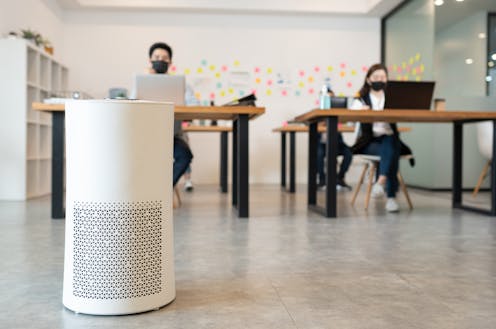
We should install air purifiers with HEPA filters in every classroom. It could help with COVID, bushfire smoke and asthma
- Written by: Donna Green, Associate Professor, Investigator for Digital Grid Futures Institute, UNSW; Affiliated Investigator NHMRC Centre for Air Pollution, Energy and Health Research, Associate Investigator the ARC Centre of Excellence for Climate Extremes, UNSW
The smell of hazard reduction burn smoke in Sydney this week[1] is an unwelcome reminder the bushfire season is almost upon us, and with it, the torment of having to breathe toxic air[2].
Even before the last of the 2019–20 Black Summer smoke dissipated, another deadly reminder of the importance of access to safe air arrived. COVID forced many of us to take a crash course in how to avoid respiratory viruses.
One of the most effective ways to reduce indoor COVID transmission is to open windows[3]. Maximising outdoor air coming inside, known as the air exchange rate, is a good way to reduce transmission risk.
Read more: Australia must get serious about airborne infection transmission. Here's what we need to do[4]
But opening windows during the bushfire season can let toxic smoke in, changing the risk calculation.
Keeping windows closed and re-circulating air through standard aircon systems can cool the air, but doesn’t remove smoke or viruses.
So how can schools reduce exposure to COVID and bushfire smoke simultaneously?
This dilemma has a solution we can implement immediately. We’ve calculated about A$50 million would provide all NSW primary and secondary school classrooms, and other shared spaces within schools, with High-Efficiency Particulate Air (HEPA) grade air purifiers.
This initial outlay pales compared to the roughly A$220 million-a-day[5] cost of Sydney’s lockdown.
The added benefit of installing air purifiers with HEPA filters is they can help reduce the risk of asthma attacks too.
Air purifiers with HEPA filters can remove over 99% of tiny particles
Most people catch COVID by inhaling it from shared air, and COVID particles often linger in the air in indoor spaces. Simple and relatively cheap air purifiers with HEPA filters have been shown to clear potentially infectious aerosols quickly and effectively[6].
HEPA air purifiers work by mechanical filtration — they force air through a fine mesh which traps particles. Off-the-shelf air purifers with HEPA filters can remove[7] more than 99.97% of all particle sizes down to 0.30-1.0 microns (one millionth of a metre).
This means they can help filter airborne viruses[8], bacteria, and tiny particles known as “particulate matter” from bushfire or hazard reduction burn smoke. They can’t completely eliminate COVID transmission, but they can help reduce the risk especially when used with other best practices like wearing masks and other public health measures.
This approach isn’t radical. It has already been mandated in New York schools[9] prior to their reopening.
Our calculations
These calculations assume each NSW primary and secondary school student, of which there are approximately 706,000 and 534,000, respectively, are grouped in classes of 25 and 20 pupils, respectively.
Each of these classrooms would require an air purifier designed to work in a standard classroom of approximately 60 square metres. We’ve allowed for each of the 3,100 schools in NSW to have six extra units to include shared spaces such as the library or resource room, staff room and administration area.
Approximately 73,500 units would be needed in NSW. We’ve applied a bulk buy discount of 30% on a currently available, high-quality HEPA air purifier retailing for A$1,000 to arrive at our estimate.
Of course, this doesn’t only affect NSW — schools across the nation would likely benefit from this approach.
Read more: We studied how to reduce airborne COVID spread in hospitals. Here's what we learnt[10]
Because these units are already available for purchase online and can ship via existing delivery services, the logistics are neither complicated nor expensive.
Installation of the units can be carried out in minutes, and one of the only concerns is the need to ensure proper PPE when changing the filter.
Unfortunately, upgrading existing aircon systems in schools by incorporating higher-grade HEPA filters is slow, expensive and not always technically possible.
In combination with other risk-reduction strategies, air purifiers could be an affordable way to reduce the risk of unmitigated COVID spread between unvaccinated students and staff, and the inevitable spread between, and within, these children’s households.
This approach would buy time until vaccines are approved and rolled out for Australian children. This is unlikely to occur before mid-2022[11] at the earliest.
There are multiple other benefits too
An added benefit is that for future years, these air purifiers might be able to reduce asthma attacks triggered by smoke[12] from the inevitable, and increasingly intense, bushfire season. That’s because for many people, asthma can be triggered by the small particles in smoke which, once inhaled, can go into the lungs causing inflammation.
Their tiny size means some of them can enter the blood stream and affect our lungs[13], heart[14] and immune systems.
Read more: How does bushfire smoke affect our health? 6 things you need to know[15]
One in ten Australian children[16] suffer from asthma, so keeping hazard reduction burn and bushfire smoke out of schools is a top priority.
Using HEPA filters will likely result in health savings associated with reduced asthma attacks from avoided smoke inhalation, and a lower burden from COVID cases stemming from school-based transmission. This will place less pressure on NSW’s overwhelmed health system[17].
It’s hard to comprehend why we haven’t raced to take such an effective no-regrets strategy.
It’s one strategy of many
Installing air purifiers with HEPA filters throughout the entire school system might be one of the most important, and cost effective, ways to improve the health and safety for millions of families in NSW, and around Australia.
We also need to deploy a range of strategies to reduce the risk to school children and staff of exposure to airborne viruses, as well as smoke and other air pollutants.
We know we need to:
promote outdoor sports over indoors
stagger outside playground access times
move non-essential person-to-person interactions online (for example parent-teacher meetings)
perform rigorous daily checks for symptomatic children
constantly encourage people with even the most minor symptoms to stay home and get tested
mandate masks in schools and on public transport
stagger drop off and pick up times where possible.
References
- ^ in Sydney this week (www.skynews.com.au)
- ^ breathe toxic air (theconversation.com)
- ^ open windows (theconversation.com)
- ^ Australia must get serious about airborne infection transmission. Here's what we need to do (theconversation.com)
- ^ A$220 million-a-day (www.smh.com.au)
- ^ quickly and effectively (theconversation.com)
- ^ can remove (www.epa.gov)
- ^ can help filter airborne viruses (www.epa.gov)
- ^ mandated in New York schools (ny.chalkbeat.org)
- ^ We studied how to reduce airborne COVID spread in hospitals. Here's what we learnt (theconversation.com)
- ^ unlikely to occur before mid-2022 (www.nytimes.com)
- ^ might be able to reduce asthma attacks triggered by smoke (pediatrics.aappublications.org)
- ^ lungs (asthma.org.au)
- ^ heart (www.hri.org.au)
- ^ How does bushfire smoke affect our health? 6 things you need to know (theconversation.com)
- ^ One in ten Australian children (www.aihw.gov.au)
- ^ overwhelmed health system (www.theguardian.com)










