What is the Islamic New Year? A scholar of religion explains
- Written by: Iqbal Akhtar, Associate Professor of Religious Studies, Florida International University
Much of the world today follows the Gregorian solar calendar[1], which has its origins in medieval Western Christianity. Conversely, the Islamic calendar[2] or hijrī, is a lunar calendar. There are 12 months in the hijrī calendar, with each month being 29 or 30 days long.
It would be over 32 to 33 years that the lunar calendar will completely cycle the solar calendar. That’s why the Islamic fasting month of Ramadan can fall in October one year, and a few years later it would be in July. It also means that the Islamic New Year is never on the same date and would also depend on the sighting of the moon[3].
Year one of the hijrī calendar is based on the emigration of the Prophet Muhammad[4] from Mecca to Medina in the year A.D. 622 to establish the first Muslim community. Despite Muhammad being from Mecca, his new faith and followers were persecuted for their beliefs. The Islamic calendar marks that beginning in Medina.
Additionally, the Islamic New Year is associated with the prophets[5] of the Christian faith as well: This is the day when Noah’s Ark is believed to have to have come to rest on land, the day on which God forgave Adam, the day of Joseph’s release from prison, the day of the births of Jesus, Abraham, and Adam, throughout the ages. It is also believed to be the day of the Prophet Muḥammad’s conception in the year 570.
Currently, while much of the world sees this as 2021, it is the Islamic year 1443, starting on Aug. 10[6] A.H.. In Latin, A.H. means Anno Hegirae – the year of the hijra, or emigration.
Unlike many traditions that celebrate the new year as a joyous occasion, the Islamic New Year is typically a somber affair. The first Islamic month is Muḥarram[7], a sacred time for prayer and reflection for both Sunni and Shiite[8] Muslims.
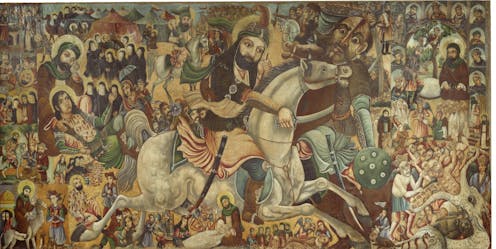
The 10th day of Muḥarram, known as Ashura, is particularly significant to Shiite[9] Muslims. In the year 680, the Prophet Mohammad’s grandson Ḥusayn[10] was killed along with most of his family and supporters in the Battle of Karbala[11] in present-day Iraq.
Yazīd[12] the caliph of the Ummayad dynasty, which ruled an area spanning from Spain to Persia from 661 to 750, saw Ḥusayn as a political threat and brutally suppressed him and his movement.
[Over 100,000 readers rely on The Conversation’s newsletter to understand the world. Sign up today[13].]
The battle was a turning point for the Shiites, who saw indifference by the majority in the massacre of the rightful heirs of Muhammad as final proof of a fundamental irreconcilability with Sunni Islam. It solidified the Sunni-Shia[14] schism[15] in Islam.
For the Shiites, Ḥusayn represents someone who stood against the forces of injustice and evil. They commemorate the battle during the first two Islamic months[16] of Muḥarram and Ṣafar.
In many countries like India and Iran, the Islamic New Year and Ashura are public holidays. Life events, such as birthdays and marriages, historically were not celebrated for the first 10 days of the month. Sunnis also observe Ashura. Many observe fasts as a way to atone for their sins and perform acts of charity.
The Conversation U.S. publishes short, accessible explanations of newsworthy subjects by academics in their areas of expertise.
References
- ^ Gregorian solar calendar (www.britannica.com)
- ^ Islamic calendar (doi.org)
- ^ moon (adsabs.harvard.edu)
- ^ emigration of the Prophet Muhammad (www.routledge.com)
- ^ prophets (dx.doi.org)
- ^ starting on Aug. 10 (www.news18.com)
- ^ Muḥarram (www.jstor.org)
- ^ Sunni and Shiite (theconversation.com)
- ^ Shiite (www.jstor.org)
- ^ Ḥusayn (dx.doi.org)
- ^ Battle of Karbala (muse.jhu.edu)
- ^ Yazīd (dx.doi.org)
- ^ Sign up today (theconversation.com)
- ^ Sunni-Shia (www.wiley.com)
- ^ schism (theconversation.com)
- ^ commemorate the battle during the first two Islamic months (doi.org)
Read more https://theconversation.com/what-is-the-islamic-new-year-a-scholar-of-religion-explains-165853