Number of women on remand in Victoria soars due to outdated bail laws
- Written by: Emma Russell, Senior Lecturer in Crime, Justice & Legal Studies, La Trobe University
Over the past 12 months, up to 1,200 people spent time in Victoria’s maximum-security women’s prison without being convicted and sentenced to a term of imprisonment. They were on remand: waiting in custody for their trial or sentencing, or to be granted bail.
Since 2018, Victoria’s bail laws have made remand the default option for an expanded list of offences. Even when a woman’s alleged offending is non-violent and relatively low level, her chance of being granted bail can be impossibly low. This is especially so if she is experiencing severe social disadvantage. Many women will be denied bail because they don’t have an address: they’re living in their car, couch-surfing, or unable to return home because of family violence.
Thanks to a series of punitive bail reforms, the remand situation in Victoria’s prisons has now reached crisis level.
In the past ten years, the number of people entering the women’s prison on remand in Victoria has trebled[1]. For First Nations women, the number has increased five-fold[2].
Shockingly, remandees now outnumber[3] sentenced prisoners in the women’s system. Most will spend less than one month on remand, although a significant proportion (32%)[4] spend between one and six months in custody. The majority[5] will leave the women’s prison without having spent any time under sentence.
Read more: Not for punishment: we need to understand bail, not review it[6]
Unfortunately, Victoria is not an outlier. In New South Wales, 43%[7] of women in prison are on remand, compared to 31% in 2013. National figures show more than a third (37%)[8] of women in prison are unsentenced, up from 22% in 2010.
On a global scale, Australia’s startling rate of growth in its remand populations far outpaces those of similar jurisdictions internationally, such as England and Wales, and Canada[9].
Increased churn[10] of unsentenced prisoners is a result of the politicisation of bail laws[11]. State governments have used bail reform to send a “tough on crime” message[12] when confronted with the fallout from high-profile instances of violent offending by people on bail.
In Victoria, this occurred after James Gargasoulos drove his car into a busy mall in central Melbourne, killing six pedestrians in January 2017. While recently released findings[13] from the coronial inquest into these deaths found changes to policing practices, not bail laws, were required to prevent a similar event occurring in the future, the Victorian government had already acted.
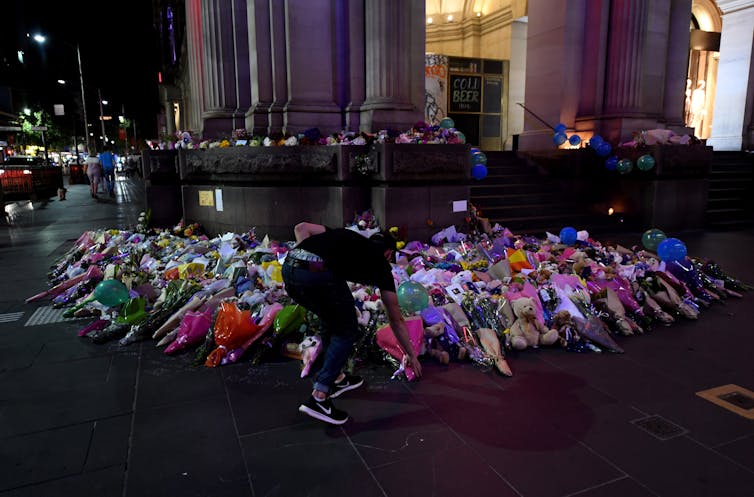 The Bourke Street killings were the catalyst for making Victoria’s bail laws more stringent.
Tracey Nearmy/AAP
The Bourke Street killings were the catalyst for making Victoria’s bail laws more stringent.
Tracey Nearmy/AAP
Twenty-two changes to the Bail Act were implemented in 2018, making it the strictest bail regime in the country[14]. But there is little consideration of the wider impact of making it harder for people to be granted bail, especially for groups that are already over-policed, such as Aboriginal and Torres Strait Islander peoples and people experiencing homelessness.
Changes to bail in Victoria were intended to enhance community protection. But lawyers working within the bail and remand system[15] report they are disproportionately affecting women who are homeless and victim-survivors of family violence. According to lawyers, a lack of safe housing options is the biggest barrier to women accessing bail in the current system.
Lawyers estimate the vast majority of women they represent in the bail and remand court are victim-survivors of family violence — a claim supported by an analysis of women entering prison on remand[16]. They fear that even short periods of remand will further traumatise women[17] and cause major disruptions to their lives and families.
Although remand is not intended to inflict punishment, its punitive effects[18] are difficult to ignore. Being remanded can result in someone losing their housing, their job, and having their children removed and placed in out-of-home care.
Lawyers are also concerned that high thresholds for bail are pressuring women to plead guilty just to avoid extended periods of time on remand awaiting their day in court. This will mean more women are trapped in cycles of incarceration that have damaging flow-on effects.
Read more: We need to consider granting bail to unsentenced prisoners to stop the spread of coronavirus[19]
Despite the overall trend of growth, last year remand numbers in Victoria declined significantly due to the impacts of COVID-19. As infection rates rose, magistrates were wary of sending people to prison unsentenced, knowing they would be held for weeks in quarantine conditions that amount to solitary confinement[20]. The ban on prison visits would also be particularly hard on women, who are more likely to be mothers and primary carers.
Victorian remand numbers are now bouncing back. Yet the 2020 downturn showed us prisoner reductions are possible and necessary. When the harmful effects of imprisonment are given serious consideration – with or without a pandemic – women can and should be diverted from prison.
To reduce rates of remand, we need to repeal changes to the Bail Act[21] that have made prison the default, not a last resort. Diverting prison funds towards public housing will also produce longer-term benefits for women, their children and the community.
References
- ^ trebled (www.corrections.vic.gov.au)
- ^ five-fold (www.corrections.vic.gov.au)
- ^ outnumber (www.corrections.vic.gov.au)
- ^ (32%) (www.corrections.vic.gov.au)
- ^ majority (www.corrections.vic.gov.au)
- ^ Not for punishment: we need to understand bail, not review it (theconversation.com)
- ^ 43% (www.bocsar.nsw.gov.au)
- ^ (37%) (www.abs.gov.au)
- ^ England and Wales, and Canada (www.prisonstudies.org)
- ^ churn (journals.sagepub.com)
- ^ politicisation of bail laws (theconversation.com)
- ^ “tough on crime” message (theconversation.com)
- ^ findings (www.coronerscourt.vic.gov.au)
- ^ strictest bail regime in the country (www.parliament.vic.gov.au)
- ^ lawyers working within the bail and remand system (d3n8a8pro7vhmx.cloudfront.net)
- ^ analysis of women entering prison on remand (www.corrections.vic.gov.au)
- ^ further traumatise women (theconversation.com)
- ^ its punitive effects (journals.sagepub.com)
- ^ We need to consider granting bail to unsentenced prisoners to stop the spread of coronavirus (theconversation.com)
- ^ quarantine conditions that amount to solitary confinement (www.tandfonline.com)
- ^ repeal changes to the Bail Act (d3n8a8pro7vhmx.cloudfront.net)