


Crown Resorts is not too big to fail. It has failed already
- Written by: Charles Livingstone, Associate Professor, School of Public Health and Preventive Medicine, Monash University
Crown Resorts was very sorry it had done so many wrong things in running its Melbourne casino, the company’s senior counsel, Michael Borsky, last week[1] told Victoria’s Finkelstein royal commission.
But his main point was to argue that Crown should keep running the casino, because cancelling or suspending its licence would not be in the public interest.
His submissions — responding to the arguments made by the counsel assisting the commission, Adrian Finanzio, for why Crown should be stripped of its licence — emphasised allowing the company to get on with reforming as the best course of action. At worst, Borsky argued, an independent supervisor or monitor with broad powers could be be appointed to direct the company’s activities.
Crown’s spin is that the public interest is mostly about maintaining the employment of the 11,600 people who work at the sprawling Melbourne casino and entertainment complex. It argues Victoria’s tourism industry would be endangered, should the licence be lost, and it is important to keep the revenue the casino provides to Victoria’s treasury flowing.
But based on the evidence, this seems a very optimistic take.
The commission has heard a litany of revelations about Crown’s malfeasance and improper conduct across a range of areas.
Last month royal commissioner Ray Finkelstein observed that everywhere he looked in the company there was evidence of inappropriate or unlawful behaviour[2]. Last week he compared Crown Resorts to a car thief[3] who promises to stop stealing cars when apprehended. He suggested it was certainly not in the public interest for a decade of malfeasance to be rewarded.
Read more: Responsible gambling – a bright shining lie Crown Resorts and others can no longer hide behind[4]
Finkelstein’s options
Several paths are open to Finkelstein. He can recommend Crown Resorts lose its licence. He could recommend the company be granted some further opportunity to rehabilitate itself. Perhaps under supervision. A manager could be appointed until Crown achieves its reform agenda, or the business is sold. Some combination of all these might be possible.
But on the prospect of Crown reforming itself, Finanzio made the case that Crown could never again be trusted.
Read more: Illegal, improper, unacceptable: revelations about Crown's casino culture just get worse[5]
The inevitability of any of the dire consequences painted by Crown if it loses its casino licence is also a question Finkelstein has kept open. Someone else might operate the casino, he has suggested. Given the profitability of the casino, why wouldn’t someone else want it?
But Crown doesn’t have much else to argue for why it should be allowed keep its casino licence.
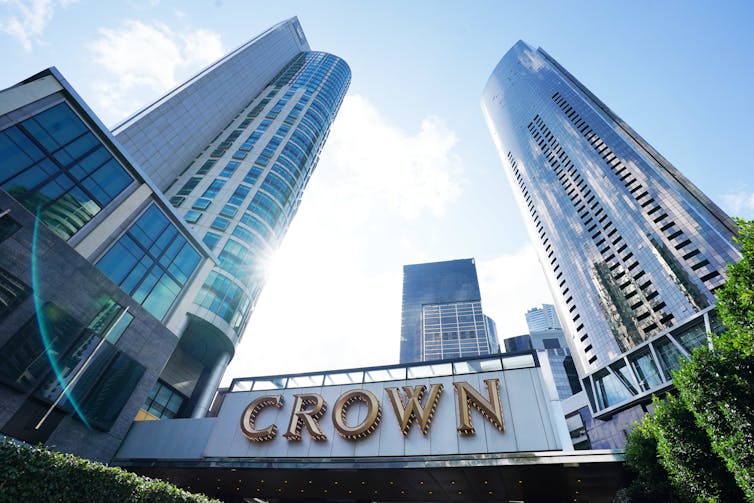 Jobs and contribution to state revenue are key to Crown Resorts’ argument for why it should be allowed to keep its Melbourne casino licence.
Michael Dodge/AAP
Jobs and contribution to state revenue are key to Crown Resorts’ argument for why it should be allowed to keep its Melbourne casino licence.
Michael Dodge/AAP
It began spruiking these arguments to the state government more than a month ago, in a July 2 letter[6] to the Victorian minister for gaming. That letter has been interpreted by Finkelstein and others[7] as an attempt to short-circuit the royal commission’s findings.
Indeed, the whole point of the casino is to contribute to Victoria, as successive governments have argued.
So what, exactly, is this contribution?
What Crown Melbourne gives …
In 2018-19 (Crown’s last “normal” year of operation) ABS data[8] shows the Melbourne casino contributed $268 million in gambling taxes to Victoria’s tax revenue. This amounts to 0.8% of state tax revenue (which was $29.2 billion in that year).
Overall, gambling taxes contributed 8.4% of state tax revenue. Poker machine gambling in pubs and clubs contributed 3.8% ($1.12 billion).
Crown Melbourne employs about 11,600 people. That’s about 0.32% of Victoria’s 3.45 million employes as of March 2021[9]. It contributes about $30 million of the total $6.3 billion the state collects in payroll taxes. That’s about 0.45% of total payroll taxes, about 0.1% of total state tax revenue.
Thus, at the upper range, Crown contributes about 0.9% of state tax revenue.
… and what it takes
Of course 11,600 jobs are significant, as is $300 million a year in taxes.
But what is also significant is Crown’s disproportionate contribution to the $7 billion[10] in annual costs attributable to gambling harm in Victoria.
The casino also significantly contributes to the 36,000[11] Victorians who are, at any one time, directly affected by serious gambling problems, and to the estimated 216,000[12] children, partners, employers and others connected to those gamblers who also suffer significant harm.
If Crown were to be placed into independent management, no one need lose their job — with the possible exception of a few board members and executives — and revenue would continue flowing to the state.
Business as usual is not an option
Whatever happens, business as usual at the casino cannot continue.
If effective responsible gambling interventions are put in place and properly observed, revenue will inevitably decline. If Crown’s permit to operate 1,000 “unlimited” poker machines is withdrawn or reduced (as it should be), revenue will decline. If it goes cashless and eliminates indoor smoking[13], revenue will decline. If criminal syndicates can no longer use the casino to launder money, revenue will decline.
These impacts are the least that can be expected from a reasonable review of casino operating practices in Victoria. A new operator may also impose their own operational requirements, and look to reduce the workforce.
Crown is not and has never been a magic pudding, producing something from nothing. What it has done is transfer large sums to shareholders from many ordinary people (and a few, often criminally connected, high rollers).
The consequences of this have been considerable, in harm to gamblers and their families, to the integrity of Australia’s attempts to stop criminals laundering money, and to stamping out political corruption[14].
Read more: How Sydney's Barangaroo tower paved the way for a culture of closed-door deals[15]
Whatever the royal commission recommends, the profitability of the casino will be affected, with consequences for the jobs and tax revenue it provides.
But the gains — involving a reduction in gambling harm, a strengthening of the rule of law, and the reinforcement of effective regulatory systems — are worth a great deal more.
References
- ^ last week (www.afr.com)
- ^ inappropriate or unlawful behaviour (theconversation.com)
- ^ a car thief (www.theguardian.com)
- ^ Responsible gambling – a bright shining lie Crown Resorts and others can no longer hide behind (theconversation.com)
- ^ Illegal, improper, unacceptable: revelations about Crown's casino culture just get worse (theconversation.com)
- ^ July 2 letter (www.rccol.vic.gov.au)
- ^ and others (www.afr.com)
- ^ ABS data (www.abs.gov.au)
- ^ March 2021 (www.abs.gov.au)
- ^ $7 billion (responsiblegambling.vic.gov.au)
- ^ 36,000 (responsiblegambling.vic.gov.au)
- ^ 216,000 (www.tandfonline.com)
- ^ eliminates indoor smoking (www.asgam.com)
- ^ political corruption (www.theage.com.au)
- ^ How Sydney's Barangaroo tower paved the way for a culture of closed-door deals (theconversation.com)
Read more https://theconversation.com/crown-resorts-is-not-too-big-to-fail-it-has-failed-already-165659










