First Nations people urgently need to get vaccinated, but are not being consulted on the rollout strategy
- Written by: Kalinda Griffiths, Scientia lecturer, UNSW
This year, just five cases of COVID-19[1] have been recorded among Aboriginal and Torres Strait Islander people in Australia. This good result is due to both significant government support measures and prompt and effective action[2] by Aboriginal and Torres Strait Islander leaders and organisations.
As the highly contagious Delta variant spreads in Australia, the task of ensuring all Australians are vaccinated becomes even more urgent. But since the vaccine rollout began in late February, only about 9% of Australians have been fully vaccinated[3].
The Delta variant is a particular concern for higher-risk populations, including Aboriginal and Torres Strait Islanders. Vaccinations of First Nations people must be carried out more quickly.
And in light of the elite Sydney private school erroneously giving all Year 12 students[4] vaccines that were intended only for First Nations students, there’s also a need for stricter guidelines and better oversight.
When questioned about the mistake this week, NSW Health Minister Brad Hazzard demanded that critics “move on”[5]. But authorities should not dismiss public concern that vaccines are not being distributed to those who need them most.
To ensure this, the vaccination rollout for First Nations people needs to involve Aboriginal community-controlled health organisations in the planning and implementation. We have already seen that when community-controlled organisations take control, vaccine delivery is successful and communities feel safer.
Read more: Comprehensive Indigenous health care in prisons requires federal funding of community-controlled services[6]
How many First Nations people have been vaccinated
Vaccine supply is a concern across the country, but the issue is most urgent at the moment in New South Wales, where a third of all Aboriginal and Torres Strait Islander people live[7], and where case numbers are growing.
Australia is now predominantly reliant on the 300,000 to 350,000 Pfizer vaccines coming into the country each week[8]. Thankfully, this number is due to increase substantially[9] in coming months.
In March, a vaccine implementation plan for Aboriginal and Torres Strait Islander peoples was published by the federal health department[10]. The publication iterated the urgent need for Aboriginal and Torres Strait Islander people to be a high priority in the rollout.
First Nations people over the age of 55 have been able to get vaccinated since March[11]. It’s also been a little over a month since Aboriginal and Torres Strait Islander people aged between 16 to 49 years have been eligible for COVID-19 vaccines.
However, there is currently limited publicly available data on just how many vaccines have actually been distributed to Aboriginal and Torres Strait Islander people so far.
Western Australia had completely vaccinated just over 2%[12] of its Aboriginal and Torres Strait Islander population as of June 21.
In Queensland, about 5,277 total vaccines have been distributed[13] in the Torres Strait and Cape York, where just under two-thirds of the population is Aboriginal and/or Torres Strait Islander.
In the Northern Territory, 17% of the total population[14] was fully vaccinated as of July 7. In remote areas, 26% of residents[15] had received their first dose at the start of the month.
This is good news for Aboriginal and Torres Strait Islander people in the territory, who make up just under a third of the total population.
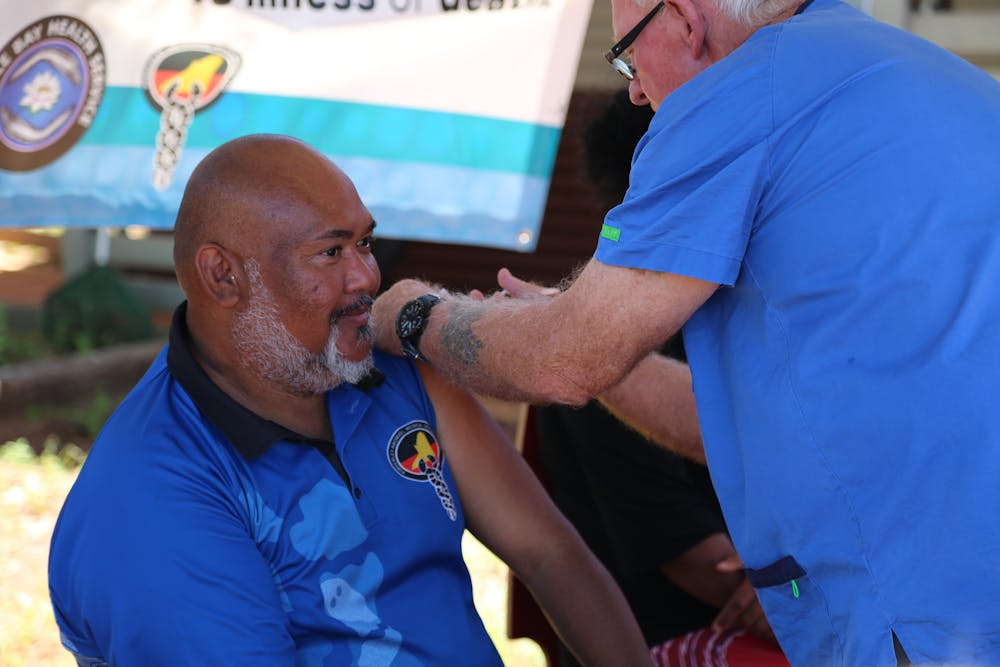 Vaughan Matsumoto, Senior Aboriginal Practitioner at the Beagle Bay clinic receives a coronavirus vaccine in the remote Aboriginal community of Beagle Bay in the Kimberley region, WA.
Kimberley Aboriginal Medical Services/AAP[16]
Vaughan Matsumoto, Senior Aboriginal Practitioner at the Beagle Bay clinic receives a coronavirus vaccine in the remote Aboriginal community of Beagle Bay in the Kimberley region, WA.
Kimberley Aboriginal Medical Services/AAP[16]
Community-controlled organisations addressing vaccine hesitancy
While the media has reported on vaccine hesitancy[17] in Aboriginal and Torres Strait Islander communities, there is anecdotal evidence that hesitancy is actually decreasing and that remote community clinics are vaccinating many First Nations people.
This includes the Mala’la clinic at Maningrida in Arnhem Land where media reports say 50 people were vaccinated across three days[18] in July. The clinic became community-run[19] in March of this year after 45 years of government oversight.
This success highlights the importance of having Aboriginal and Torres Strait Islander organisations involved in the rollout. This involves recognising that self-determination[20], as well as health information being delivered in first languages[21], results in improved uptake of services and better health outcomes.
For example, in Pitjantjatjara, community worker Frank Dixon provided the men of his community with information about the vaccine and accompanied them to their vaccinations[22]. Mala'la Health Service’s chairman, Charlie Gunabarra, has also delivered information about the vaccine to his community and was the first among them to get vaccinated.
Read more: Is it more infectious? Is it spreading in schools? This is what we know about the Delta variant and kids[23]
Despite this, there is evidence First Nations people are not being sufficiently included in planning and implementation of the rollout.
For example, a meeting of the national COVID vaccine taskforce last week excluded the National Aboriginal Community Controlled Health Organisation. The Aboriginal and Torres Strait Islander Advisory Group on COVID-19 was also excluded from the discussion[24].
Pat Turner, the head of the National Aboriginal Community Controlled Health Organisation, said the lack of First Nations inclusion was “deeply concerning[25]”.
The vaccine rollout must be managed so First Nations people and other vulnerable groups are prioritised. This means securing better vaccine supplies and putting Aboriginal and Torres Strait Islander people at the heart of decision-making.
References
- ^ five cases of COVID-19 (www1.health.gov.au)
- ^ prompt and effective action (www.mja.com.au)
- ^ only about 9% of Australians have been fully vaccinated (www.theguardian.com)
- ^ erroneously giving all Year 12 students (www.theguardian.com)
- ^ critics “move on” (www.smh.com.au)
- ^ Comprehensive Indigenous health care in prisons requires federal funding of community-controlled services (theconversation.com)
- ^ a third of all Aboriginal and Torres Strait Islander people live (www.aboriginalaffairs.nsw.gov.au)
- ^ 300,000 to 350,000 Pfizer vaccines coming into the country each week (www.abc.net.au)
- ^ due to increase substantially (www.abc.net.au)
- ^ was published by the federal health department (www.health.gov.au)
- ^ since March (theconversation.com)
- ^ completely vaccinated just over 2% (www.abc.net.au)
- ^ 5,277 total vaccines have been distributed (www.qld.gov.au)
- ^ 17% of the total population (www.abc.net.au)
- ^ 26% of residents (www.abc.net.au)
- ^ Kimberley Aboriginal Medical Services/AAP (www.photos.aap.com.a)
- ^ the media has reported on vaccine hesitancy (www.abc.net.au)
- ^ 50 people were vaccinated across three days (www.abc.net.au)
- ^ community-run (www.abc.net.au)
- ^ self-determination (www.theguardian.com)
- ^ first languages (www1.racgp.org.au)
- ^ provided the men of his community with information about the vaccine and accompanied them to their vaccinations (www.abc.net.au)
- ^ Is it more infectious? Is it spreading in schools? This is what we know about the Delta variant and kids (theconversation.com)
- ^ excluded from the discussion (www.theguardian.com)
- ^ deeply concerning (www.sbs.com.au)