


Swap shapes for rice crackers, chips for popcorn… parents can improve their kids’ diet with these healthier lunchbox options
- Written by: Matthew Mclaughlin, PhD Candidate, School of Medicine and Public Health, University of Newcastle
Four in five[1] primary school students eat a packed lunch every day, costing parents around A$20 a week[2]. That’s almost 10 million[3] lunchboxes across Australia every week.
But nine in ten[4] of these contain so-called “discretionary foods[5]” such as cake, chips, muesli bars and fruit juice. These foods are not necessary for a healthy diet, and are often high in saturated fat, sugar and salt, and low in fibre. 40%[6] of energy in an average lunchbox comes from these discretionary foods.
Busy parents need to find replacements for these discretionary foods, which are not only healthy, but also easy, cheap and tasty. Our research[7] shows parents can make healthier swaps, without costing them more.
What children should be eating
Healthy lunchboxes can play a big role in positively influencing students behaviour in the classroom[8], academic achievement[9], health[10] and weight[11].
Generally children should have a variety of foods[12] from the five core food groups: vegetables and legumes; fruit; grain foods (mostly wholegrain and those high in fibre); lean meats and poultry, fish, eggs, tofu, nuts and seeds; milk, yoghurt and cheese (or alternatives).
Depending on their age and sex, children should consume somewhere between 4,500-7,000[13] kilojoules per day. But it’s also important where[14] they get that energy from. It’s recommended[15] children limit their intake of saturated fat, salt and added sugar.
Read more: How much food should my child be eating? And how can I get them to eat more healthily?[16]
A healthy lunchbox doesn’t need to be fancy[17], expensive[18] or time consuming[19].
A healthy recess would mean, for instance, children eating one serving of fruit or vegetables, some yoghurt and a few rice crackers[20]. At lunch, children could eat a simple sandwich, wrap or roll, or leftovers made from core food group[21] ingredients such as veggie-loaded wholegrain pasta.
How to replace junk foods with healthy ones
Parents have told us they want[22] convenient and cheap foods to pack, that their children want to eat. So, we developed a healthy lunchbox program called SWAP IT[23]. In this program, we provide simple ideas for swapping unhealthy foods kids might like to healthier ones comparable on cost, taste, texture and preparation time.
Read more: A healthy diet is cheaper than junk food but a good diet is still too expensive for some[24]
For instance, you could swap
Shapes for rice crackers. This will mean 159 less kJ, 77% less saturated fat and 39% less sodium
chips for popcorn. This is 176 less kJ, 57% less saturated fat, 56% less sodium
cake for pikelets means 464 less kJ and 63% less sugar.
Perhaps one of easiest things you could do is to try ensure your kids stick to drinking water.
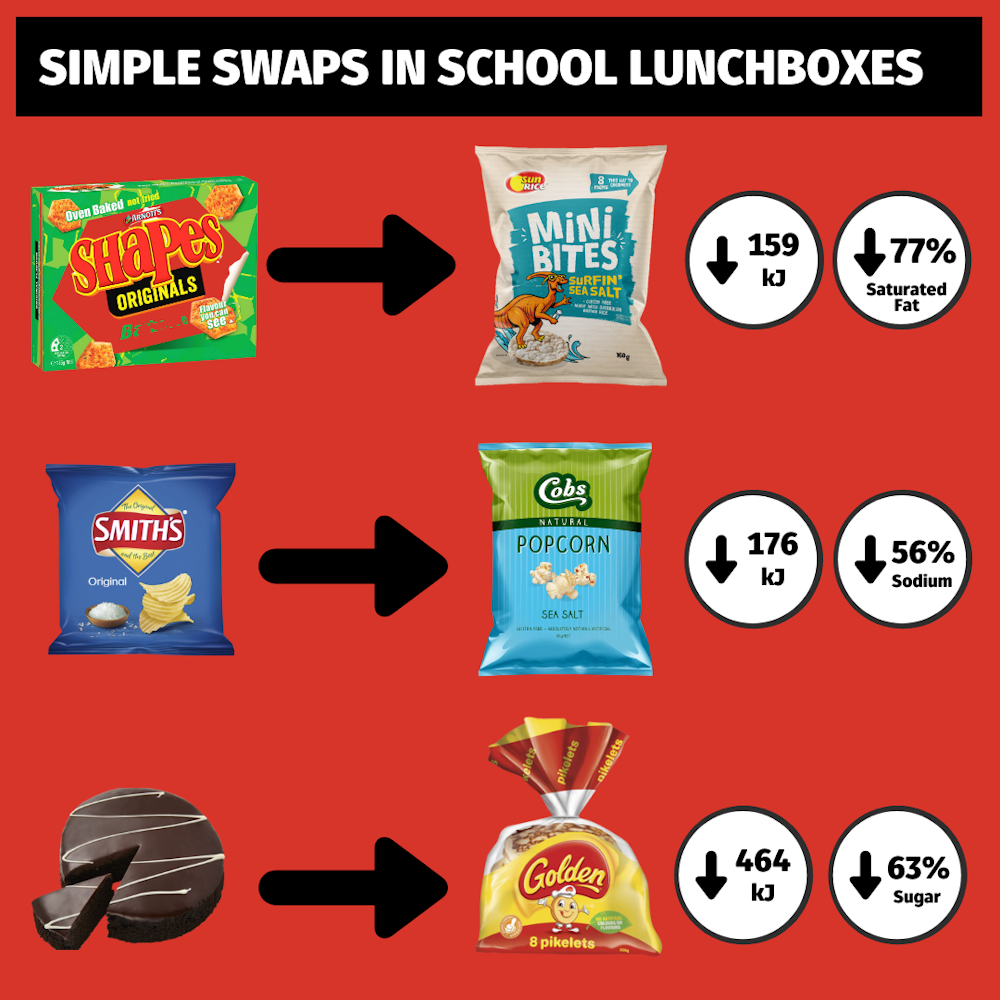 Calculations are made based on the serving sizes. (Shapes 25g, rice crackers 20g, Smith chips 19g, popcorn 13g, slice of cake 75g, 3 pikelets 75g)
Author provided
Calculations are made based on the serving sizes. (Shapes 25g, rice crackers 20g, Smith chips 19g, popcorn 13g, slice of cake 75g, 3 pikelets 75g)
Author provided
Our research found SWAP IT[25] supported parents and students to reduce energy from discretionary foods by 600kJ per week. Research suggests a small reduction of 600kJ[26] per week is enough to meaningfully impact population levels of obesity.
It can be rolled out to schools
Parents are sometimes blamed[27] for unhealthy lunchboxes.
But a barrage of unhealthy foods are promoted[28] to parents and children, often disguised as healthy choices. Parents and children see as many as ten junk food adverts[29] per hour. And more than half of parents report their child’s “pester power[30]” influences what they pack in their lunchbox.
Read more: Give in to pester power at the supermarket checkout? You're not alone[31]
Parents told us[32] they wanted easy to access information when they were in the supermarket. So we got parents to sign up to SWAP IT via their school’s usual communication[33] app[34]. Around two-thirds[35] of primary schools used such apps.
We prompted parents with swap ideas each week by sending push notifications to their phones. We found 84%[36] of parents liked having the messages sent directly to their phones.
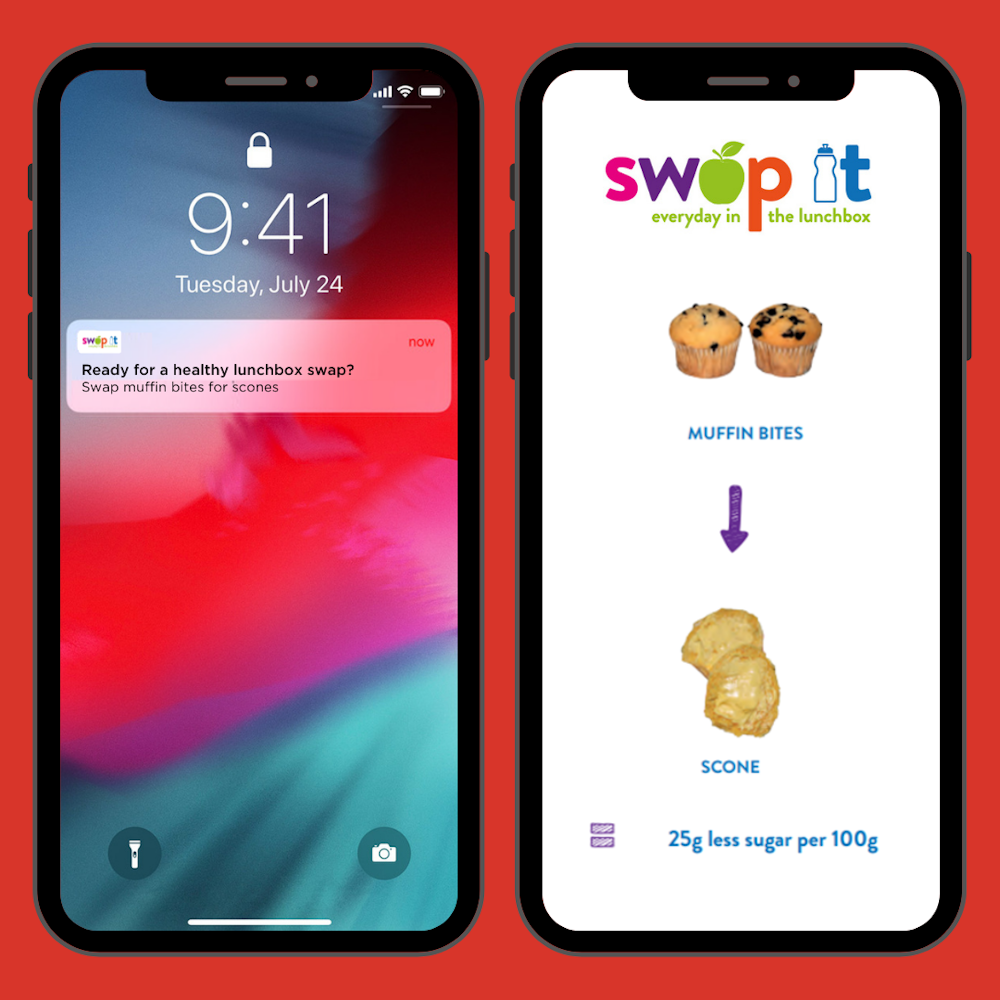 Example notification from the SWAP IT school lunchbox program.
Author provided
Example notification from the SWAP IT school lunchbox program.
Author provided
Research shows four in five[37] primary school principals agree it is a school’s role to support parents to pack healthy lunchboxes. We found SWAP IT could be rolled-out to schools through their communication apps at a cost of less[38] than A$1,800[39] per school.
Investment in promoting a healthy diet is cost-effective[40], as less people end up in hospital and productivity is improved.
Lunchbox swap ideas for Monday to Friday that are cheap, simple, healthy and tasty.Schools across Australia can register their interest[41] in the SWAP IT program. In the future, schools could choose to sign up to SWAP IT, in a similar way to signing up to other programs such as Crunch & Sip[42].
References
- ^ Four in five (www.dx.doi.org)
- ^ A$20 a week (doi.org)
- ^ 10 million (www.abs.gov.au)
- ^ nine in ten (ijbnpa.biomedcentral.com)
- ^ discretionary foods (www.eatforhealth.gov.au)
- ^ 40% (www.dx.doi.org)
- ^ Our research (doi.org)
- ^ behaviour in the classroom (www.researchgate.net)
- ^ academic achievement (www.researchgate.net)
- ^ health (apps.who.int)
- ^ weight (apps.who.int)
- ^ variety of foods (www.eatforhealth.gov.au)
- ^ 4,500-7,000 (www.nrv.gov.au)
- ^ where (www.eatforhealth.gov.au)
- ^ recommended (www1.health.gov.au)
- ^ How much food should my child be eating? And how can I get them to eat more healthily? (theconversation.com)
- ^ fancy (www.youtube.com)
- ^ expensive (www.youtube.com)
- ^ time consuming (www.youtube.com)
- ^ yoghurt and a few rice crackers (www.goodforkids.nsw.gov.au)
- ^ core food group (www.eatforhealth.gov.au)
- ^ want (www.dx.doi.org)
- ^ SWAP IT (doi.org)
- ^ A healthy diet is cheaper than junk food but a good diet is still too expensive for some (theconversation.com)
- ^ SWAP IT (www.goodforkids.nsw.gov.au)
- ^ 600kJ (doi.org)
- ^ are sometimes blamed (www.news.com.au)
- ^ promoted (theconversation.com)
- ^ ten junk food adverts (www.cancercouncil.com.au)
- ^ pester power (theconversation.com)
- ^ Give in to pester power at the supermarket checkout? You're not alone (theconversation.com)
- ^ told us (doi.org)
- ^ communication (www.moqproducts.com.au)
- ^ app (www.flexischools.com.au)
- ^ two-thirds (www.dx.doi.org)
- ^ found 84% (doi.org)
- ^ four in five (www.dx.doi.org)
- ^ less (www.dx.doi.org)
- ^ A$1,800 (doi.org)
- ^ cost-effective (www.phaa.net.au)
- ^ register their interest (www.goodforkids.nsw.gov.au)
- ^ Crunch & Sip (www.crunchandsip.com.au)










