Iran can’t ‘win’ this war. But it can force a US retreat using these 4 insurgency tactics
- Written by: Jessica Genauer, Academic Director, Public Policy Institute, UNSW Sydney

Iran knows it is militarily much weaker than the United States. The US accounts for 37% of military spending worldwide[1], while Iran accounts for less than 1%. On paper, we’d expect the US to easily win a military confrontation with Iran.
But, as history shows, the US does not win wars against groups that use insurgent tactics. This was made clear in Vietnam, Iraq and Afghanistan[2]. The US did not “lose” these wars, but it also could not win them. In each instance, the US eventually withdrew and allowed its opponents to claim victory.
Iran knows this and is using four key insurgency tactics to force a US withdrawal from the war.
Provocation
By hitting critical infrastructure and military bases across the Persian Gulf, Iran is hoping to provoke the US into an escalated use of military force.
This accomplishes specific goals for the regime.
As the US bombing campaign intensifies, support for the war among opponents of the Islamic regime in Iran will begin to diminish. Already, more than 1,400 Iranians have been killed[3] and more than 18,000 wounded in the fighting, according to Iran’s health ministry.
Meanwhile, support for the war will no doubt drop in the US as the cost of expending massive military force grows, without a decisive victory in sight. In one recent poll by Reuters and Ipsos, just 27% of Americans supported the war[4].
This will likely drive political pressure on President Donald Trump to withdraw.
But if the opposite happens – Iran succeeds in provoking the US into putting boots on the ground – this would enable it to shift to a full-scale insurgency that would cost the US even more lives. And this would be far more disastrous for Trump.
Spoiling
Iran is also hitting out at its Persian Gulf neighbours – Saudi Arabia, the United Arab Emirates, Oman, Kuwait, Qatar and Bahrain.
This may seem like a risky strategy, as Iran will need to live with these close neighbours[5] after the war is over. But the regime has a purpose – it wants to spoil the increasingly close relationship between the Gulf states and the US.
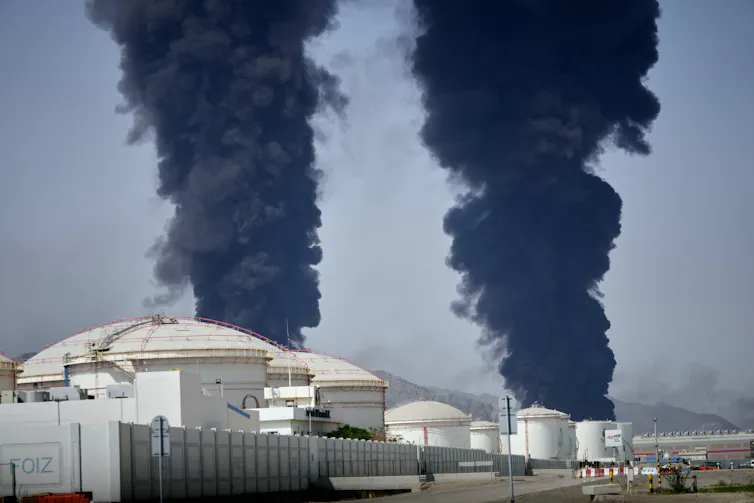
For decades, the Gulf countries have been reliant on the US as their ultimate security guarantor[6]. The US exports billions of dollars worth of arms to these countries, and many host US military bases.
By attacking them now, Iran is creating pressure on Gulf leaders to distance themselves from the US.
Across the region, distrust and political antagonism toward the US[7] remains high. Resentment is likely to build further, as economies continue to take a major hit from an American and Israeli military venture.
If Iran succeeds in spoiling the closeness between the US and Gulf countries, this could fundamentally change the security environment in the Middle East and increase its own power in a region where it has few friends.
Light weapons and attack craft
Iran is using light weapons – primarily drones and small attack craft – and nimble fighting tactics to its advantage.
Iran lost the majority of its naval capability[8] in the early days of the war. So, it almost immediately adopted an asymmetric naval warfare strategy[9] to effectively block the Strait of Hormuz.
It is doing this by employing fast-attack boats, naval mines and midget submarines[10] – which are designed specifically to operate in the Gulf’s shallow, murky waters – to threaten attacks against large and cumbersome oil tankers.
This insurgency tactic has given Iran control over an important part of the global economy, restricting the flow of oil, critical minerals[11] and liquified natural gas to the rest of the world.
Targeting civilian infrastructure
Lastly, Iran is targeting civilian infrastructure, such as airports, water desalination plants and energy facilities, across the Gulf.
It is now threatening to destroy[12] this infrastructure completely if Trump follows through on his pledge to “obliterate” Iran’s power plants.
This is ramping up the pressure on Gulf countries by putting their critical economic and humanitarian assets at risk. It is also driving global economic disruption with the closure of international transport hubs in the UAE and Qatar.
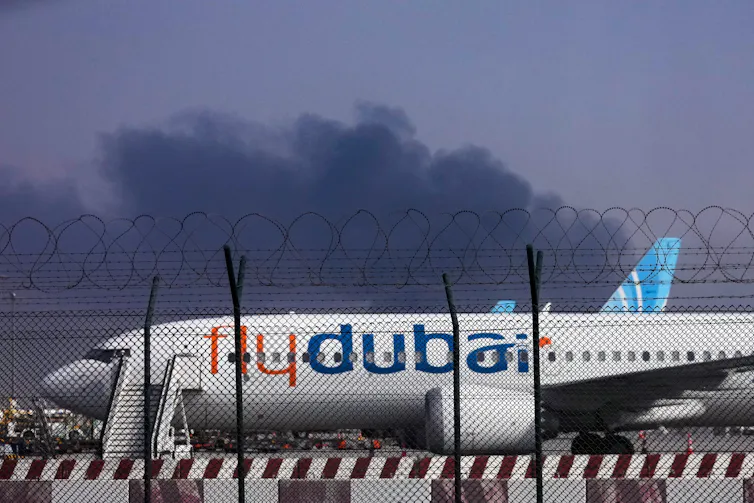
Attacks on non-military targets unsettle the entire population. No one knows what might be hit next.
These pressures increase the likelihood that countries in the Gulf and around the world will push for a US withdrawal.
Read more: After the Iran war, Persian Gulf nations face tough decisions on the US – a former diplomat explains[13]
Iran can outlast the US
So, what does Iran’s use of insurgent tactics suggest about how this war will end?
Previous wars that involved a strong military power against a much weaker opponent have taught us a lesson.
The weak actor has to survive long enough for political and economic pressure to build on their adversary, compelling them to withdraw. Despite being severely degraded, the weaker actor can then claim victory.
So, the Iranian regime just has to survive longer than the US political will to fight.
To be sure, the regime has been greatly weakened. It could fall in the medium- to long-term. But it is only concerned with the immediate future right now, using these insurgency tactics to outlast the US in the short term.
How the US should pivot
If the US wants to win, it needs a fundamental pivot and adoption of a central counterinsurgency[14] principle: damage the enemy, but win the hearts and minds of the people.
The US has a long history[15] of attempting this strategy in Iraq and Afghanistan, and can learn lessons from these conflicts.
However, the Iran war, so far, has not shown this to be a priority.
Civilians have borne the brunt[16] of the US and Israeli strikes, which included the destruction of a girls’ school that reportedly killed 175 people, mostly children. Cultural sites and civilian infrastructure[17] have also been hit.
Trump has made surface-level overtures[18] to the Iranian people, encouraging them to rise up and reclaim their government. But he has not put actions behind these words.
One way of rebuilding trust would be placing far more emphasis on protecting civilian assets and lives[19] in its strikes.
There may not be a clear exit strategy for the US at this stage, but supporting a pathway for the long-term viability of Iran beyond this regime means ensuring that civilians are not decimated by this war.
References
- ^ 37% of military spending worldwide (www.sipri.org)
- ^ Vietnam, Iraq and Afghanistan (www.cambridge.org)
- ^ more than 1,400 Iranians have been killed (www.cer.eu)
- ^ 27% of Americans supported the war (www.ipsos.com)
- ^ live with these close neighbours (theconversation.com)
- ^ ultimate security guarantor (www.theguardian.com)
- ^ distrust and political antagonism toward the US (theconversation.com)
- ^ majority of its naval capability (www.csis.org)
- ^ asymmetric naval warfare strategy (www.marshallcenter.org)
- ^ midget submarines (www.ynetnews.com)
- ^ critical minerals (investornews.com)
- ^ threatening to destroy (www.theguardian.com)
- ^ After the Iran war, Persian Gulf nations face tough decisions on the US – a former diplomat explains (theconversation.com)
- ^ counterinsurgency (www.armyupress.army.mil)
- ^ long history (www.csis.org)
- ^ borne the brunt (www.theguardian.com)
- ^ Cultural sites and civilian infrastructure (theconversation.com)
- ^ surface-level overtures (www.canberratimes.com.au)
- ^ far more emphasis on protecting civilian assets and lives (tnsr.org)