


Our ‘frog saunas’ could help save endangered species from the devastating chytrid fungus
- Written by: Anthony Waddle, Schmidt Science Fellow in Conservation Biology, Macquarie University
All over the world, frogs are being wiped out by the chytrid fungus. At least 500 species have declined, including as many as 90 species now presumed extinct[1].
This catastrophic and ongoing biodiversity loss[2] surpasses the devastation wrought by other notorious invasive species such as cats, rats and even cane toads. Short of removing species from the wild and treating them in captivity, few strategies exist to deal with the chytrid threat.
Our new research[3], published today in the journal Nature, offers a promising option.
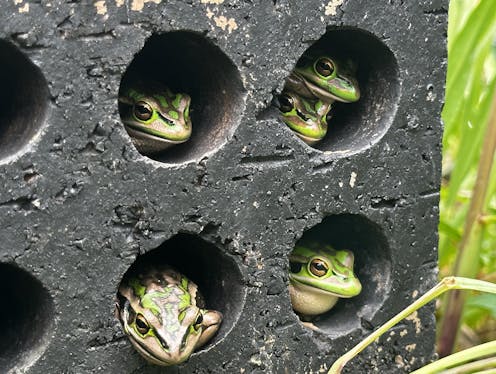
Outbreaks of chytrid (pronounced “KY-trid”) are more common in cold winter months – just like seasonal human flu. We found a way to combat these winter outbreaks using heat. Our purpose-built “frog saunas” allow affected amphibians to warm up and bake off their infections. They are so simple you can build a frog sauna using supplies from the hardware store.
Why should we care about frogs?
If frogs’ good looks are not enough for you to care about their welfare, perhaps learning how they contribute to the environment or human health will pique your interest.
Frogs eat insects[4] that carry and spread human diseases. Their skin is also a rich source of new medicines that could help us combat antibiotic-resistant “superbugs[5]” or curb the startling increase in opioid addiction[6].
The frogs themselves are food for many predators[7], including humans[8].
Often starting life as a tadpole eating algae, before morphing into a carnivorous adult, frogs carry energy from aquatic ecosystems onto land – where it can be transferred throughout the food web. So losing a single frog species can have serious flow-on effects.

The origin and spread of chytrid
It’s likely the chytrid fungus originated in Asia[9], where the pathogen seems to coexist with native amphibians. But chytrid is deadly elsewhere, possibly because other frogs have no natural defences.
Chytrid harms frogs by disrupting the integrity of their skin, depleting electrolytes needed for heart function. Infected frogs can die of cardiac arrest[10].
Chytrid has spread worldwide through the trade of amphibians, becoming a seemingly permanent part of ecosystems. As eradicating chytrid from the wild is not possible, we need a way to help frogs battle infection.
Chytrid: the frog-killing fungus, featuring Associate Professor Lee Berger (Australian Academy of Science)Introducing frog saunas
Research has shown chytrid is worse in winter[11]. My colleagues and I wondered whether, if frogs had access to warmth during winter, could they fight off infection?
The fungus can’t tolerate high temperatures, so if we gave frogs a place to stay warm – even for a few hours a day – perhaps they could survive and recover.
We tested this idea, both in the laboratory and in outdoor experiments.
First we established that endangered green and golden bell frogs will select temperatures that reduce or eliminate chytrid infections, when given the opportunity.
Then we conducted experiments in the lab, with 66 infected frogs. The group given the option of choosing the temperature they liked best rapidly cleared their infection. The group placed in a set, warm temperature also cleared their infection, but it took longer. The low-temperature control group remained infected.
Next, we wanted to see what would happen if frogs that cured infections with heat would still get sick. Or were they immune? The group of 23 heat-cured frogs were 22 times more likely to survive the second infection than the 23 frogs that were heat-treated but not previously infected. So frogs cured with heat acquire resistance to future infections.
Finally, we wanted to see if this could work in a natural setting. We ran outdoor experiments with 239 frogs. Half were infected with chytrid one week before the experiment began. Then they were placed in enclosures with artificial structures that heat up in the sun, called “frog saunas”. But the frogs could choose from shaded and unshaded areas, with or without saunas.
We found frogs flocked to the sunny saunas, heated up their little bodies, and quickly fought off infection. Think of frog saunas as little factories that pump out healthy, chytrid-resistant frogs.
The frog saunas could be used on a wider scale. We believe they would be best suited to supporting populations of Australian green and golden bell frogs, but they could be useful for other species too.
The saunas are made of inexpensive materials that can be found at your local hardware store, making them accessible to the general public and wildlife managers alike.
We are already building shelters at Sydney Olympic Park, working with Macquarie University and the Sydney Olympic Park Authority. The park is home to one of the largest remaining populations of green and golden bell frogs.
 Frog saunas have been set up to support a wild population of frogs in Sydney.
Anthony Waddle
Frog saunas have been set up to support a wild population of frogs in Sydney.
Anthony Waddle
Want to get involved?
You can become a citizen scientist and help save frogs from extinction. Start by downloading the FrogID[12] app to learn how frogs are faring. Record frog calls with the app for scientists to identify them. This helps provide valuable data for frog conservation.
Build a frog sauna[13] for your backyard, to help keep them healthy through winter.
It’s essentially a brick-filled greenhouse, warmed by sunlight. All you need is some common clay ten-hole masonry bricks, black paint and cable ties – and a little greenhouse to put the sauna inside.
Changing the fate of frogs
Since the discovery of chytrid more than 25 years ago, the pathogen has been a seemingly insurmountable challenge to endangered frog conservation. Now, we have developed a promising, inexpensive and widely applicable strategy to combat chytrid.
Amphibians are such a diverse group that no single approach will be suitable for all species. So this is no silver bullet. But a useful tool for even one threatened or endangered species is cause for optimism.
The concept could also be applied to other wildlife diseases, where differences between the physiology of the host and pathogen can be exploited.
References
- ^ 90 species now presumed extinct (www.science.org)
- ^ catastrophic and ongoing biodiversity loss (www.science.org)
- ^ Our new research (www.nature.com)
- ^ eat insects (iopscience.iop.org)
- ^ combat antibiotic-resistant “superbugs (www.sciencedirect.com)
- ^ opioid addiction (www.ncbi.nlm.nih.gov)
- ^ predators (journals.plos.org)
- ^ including humans (www.sciencedirect.com)
- ^ originated in Asia (www.science.org)
- ^ die of cardiac arrest (www.science.org)
- ^ worse in winter (onlinelibrary.wiley.com)
- ^ FrogID (www.frogid.net.au)
- ^ Build a frog sauna (sites.google.com)










