Culturally diverse teens greatly benefit from social media – banning it would cause harm
- Written by: Amelia Johns, Associate Professor, Digital and Social Media, School of Communication, University of Technology Sydney
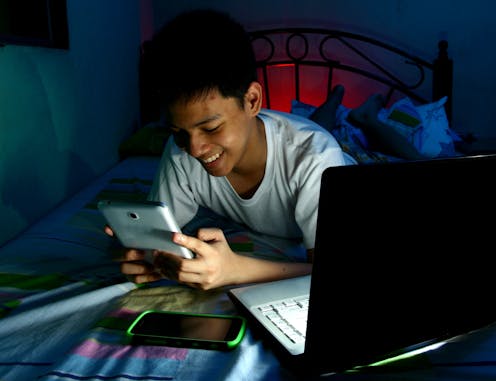
There is currently a bipartisan push from state and federal governments[1] to introduce laws in Australia banning young people under 16 from accessing social media platforms. Politicians are citing fears that minors are exposed to harmful or inappropriate content online.
The proposed reform has been accompanied by federal government plans to pilot “age assurance” technologies[2]. Proposed tools for age verification range from uploading ID documents to the use of biometric face-scanning technologies. Most of these methods are fraught with problems, including privacy risks[3].
Research from overseas[4] has already raised concerns about the potential harms of introducing a social media ban. Australian research[5] has also pointed out how essential social media is for young people’s fundamental right to access information and participate in society.
However, less attention has been paid to what impacts the ban might have on some of the most marginalised young people in the community.
We have conducted research with culturally diverse young people (aged 13–18), and educators and policymakers in New South Wales and Victoria. In our forthcoming study we found that young people who have migrated to Australia – or were born to parents or grandparents who had – are capable users of social media.
They use social media platforms to connect with culture and community, to have a voice on issues that concern them, and to address digital and other social harms.
Mirroring debates regarding the social media ban, our research also revealed a gap between how adults and culturally diverse youths perceive the role that digital and social media plays in young people’s lives. There is also a difference of opinion over how to create safer online environments.
What do young people think?
In our research, educators and policymakers thought young people from some communities are more at risk from social harms related to accessing inappropriate content. Therefore, these adults argued for more parental controls and limits on social media use.
Meanwhile, the young people in our study claimed social media allows them to fulfil responsibilities that go beyond personal safety.
These include:
- connecting with family and friends, locally and overseas
- learning about their own and other cultures, and becoming informed about the world and their roles and responsibilities within it
- engaging in activism and advocacy to address systemic hate and racism experienced in their everyday lives, and
- defusing toxic online cultures through participation in, and moderation of, digital communities and fandoms.
As one participant told us:
As younger people, we realise, oh, we have beliefs and stuff too, we need to share them […] because obviously adults, they can do it through voting.
Others spoke about the privilege that young people in Australia have to speak up on social issues and contest government policies. They compared this to countries where media, including social media, is censored or banned by the state.
This is also a point that speaks to some of the dangers of banning social media for this age group:
I think it’s important for the citizens of Australia to raise awareness and protest about stuff […] because they’re a free country and they have the access to using information […] I feel like if you had that access, you should […] raise awareness for people who […] don’t have that same opportunity.

Socialising online isn’t always public
Rather than social media engagement always being public and vocal, young people also participated in quieter, less public acts. These were focused on finding information and building supportive communities through moderation and respectful dialogue. One participant said:
There’s been a certain person in the Discord [online messaging platform with individual communities] that I moderate on, which is the one me and my friends made, who […] it wasn’t necessarily stuff he was doing on the Discord, but in person he was doing some quite rude stuff. So we kind of just ended up cutting him off and banning him from Discords and group chats and stuff like that.
The latter point is important given that, in the current debate, politicians seem to view young people’s safety as being dependent on political, legal and platform intervention.
This denies culturally diverse young people agency. It also ignores their capabilities and skilful navigation of social media.
In our study, young people demonstrated a sense of social responsibility to raise their voice against collective harms, and to learn the tools and skills to defuse toxic online cultures. By banning their access to social media, these skills become lost.
This shows we need to move beyond only viewing social media as a source of harm to young people. Instead, we argue that age-based social media bans would create unintended consequences and harms, such as the withdrawal of diverse voices critical to realising and building safer digital communities and societies.
Read more: Age verification for social media would impact all of us. We asked parents and kids if they actually want it[6]
References
- ^ bipartisan push from state and federal governments (www.theguardian.com)
- ^ “age assurance” technologies (theconversation.com)
- ^ fraught with problems, including privacy risks (theconversation.com)
- ^ Research from overseas (www.socialdriver.com)
- ^ Australian research (westernsydney.edu.au)
- ^ Age verification for social media would impact all of us. We asked parents and kids if they actually want it (theconversation.com)