Bird flu is hitting Australian poultry farms, and the first human case has been reported in Victoria. Here’s what we know
- Written by: C Raina MacIntyre, Professor of Global Biosecurity, NHMRC L3 Research Fellow, Head, Biosecurity Program, Kirby Institute, UNSW Sydney
The first human case of avian influenza (bird flu) in Australia was reported yesterday in Victoria[1]. A child acquired the H5N1 strain of the virus in India and became ill upon returning home to Australia in March this year.
Based on information made available yesterday on the Global Initiative on Sharing All Influenza Data (GISAID[2]), we can ascertain the child is a two-year-old girl. She tested positive in early March and was reportedly very unwell but has since fully recovered[3].
According to the Victorian Department of Health[4], contact tracing revealed no additional cases, and the risk to others is very low.
Humans who acquire H5N1 generally have close contact[5] with infected poultry; H5N1 does not spread easily between people. But the fatality rate in human cases is about 50%[6].
So what should we make of this latest development, as bird flu makes news locally and around the world?
H5N1
There’s no publicly available information on how this child became infected in India, or even where in India this case came from. However, the country is currently facing significant avian flu outbreaks in the states of Kerala, Andhra Pradesh and Maharashtra.
H5N1 is a strain of influenza A, which is further divided into variants called clades. GISAID data shows the virus the child was infected with belongs to the H5N1 clade 2.3.2.1a[7]. The South Asian clade 2.3.2.1a was first identified in 2009[8] and is still circulating in birds in Bangladesh and India[9].
This is different from the clade behind outbreaks in dairy cattle making headlines in the United States[10] (H5N1 clade 2.3.4.4b). A second human case[11] in the US associated with this outbreak has just been reported – a dairy worker in Michigan. Globally, a total of 14 human cases[12] have been linked to this clade.
What about the poultry farms?
On the same day we heard about the child with H5N1, a bird flu outbreak was reported at an Australian egg farm in Meredith, Victoria[13].
This was a different strain[14], influenza A H7N3. H7 outbreaks are not new to Australia. The earliest H7 outbreak in Australia was an H7N7 outbreak in Melbourne, Victoria in 1976[15]. The three most recent outbreaks occurred in free-range farms[16] in Lethbridge, Victoria, in 2020.
While some strains of avian flu tend to produce mild or no visible disease (called low pathogenic), H5N1 and H7N3 are both highly pathogenic[17] viruses. This means they cause severe illness in poultry and wild birds.
Wild birds are the source, and can infect farmed or domestic poultry. They can also infect animals such as pigs and horses.
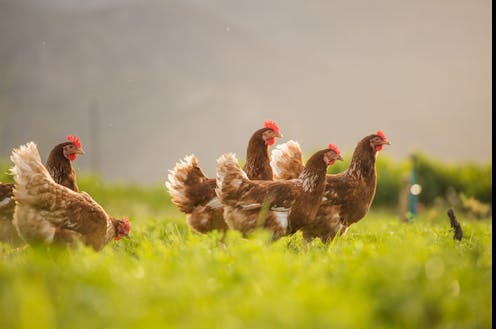
Free range farms are at risk of avian flu, as they are outdoors and may be exposed to infected wild birds. But overall there have been very few highly pathogenic avian influenza outbreaks in Australian poultry, summarised in the table below.
The strain dominating Europe and the Americas, H5N1 clade 2.3.4.4b, began in 2020 and spread globally to infect more than 300 avian and 40 mammalian species[18].
This is the most worrying clade[19], as it has spread further and more widely than any other avian flu virus. In mammals and birds it causes severe respiratory disease but also affects the brain.
Some good news
To date, H5N1 has not been detected in birds in Australia. It’s positive news that the egg farm outbreak is H7N3 rather than H5N1. The unrelated H5N1 infection in the child showed no evidence of spread, and the child recovered.
Australia has historically been protected[20] from highly pathogenic avian flu because it’s spread by migrating ducks, geese and swans (known as waterfowl) from Asia. Their flyways bypass Australia.
However, with a range of different wild birds now infected by H5N1 clade 2.3.4.4b[21], including in Antarctica, there may be new bird migration routes by which the virus could enter Australia.
The egg farm outbreak should be controlled quickly by culling infected birds. There are vaccines for poultry, but they are only partially effective and can mask outbreaks, so tend not to be used. France, which has had widespread outbreaks of H5N1 in its farms, began vaccinating poultry recently, but has experienced continued outbreaks[22].
What needs to happen now?
Past H7 outbreaks[24] have been controlled rapidly in Australia, but we must remain vigilant. Meanwhile, an outbreak of low-pathogenic avian influenza virus H9N2 has been reported[25] in a poultry farm in Western Australia today. The situation is being closely monitored.
There are often delays in reporting and sharing of avian flu data. Information on the child in Victoria[26] was reported almost three months after the event[27], which is not ideal for preparedness.
Open source surveillance using publicly available data and intelligence[28], such as our Epiwatch[29] platform, can provide more rapid information where there may be delays in updates to international reporting databases[30].
Avian influenza is a global concern, so heightened and timely surveillance in animals, birds and humans is crucial, as is global data sharing. The impact of avian flu on farming and the economy is substantial, but we also worry about a human pandemic arising.
H5N1 is so widespread globally now that the chance of it mutating to a point where it’s able to spread between humans is higher than ever.
References
- ^ in Victoria (www.health.vic.gov.au)
- ^ GISAID (gisaid.org)
- ^ fully recovered (www.abc.net.au)
- ^ Victorian Department of Health (www.health.vic.gov.au)
- ^ close contact (doi.org)
- ^ is about 50% (www.cdc.gov)
- ^ 2.3.2.1a (gisaid.org)
- ^ 2009 (doi.org)
- ^ Bangladesh and India (cdn.who.int)
- ^ United States (theconversation.com)
- ^ second human case (www.theguardian.com)
- ^ 14 human cases (www.who.int)
- ^ Meredith, Victoria (agriculture.vic.gov.au)
- ^ a different strain (www.abc.net.au)
- ^ 1976 (www.ncbi.nlm.nih.gov)
- ^ free-range farms (wahis.woah.org)
- ^ highly pathogenic (wwwnc.cdc.gov)
- ^ 300 avian and 40 mammalian species (www.fao.org)
- ^ most worrying clade (www.nature.com)
- ^ has historically been protected (theconversation.com)
- ^ H5N1 clade 2.3.4.4b (www.medrxiv.org)
- ^ continued outbreaks (www.cidrap.umn.edu)
- ^ Iv-olga/Shutterstock (www.shutterstock.com)
- ^ H7 outbreaks (www.ncbi.nlm.nih.gov)
- ^ reported (www.abc.net.au)
- ^ child in Victoria (www.health.vic.gov.au)
- ^ after the event (gisaid.org)
- ^ intelligence (www.cell.com)
- ^ Epiwatch (www.epiwatch.org)
- ^ international reporting databases (www.woah.org)