


here’s how young New Zealanders are finding it so easy to access
- Written by: Anna DeMello, Research Fellow, University of Otago
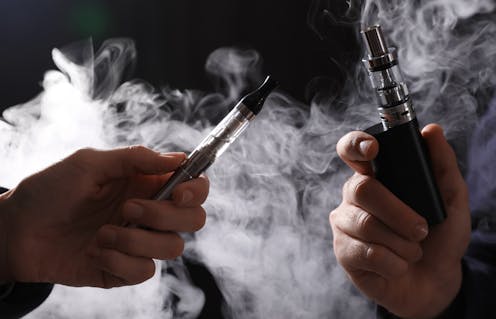
Despite measures to reduce young people’s access to vapes, many countries are recording rising use by underage adolescents, especially since refillable “pod mods” and disposable devices have become widely available[1].
Vapes appeal to young people because of their sleek designs and flavours, but these products also carry risk[3]. Vapes containing nicotine can cause addiction[4] and non-smoking young people who vape are more likely to take up cigarette smoking[5].
Some countries have set a minimum legal sales age to curb underage use. In New Zealand, vapes are a notifiable product and, like tobacco products, must not be sold to people under 18[6]. Australia has gone further, requiring a prescription[7] to access nicotine-containing vapes.
However, youth vaping has continued to rise in Canada, the United Kingdom, Australia and in New Zealand, where the latest health survey[8] found 20% of people between 15 and 17 had vaped in the past month. Nearly 28% of Māori youth vaped regularly, which suggests inequities similar to those observed in tobacco smoking.
We wanted to know how underage youth obtain vapes. We reviewed international research[9] and found “social sourcing” (sharing between friends) was the most common access route. Underage vape users were also able to buy from commercial retailers, and some steal vapes.
Sharing appears rampant and opportunistic
We also conducted interviews with 30 New Zealand adolescents (aged 16-17) who vape to probe how they accessed vaping products. This research[11] explains the varied ways these adolescents obtain nicotine-containing vapes and exposes serious gaps in current policy.
All participants reported sharing vapes with friends and family members, work acquaintances or people they met socially. Sharing helped participants bond more deeply with their friends and connect to new social groups.
We all try each other’s [vapes …] I can’t even explain how big [this] is […] If I’m with my friends, I’m probably not using my vape, I’m using theirs.
Sharing others’ vapes allowed some participants to avoid owning their own device (or purchasing infrequently, on special occasions). They felt uncommitted to vaping and in control of their use.
I still just do it socially […] for fun. In the three years I’ve been vaping, I’ve never owned one. I’ve tried to keep it under control, not let it affect me too much.
Relying on ‘proxies’ to purchase vapes
Most participants asked “proxies” (older friends or siblings over 18) to purchase vapes for them. Once participants had an established buyer they tended to rely on this person, who would often supply a wider underage peer group.
There’s always [someone with] an older sibling or [person] that’s fine with buying for them. [So] everybody will ask them whenever they want [product].
Proxies typically supplied people they knew at no extra cost, but sometimes charged a fee (up to NZ$10 above the cost of the vapes and e-liquid refills).
There’s that one 18-year-old at school always doing it. He charges $5 more than what a vape costs […] that’s why they come to him. They know he’ll be available, no questions asked.
A minority asked “randoms” (people they did not know) who they met on social media to buy vapes for them. Alternatively, some approached people they saw outside retail shops and asked if they would purchase products for them.
Underage youth purchase vapes themselves
Nearly all participants knew of retailers who sold to underage people; many had bought vaping products from a “dodgy dairy” that did not ask them for an ID. Several knew peers who used fake IDs.
There [are] certain dairies that people always know of [by] word of mouth. Someone would go in and not get ID’d, then tell people.
Many also knew of younger adolescents who had purchased vapes in person.
There’s so many kids who do that. That’s how the 13 and 14-year-olds get it, because they wouldn’t be friends with 18-year-olds. They just try their luck.
Our study found access routes sit on a continuum from spontaneous sharing to “proxy” purchasing to self-purchasing.
Reports that underage people buy vapes directly from small shops support the government’s proposal to introduce escalating retailer fines[12]. But it also suggests we need stronger retailer monitoring and enforcement.
It is also crucial to disrupt social supply routes, including sharing and proxy purchasing. We believe we need upstream policy measures that reduce the widespread availability and appeal of vaping products, including the following:
limiting product sales to age-restricted specialist shops
capping vape retailer numbers to lower density
restricting all (current and future) general and specialist vape retailers from operating within 500 metres of schools and marae
monitoring the impact of a ban on sales of disposable vapes (as the government plans to do[13]) to ensure this measure is not undermined by, for instance, allowing new low-cost refillable devices to enter the market.
References
- ^ widely available (www.grandviewresearch.com)
- ^ Getty Images (www.gettyimages.com.au)
- ^ carry risk (www.ncbi.nlm.nih.gov)
- ^ addiction (www.ncbi.nlm.nih.gov)
- ^ cigarette smoking (www.ncbi.nlm.nih.gov)
- ^ must not be sold to people under 18 (www.health.govt.nz)
- ^ requiring a prescription (www.health.gov.au)
- ^ latest health survey (www.phcc.org.nz)
- ^ reviewed international research (bmcpublichealth.biomedcentral.com)
- ^ Getty Images (www.gettyimages.com.au)
- ^ research (academic.oup.com)
- ^ proposal to introduce escalating retailer fines (www.beehive.govt.nz)
- ^ plans to do (www.rnz.co.nz)










