‘Westralia shall be free!’ How Western Australia’s secessionists stoked British fears the Empire was at risk
- Written by: Benjamin Wilson Mountford, Associate Professor in History, Australian Catholic University
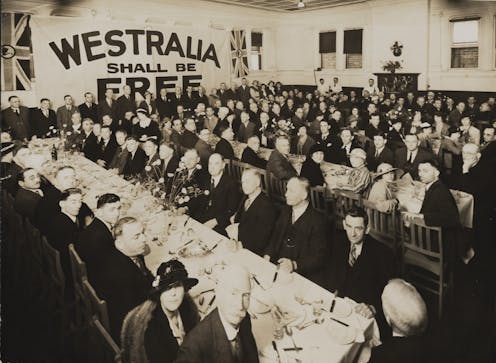
Around 90 years ago, two-thirds of Western Australian voters voted in favour of leaving the Commonwealth at a state referendum.
This 1933 result – often seen as a protest vote against the economic and political disadvantages imposed on WA and exacerbated by the Great Depression – was never enacted.
After the referendum, WA secessionists turned to the British parliament, hoping London would intervene to free them from the Australian federation. Despite some sympathy for WA, however, the British government was reluctant to involve itself in a stoush between Perth and Canberra.
Today, WA secessionists are often regarded as more of an amusing curiosity than a serious political movement. But, as our research[1] explores, the curious tale of WA secession in the 1930s resonated well beyond Australian shores, and was taken more seriously overseas.
Internationally, it threatened to undermine the idea of political federations, at a time when they seemed crucial to the future of international relations.
For the British, it represented an unpleasant thought: if you couldn’t keep somewhere like WA happy, what hope did you have in holding the British empire together?
Read more: Republic of Western Australia: how the west has always charted its own course, from secession to COVID[2]
The secessionists go to London
In 1934, a year after the referendum result, the WA government sent a delegation to London. The delegation included members of the leading secessionist organisation at that time, the Dominion League of Western Australia[3].
The delegates petitioned the British government to legislate to liberate WA from the federation of Australia, and to enable the state to revert to its former status as a self-governing British dominion.
“Westralia shall be free!” was their rallying cry.
It would have been a major intervention by London in Australian affairs.
Once there, the delegation unfurled[4] the homespun flag of a new “Dominion of Western Australia” on the roof of the Savoy Hotel in central London.
They carried a printed 489-page analysis of the “Case for Secession”, which was to be presented to all British parliamentarians who would take it.
Meanwhile, three copies of WA’s petition had been painstakingly written out by hand. They came upon rolls of sheepskin, some 26 feet long, and were each encased in wooden caskets made of jarrah.
But after all the hype, the situation came to a resounding anti-climax. A joint parliamentary committee at Westminster eventually ruled WA’s petition could not even be received by the British parliament. The decision was fatal to the secessionist cause.
With time, improving economic conditions, political change and the new geopolitical realities of the later 1930s, WA moved on. The broader impact on imperial and international politics, however, was more significant.

A fraught issue at a fraught time
For Britain, the issue of WA secession was fraught for a number of reasons.
First, it carried implications for imperial integrity and governance, near and far.
News of the referendum result had been keenly watched[6] in parts of Tasmania and South Australia.
More broadly, WA secessionist sentiment came to be seen by some as inspiration for challenging existing political arrangements in other parts of the British Empire.
As Canadian researcher Christopher Besant put[7] it:
The movement has to be seen in the context of the growing problem of nationalism within the British Empire itself between 1919-1935.
At the very time that the Western Australian secession petition was presented to parliament, the Irish under Eamon De Valera were straining against their ‘treaty’ with Great Britain, the Scottish National Party were agitating for Scotland’s liberation, Indian reformers were demanding self-government, and South Africans had their own demands. The very Statute of Westminster which recognised the reality of nationalist spirit in Canada and Australia was but three years old, and not yet ratified in Canberra.
In this world, WA secession mattered. It focused attention on a recurrent concern of interwar British imperial policy-making. That was the fear federations – a common British response to challenges to imperial authority – didn’t work or were, at the very least, beset with problems.
WA’s situation soon interacted with debates on the future of India. Two days after the flag of the Dominion League was unfurled in London, the Government of India Bill was introduced into the British parliament. This legislation proposed a federal model for governing India, as Britain’s attempt to contain the forces of Indian nationalism.
The hearings on the merits and demerits of receiving the WA secession petition took place in the middle of the heated parliamentary debate over the India Bill.
In other words, much of the attention the WA delegation received in London was because of its implications for one of the central political issues of the day – Indian reform.
For Tory diehards like Winston Churchill and George Lloyd – who hoped to resist attempts at Indian reform – the secession of WA was useful ammunition against the argument India should get greater autonomy. It showed the difficulties associated with political federations.
 For Tory diehards like Winston Churchill, the secession of WA was useful ammunition against the argument India should get greater autonomy.
EPA/ANDY RAIN/AAP[8]
For Tory diehards like Winston Churchill, the secession of WA was useful ammunition against the argument India should get greater autonomy.
EPA/ANDY RAIN/AAP[8]
The WA secessionists also came to the attention of Canadians at the time. F. Maclure Sclanders, a commissioner in New Brunswick, referenced WA’s case in his own investigation[9] into the “inequalities” of federation in Canada.
The Scottish National Party also expressed interest in the “Westralian” cause. It offered to set up meetings with those “interested in the self-government movement” both in Scotland and abroad.
For London, the consequences of WA secession were hard to predict and even harder to control.
So while WA’s secession movement foundered, it nonetheless sparked a series of debates around London’s obligations to overseas Britons, Britannic identity, and the future of imperial relations.
Read more: Breaking up is hard to do: why Western Australia would find it difficult to divorce Canberra [10]
References
- ^ research (acuresearchbank.acu.edu.au)
- ^ Republic of Western Australia: how the west has always charted its own course, from secession to COVID (theconversation.com)
- ^ Dominion League of Western Australia (webarchive.slwa.wa.gov.au)
- ^ unfurled (en.wikipedia.org)
- ^ State Library of Western Australia, call number: 000757D (encore.slwa.wa.gov.au)
- ^ keenly watched (acuresearchbank.acu.edu.au)
- ^ put (www8.austlii.edu.au)
- ^ EPA/ANDY RAIN/AAP (photos.aap.com.au)
- ^ investigation (www.tandfonline.com)
- ^ Breaking up is hard to do: why Western Australia would find it difficult to divorce Canberra (theconversation.com)