

Can AI improve football teams’ success from corner kicks? Liverpool and others are betting it can
- Written by: Mark Scanlan, Lecturer, Edith Cowan University
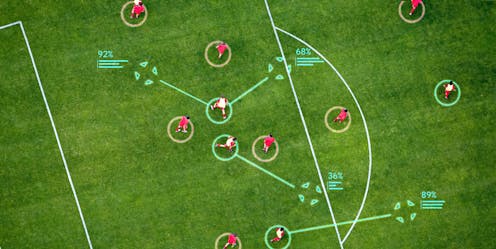
Last Sunday, Liverpool faced Manchester United in the quarter finals of the FA Cup[1] – and in the final minute of extra time, with the score tied at three-all, Liverpool had the crucial opportunity of a corner kick. A goal would surely mean victory, but losing possession could be risky.
What was Liverpool to do? Attack or play it safe? And if they were to attack, how best to do it? What kind of delivery, and where should players be waiting to attack the ball?
Set-piece decisions like this are vital not only in football but in many other competitive sports, and traditionally they are made by coaches on the basis of long experience and analysis. However, Liverpool has recently been looking to an unexpected source for advice: researchers at the Google-owned UK-based artificial intelligence (AI) lab DeepMind[2].
In a paper published today[3] in Nature Communications, DeepMind researchers describe an AI system for football tactics called TacticAI, which can assist in developing successful corner kick routines. The paper says experts at Liverpool favoured TacticAI’s advice over existing tactics in 90% of cases.
What TacticAI can do
At a corner kick, play stops and each team has the chance to organise its players on the field before the attacking team kicks the ball back into play – usually with a specific prearranged plan in mind that will (hopefully) let them score a goal. Advice on these prearranged plans or routines is what TacticAI sets out to offer.
The package has three components: one that predicts which player is most likely to receive the ball in a given scenario, another that predicts whether a shot on goal will be taken, and a third that recommends how to adjust the position of players to increase or decrease the chances of a shot on goal.
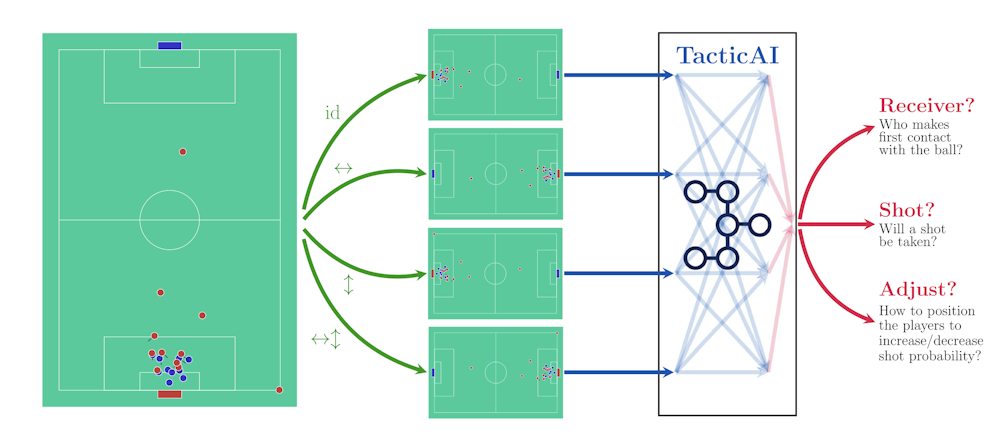
Trained on a dataset of 7,176 corner kicks from Premier League matches, TacticAI used a technique called “geometric deep learning” to identify key strategic patterns.
The researchers say this approach could be applied not only to football, but to any sport in which a stoppage in the game allows teams to deliberately manoeuvre players into place unopposed, and plan the next sequence of play. In football, it could also be expanded in future to incorporate throw-in routines as well as other set pieces such as attacking free kicks.
Vast amounts of data
AI in football is not new. Even in amateur and semi-professional football, AI-powered auto-tracking camera systems are becoming commonplace, for example. At the last men’s and women’s World Cups in 2022 and 2023, AI in conjunction with advanced ball-tracking technology produced semi-automated offside decisions with an unprecedented level of accuracy.
Read more: Games by numbers: machine learning is changing sport[5]
Professional football clubs have analytical departments using AI at every level of the game, predominantly in the areas of scouting[6], recruitment[7] and athlete monitoring[8]. Other research has also tried to predict players’ shots on goal[9], or guess from a video what off-screen players are doing[10].
Bringing AI into tactical decisions promises to offer coaches a more objective and analytical approach to the game. Algorithms can process vast amounts of data, identifying patterns that may not be apparent to the naked eye, giving teams valuable insights into their own performance as well as that of their opponents.
A useful tool
AI may be a useful tool, but it cannot make decisions about match play alone. An algorithm might suggest the optimal positional setup for an in-swinging corner or how best to exploit the opposition’s defensive tactics.
What AI cannot do is make decisions on the fly – like deciding whether to take a corner quickly to exploit an opponent’s lapse in concentration.
Sometimes the best move is a speedy reaction to conditions on the ground, not an elaborate prearranged set play.There’s also something to be said for allowing players creative licence in some situations. Once teams are using AI to suggest the optimal corner strategy, opponents will doubtless counter with their own AI-prompted defensive setup.
So while the tech behind TacticAI is very interesting, it remains to be seen whether it can evolve to be useful in open play. Could AI get to the stage where it can recognise the best tactical player substitution in a given situation?
DeepMind researchers have advanced decision-making like this in their sights for future research[11], but will it ever reach a point where coaches would trust it?
My sense from discussions with people in the industry is many believe AI should only be used as an input to decision-making, and not be allowed to make decisions itself. There is no substitute for the experience and instinct of the best coaches, the intangible ability to feel what the game needs, to make a change in formation, to play someone out of position.
Smart tactics – but what about strategy?
Coming back to that crucial Liverpool corner in last Sunday’s FA Cup quarter final: we don’t know whether Liverpool’s manager Jürgen Klopp considered AI advice, but the decision was made to play an attacking corner kick, presumably in the hope of scoring a last-minute winner.
The out-swinging delivery into the box may well have been the tactic with the highest probability of scoring a goal – but things rapidly went wrong. Manchester United gained possession of the ball, moved it down the pitch on the counterattack and slotted home the winning goal, sending Liverpool out of the tournament at the last moment.
Even the best tactics can go wrong.So while AI might suggest the optimal delivery and setup for a set piece, a coach might decide the wiser move is to play safe and avoid the risk of a counterattack. If TacticAI continues its career progression as a coaching assistant, it will no doubt learn that keeping the ball in the corner and playing for penalties may sometimes be the better option.
References
- ^ quarter finals of the FA Cup (www.espn.com.au)
- ^ DeepMind (deepmind.google)
- ^ paper published today (www.nature.com)
- ^ Wang et al. / Nature Communications (doi.org)
- ^ Games by numbers: machine learning is changing sport (theconversation.com)
- ^ scouting (www.wired.com)
- ^ recruitment (www.engadget.com)
- ^ athlete monitoring (theathletic.com)
- ^ predict players’ shots on goal (www.mdpi.com)
- ^ off-screen players are doing (www.nature.com)
- ^ future research (dl.acm.org)










