Do you have 7,513 unread emails in your inbox? Research suggests that’s unwise
- Written by: Matt Balogh, Adjunct Lecturer, University of New England
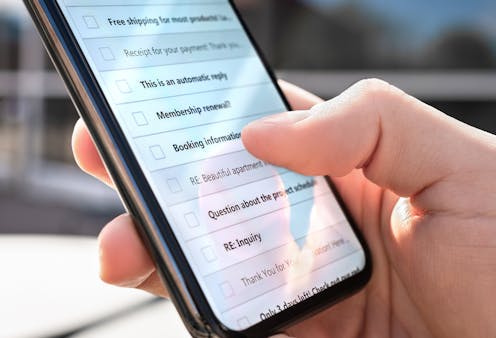
How do you manage your emails? Are you an “inbox zero[1]” kind of person, or do you just leave thousands of them unread?
Our new study, published today in the journal Information Research[2], suggests that leaving all your emails in the inbox is likely to leave you dissatisfied with your personal records management.
In an exploratory survey, we asked participants how they dealt with their personal records such as bills, online subscriptions and similar items. Many of these arrive by email[3].
We found that most respondents left their electronic records in their email. Only half saved items such as bills and other documents to other locations, like their computer or the cloud. But having a disorganised inbox also led to problems, including missing bills and losing track of important correspondence.
The risk of losing track of your emails
Receiving bills, insurance renewals and other household documents by email saves time and money[4], and reduces unnecessary paper use.
However, there are risks involved if you don’t stay on top of your electronic records. Respondents in our research reported issues such as lapsed vehicle registration[5], failing to cancel unwanted subscriptions[6], and overlooking tax deductions because it was too much trouble finding the receipts.
This suggests late fines and other email oversights could be costing people hundreds of dollars each year.
In addition to the financial costs, research suggests that not sorting and managing electronic records makes it more difficult to put together the information needed at tax time, or for other high-stakes situations, such as loan applications.
Read more: Why do I get so much spam and unwanted email in my inbox? And how can I get rid of it?[7]
What did we find?
We surveyed over 300 diverse respondents on their personal electronic records management. Most of them were from Australia, but we also received responses from other countries, such as the United Kingdom, United States, Switzerland, Portugal and elsewhere.
Two-thirds of the respondents used their email to manage personal records, such as bills, receipts, subscriptions and more. Of those, we found that once respondents had dealt with their email, about half of them would sort the emails into folders, while the other half would leave everything in the inbox.
While most sorted their workplace email into folders, they were much less likely to sort their personal email in the same way.
The results also showed that only half (52%) of respondents who left all their email in the inbox were satisfied with their records management, compared to 71% of respondents who sorted their email into folders.
Of the respondents who saved their paperwork in the cloud (Google Drive, iCloud, Dropbox and similar), 83% reported being satisfied with their home records management.
The study was exploratory, so further research will be needed to see if our findings apply more universally. However, our statistical analysis did reveal practices associated with more satisfactory outcomes, and ones that might be better to avoid.

What can go wrong with an inbox-only approach?
Based on the responses, we have identified three main problems with leaving all your email in the inbox.
First, users can lose track of the tasks that need to be done. For example, a bill that needs to be paid could slip down the line unnoticed, drowned by other emails.
Second, relying on search to re-find emails means you need to know exactly what you’re looking for. For example, at tax time searching for charity donation receipts depends on remembering what to search for, as well as the exact wording in the email containing the receipt.
Third, many bills and statements are not sent as attachments to emails, but rather as hyperlinks[9]. If you change your bank or another service provider, those hyperlinks may not be accessible at a later date. Not being able to access missing payslips from a former employer can also cause issues, as shown by the Robodebt scandal[10] or the recent case of the Australian Tax Office reviving old debts[11].
 You can apply a few simple practices to your email management to minimise stress and financial losses.
kpatyhka/Shutterstock[12]
You can apply a few simple practices to your email management to minimise stress and financial losses.
kpatyhka/Shutterstock[12]
4 tips for better records management
When we asked respondents to nominate a preferred location for keeping their personal records, they tended to choose a more organised format than their current behaviour. Ideally, only 8% of the respondents would leave everything in their email inbox, unsorted.
Our findings suggest a set of practices that can help you get on top of your electronic records and prevent stress or financial losses:
sort your email into category folders, or save records in folders in the cloud or on a computer
download documents that are not attached to emails or sent to you – such as utility bills and all your payslips
put important renewals in your calendar as reminders, and
delete junk mail and unsubscribe, so that your inbox can be turned into a to-do list.
Read more: Do you answer emails outside work hours? Do you send them? New research shows how dangerous this can be[13]
References
- ^ inbox zero (www.theguardian.com)
- ^ Information Research (informationr.net)
- ^ arrive by email (arxiv.org)
- ^ saves time and money (www.questline.com)
- ^ lapsed vehicle registration (www.dailytelegraph.com.au)
- ^ unwanted subscriptions (newsroom.ing.com.au)
- ^ Why do I get so much spam and unwanted email in my inbox? And how can I get rid of it? (theconversation.com)
- ^ Tada Images/Shutterstock (www.shutterstock.com)
- ^ but rather as hyperlinks (publications.archivists.org.au)
- ^ Robodebt scandal (ia.acs.org.au)
- ^ reviving old debts (www.abc.net.au)
- ^ kpatyhka/Shutterstock (www.shutterstock.com)
- ^ Do you answer emails outside work hours? Do you send them? New research shows how dangerous this can be (theconversation.com)