Asbestos in mulch? Here’s the risk if you’ve been exposed
- Written by: Peter Franklin, Associate Professor and Director, Occupational Respiratory Epidemiology, The University of Western Australia
Mulch containing asbestos has now been found at 41 locations[1] in New South Wales, including Sydney parks, schools[2], hospitals[3], a supermarket[4] and at least one regional site[5]. Tests are under way at other sites[6].
As a precautionary measure, some parks have been cordoned off[7] and some schools have closed[8] temporarily. Fair Day – a large public event that traditionally marks the start of Mardi Gras – was cancelled[9] after contaminated mulch was found at the site.
The New South Wales government has announced a new taskforce[10] to help investigate how the asbestos ended up in the mulch.
Here’s what we know about the risk to public health of mulch contaminated with asbestos, including “friable” asbestos, which has been found[11] in one site[12] (Harmony Park[13] in Surry Hills).
What are the health risks of asbestos?
Asbestos is a naturally occurring, heat-resistant fibre that was widely used in building materials from the 1940s to the 1980s[14]. It can be found in either a bonded or friable[15] form.
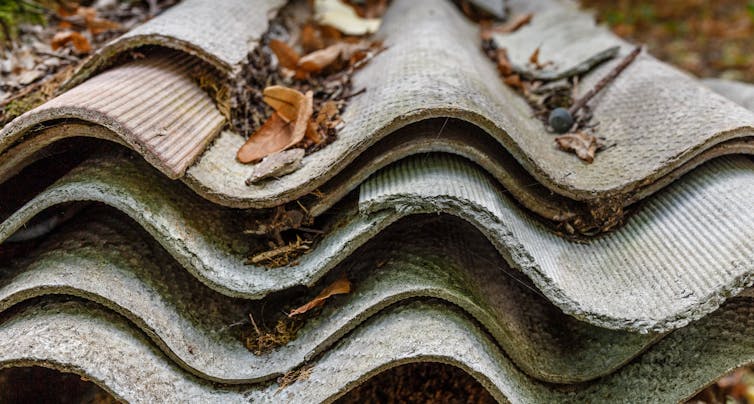
Bonded asbestos means the fibres are bound in a cement matrix. Asbestos sheeting that was used for walls, fences, roofs and eaves are examples of bonded asbestos. The fibres don’t escape this matrix unless the product is severely damaged or worn.
A lot of asbestos fragments from broken asbestos products are still considered bonded as the fibres are not released as they lay on the ground.
Friable asbestos, in contrast, can be easily crumbled by touch. It will include raw asbestos fibres and previously bonded products that have worn to the point that they crumble easily.
The risk of disease from asbestos exposure is due to the inhalation of fibres[17]. It doesn’t matter if those fibres are from friable or bonded sources.
However, fibres can more easily become airborne, and therefore inhalable, if the asbestos is friable. This means there is more of a risk of exposure if you are disturbing friable asbestos than if you disturb fragments of bonded asbestos.
Who is most at risk from asbestos exposure?
The most important factor for disease risk is exposure – you actually have to inhale fibres to be at risk of disease.
Just being in the vicinity of asbestos, or material containing asbestos, does not put you at risk of asbestos-related disease.
For those who accessed the contaminated areas, the level of exposure will depend on disturbing the asbestos and how many fibres become airborne due to that disturbance.
However, if you have been exposed to, and inhaled, asbestos fibres it does not mean you will get an asbestos-related disease. Exposure levels from the sites across Sydney will be low and the chance of disease is highly unlikely.
The evidence for disease risk from ingestion remains highly uncertain[18], although you are not likely to ingest sufficient fibres from the air, or even the hand to mouth activities that may occur with playing in contaminated mulch, for this to be a concern.
The risk of disease from exposure depends on the intensity, frequency and duration of that exposure[19]. That is, the more you are exposed to asbestos, the greater the risk of disease.
Most asbestos-related disease has occurred in people who work with raw asbestos (for example, asbestos miners) or asbestos-containing products (such as building tradespeople). This has been a tragedy and fortunately asbestos is now banned.
There have been cases of asbestos-related disease, most notably mesothelioma – a cancer of the lining of the lung (mostly) or peritoneum – from non-occupational exposures. This has included people who have undertaken DIY home renovations and may have only had short-term exposures[20]. The level of exposure in these cases is not known and it is also impossible to determine if those activities have been the only exposure.
Read more: DIY renovators now most at risk of asbestos cancers[21]
There is no known safe level of exposure – but this does not mean that one fibre will kill[22]. Asbestos needs to be treated with caution.
As far as we are aware, there have been no cases of mesothelioma, or other asbestos-related disease, that have been caused by exposure from contaminated soils or mulch[23].
Has asbestos been found in mulch before?
Asbestos contamination of mulch is, unfortunately, not new[24]. Environmental and health agencies have dealt with these situations in the past. All jurisdictions have strict regulations about removing asbestos products from the green waste stream but, as is happening in Sydney now, this does not always happen.
What if I’ve been near contaminated mulch?
Exposure from mulch contamination is generally much lower than from current renovation or construction activities and will be many orders of magnitude lower than past occupational exposures.
Unlike activities such as demolition, construction and mining, the generation of airborne fibres from asbestos fragments in mulch will be very low. The asbestos contamination will be sparsely spread throughout the mulch and it is unlikely there will be sufficient disturbance to generate large quantities of airborne fibres.
Despite the low chance of exposure, if you’re near contaminated mulch, do not disturb it.
If, by chance, you have had an exposure, or think you have had an exposure, it’s highly unlikely you will develop an asbestos-related disease in the future. If you’re worried, the Asbestos Safety and Eradication Agency[26] is a good source of information.
Read more: Asbestos still haunts those exposed as kids in mining towns[27]
References
- ^ 41 locations (www.epa.nsw.gov.au)
- ^ schools (www.epa.nsw.gov.au)
- ^ hospitals (www.epa.nsw.gov.au)
- ^ supermarket (www.epa.nsw.gov.au)
- ^ one regional site (www.sbs.com.au)
- ^ other sites (www.epa.nsw.gov.au)
- ^ cordoned off (www.reuters.com)
- ^ closed (www.epa.nsw.gov.au)
- ^ was cancelled (whatson.cityofsydney.nsw.gov.au)
- ^ taskforce (www.epa.nsw.gov.au)
- ^ has been found (www.theguardian.com)
- ^ site (www.epa.nsw.gov.au)
- ^ Harmony Park (www.smh.com.au)
- ^ 1940s to the 1980s (www.cancer.org.au)
- ^ bonded or friable (www.safeworkaustralia.gov.au)
- ^ Tomas Regina/Shutterstock (theconversation.com)
- ^ inhalation of fibres (www.asbestossafety.gov.au)
- ^ highly uncertain (iris.who.int)
- ^ intensity, frequency and duration of that exposure (onlinelibrary.wiley.com)
- ^ short-term exposures (www.mja.com.au)
- ^ DIY renovators now most at risk of asbestos cancers (theconversation.com)
- ^ does not mean that one fibre will kill (onlinelibrary.wiley.com)
- ^ exposure from contaminated soils or mulch (onlinelibrary.wiley.com)
- ^ not new (www.perthnow.com.au)
- ^ gibleho/Shutterstock (www.shutterstock.com)
- ^ Asbestos Safety and Eradication Agency (www.asbestossafety.gov.au)
- ^ Asbestos still haunts those exposed as kids in mining towns (theconversation.com)
Read more https://theconversation.com/asbestos-in-mulch-heres-the-risk-if-youve-been-exposed-223729