'Politically neutral' Russian athletes can now enter the Olympics – but don't expect many to compete
- Written by: Keith Rathbone, Senior Lecturer, Modern European History and Sports History, Macquarie University
Earlier this month, the International Olympic Committee (IOC) announced Russian and Belarussian athletes will be able to compete[1] in the 2024 Paris Olympics if they are politically neutral. The decision from the committee’s executive board reversed an earlier ban.
The IOC made this change even though the Russian National Olympic Committee remains suspended from competition for its violation[2] of “the territorial integrity of the National Olympic Committee of Ukraine”. For its part, Russia rejects[3] the decision.
The committee’s decision has enraged Western leaders, particularly those in Ukraine. Ukrainian Foreign Minister Dmytro Kuleba accused[4] the committee of effectively giving “[…] Russia the green light to weaponize the Olympics”.
While it might seem like a good idea not to hold individual athletes responsible for the decisions of governments, the decision is more complicated that it appears.
Read more: Refugee team offers a way for Russian and Belarusian dissidents to compete at the Paris Olympics[5]
Athletes caught in the middle
More than 30 Western nations, including Australia, have previously called for[6] a complete ban on Russian participation in the Games.
IOC President Thomas Bach defended his decision[7] by arguing “individual athletes cannot be punished for the acts of their governments”.
The ruling came with strict conditions[8]. Athletes must not be open supporters of the Russian invasion and they cannot be affiliated with Russian or Belarussian military or security services.
They cannot compete under their home country’s flag, or with national emblems or anthems.

The committee estimates that only 11 athletes – six Russians and five Belarussians – will qualify under these regulations.
The committee has been slowly working towards this policy[9] since the spring of 2023.
The call may seem reasonable. After all, why should Russian and Belarussian athletes, especially those not supportive of the invasion, suffer from the actions of their government?
But it’s not quite that cut and dry.
Different, inconsistent approaches
The rule change seems inconsistent. As the committee continues to ban the participation of Russian teams, not all neutral Russian and Belarussian athletes will be able to participate.
Sporting federations can also continue to ban Russian and Belarussian athletes from competition and therefore qualification for the Games. World Athletics President Seb Coe confirmed[10] that the organisation will continue to ban them.
By contrast, World Taekwondo and World Judo have both allowed Russian and Belarussian athletes to compete in qualification[11].
In September, the International Paralympic Committee also decided neutral athletes can compete[12].
What can Ukraine’s allies do?
With the Paris 2024 games only seven months away, the IOC’s decision seems final. But frustrated Western leaders have other options.
In the past year, Western officials have threatened to boycott[13] the Olympics if Russian and Belarussian athletes competed.
There is a long history of politically motivated Olympic boycotts and threatened boycotts. In 1980, the United States and 66 other countries boycotted the Moscow games in response to the Soviet Invasion of Afghanistan[14]. Eight other countries, including Australia, competed under an Olympic flag to signal their opposition to the invasion.
Read more: In a year of sporting mega-events, the Brisbane Olympics can learn a lot from the ones that fail their host cities[15]
In 1984, in response, the Soviet Union and its allies boycotted the summer Olympics in Los Angeles.
A boycott of the Paris Olympics would be devastating to the organisers, but it remains very unlikely. France is a Western nation and a strong supporter of Ukraine. President Emmanuel Macron recently encouraged the European Union[16] to continue supporting the beleaguered nation.
As a more palatable approach, Western leaders could ban athletes from Russia and Belarus from competing in international athletic competitions in Western Europe in the run-up to the games. This would likely make it impossible for any athletes from those countries to qualify for spots in Paris.
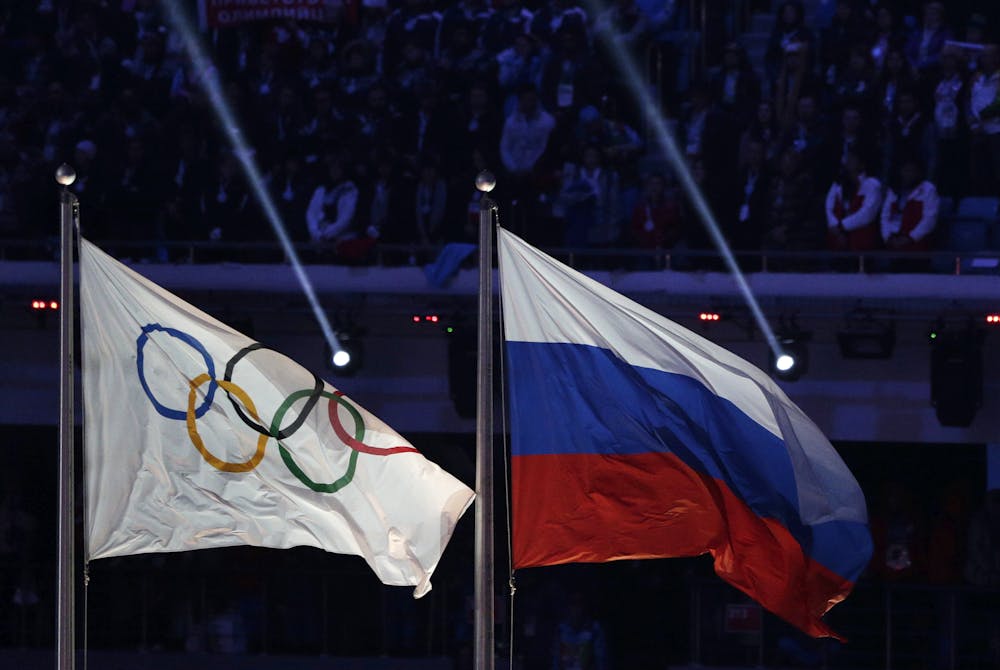 Russian teams remain banned from the 2024 Paris Olympic Games.
Matthias Schrader/AP
Russian teams remain banned from the 2024 Paris Olympic Games.
Matthias Schrader/AP
As historian Heather Dichter has shown[17], travel bans have a long history in the Olympics.
In the 1960s, there was a NATO-wide ban on East German athletes[18] travelling to compete in events in Western European countries. This effectively barred them from participation in several major sporting competitions and from qualifying for the Olympics.
Some Western leaders have already attempted to use this strategy against Russian and Belarussian athletes. Polish President Andrzej Duda refused to issue visas[19] to Russian and Belarussian fencers for a qualification competition in June. The International Fencing Federation moved the matches to Bulgaria where the neutral athletes could compete.
Read more: Gender inequality will still be an issue at the Paris 2024 Olympics — despite the Games being gender-balanced[20]
As a more drastic step, French officials could simply ban all Russian and Belarussian athletes from travelling to Paris during the Olympics. The committee would likely have no recourse at this late date.
It would would align with the approach of some other EU member nations that ban Russian tourism and travel[21].
However, the French National Olympic Committee would likely oppose such a move. They might worry that it threatens the viability of their likely future 2030 Winter Olympic Games[22].
At a time when so much international attention has turned to the Israel/Hamas war, will leaders, however frustrated, do anything in response?
Only time will tell, but one thing’s for sure: whatever happens will be carefully calculated to account for the vast array of geopolitical moving parts.
References
- ^ will be able to compete (olympics.com)
- ^ violation (olympics.com)
- ^ rejects (www.npr.org)
- ^ accused (www.insidethegames.biz)
- ^ Refugee team offers a way for Russian and Belarusian dissidents to compete at the Paris Olympics (theconversation.com)
- ^ have previously called for (www.theguardian.com)
- ^ defended his decision (www.bbc.com)
- ^ strict conditions (olympics.com)
- ^ slowly working towards this policy (www.bbc.com)
- ^ Seb Coe confirmed (news.yahoo.com)
- ^ compete in qualification (olympics.com)
- ^ can compete (www.paralympic.org)
- ^ threatened to boycott (www.euronews.com)
- ^ in response to the Soviet Invasion of Afghanistan (www.washingtonpost.com)
- ^ In a year of sporting mega-events, the Brisbane Olympics can learn a lot from the ones that fail their host cities (theconversation.com)
- ^ encouraged the European Union (www.barrons.com)
- ^ has shown (muse.jhu.edu)
- ^ NATO-wide ban on East German athletes (members.shafr.org)
- ^ refused to issue visas (olympics.com)
- ^ Gender inequality will still be an issue at the Paris 2024 Olympics — despite the Games being gender-balanced (theconversation.com)
- ^ ban Russian tourism and travel (www.france24.com)
- ^ 2030 Winter Olympic Games (olympics.com)