The Times Australia
Google AI
The Times World News

.

Think potholes on our roads are getting worse? You're right – and here's why

  • Written by Marion Terrill, Transport and Cities Program Director, Grattan Institute
Think potholes on our roads are getting worse? You're right – and here's why

If you’re a driver, particularly in the country, you could be forgiven for thinking potholes have become a design feature of Australia’s local roads.

You would certainly know they are in a state of disrepair. And you have every reason to be fed up, because bad roads are dangerous, they increase your travel time, and they force you to spend more on fuel and on car maintenance.

They are getting worse because we’re not spending enough to maintain them.

Three-quarters of our roads are managed by local councils.

Every year, those councils spend A$1 billion less on maintenance than is needed to keep those roads in their current condition – let alone improve them.

The underspend is largest in regional and remote areas.

New Grattan Institute research[1] finds the typical regional area has a funding shortfall of more 40%. In remote areas, it’s more than 75%.

Federal funding is falling behind

One reason for this underspend is that untied federal government grants to local councils haven’t kept pace with soaring costs.

Councils raise most of their own revenue – 80% on average. But in large parts of the country, there are a lot of roads and not enough ratepayers to pay for them.

Rural and remote councils have limited ability to raise more revenue from ratepayers. Their ratepayers already pay higher rates than those in cities, despite having lower average incomes.

Rate caps in place in New South Wales and Victoria also make it difficult for councils to raise more revenue.
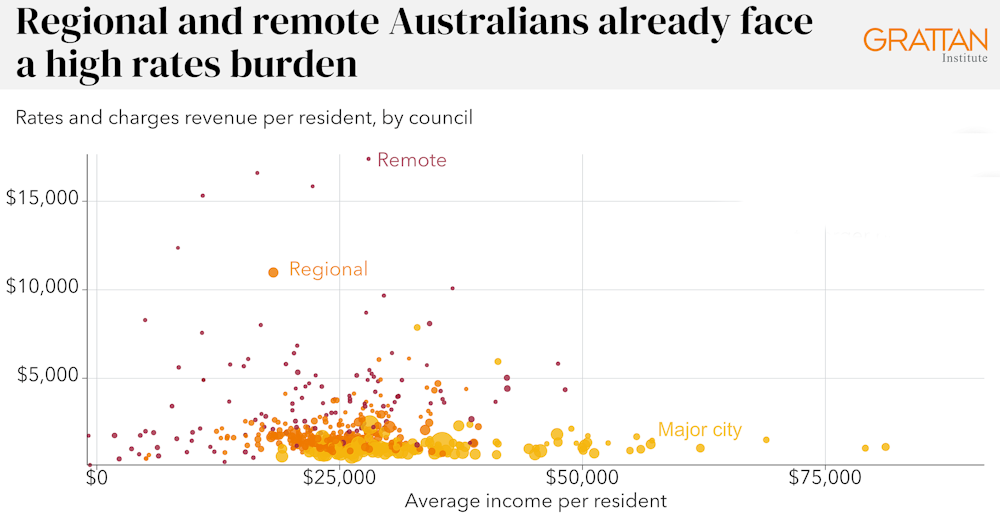
Larger dots represent councils with larger populations. Grattan Institute[2]

Councils receive top-up grants from the federal and state governments. The primary grants from the federal government, available for councils to spend as they see fit – including on roads – are called Financial Assistance Grants[3].

These are worth about $3 billion a year.

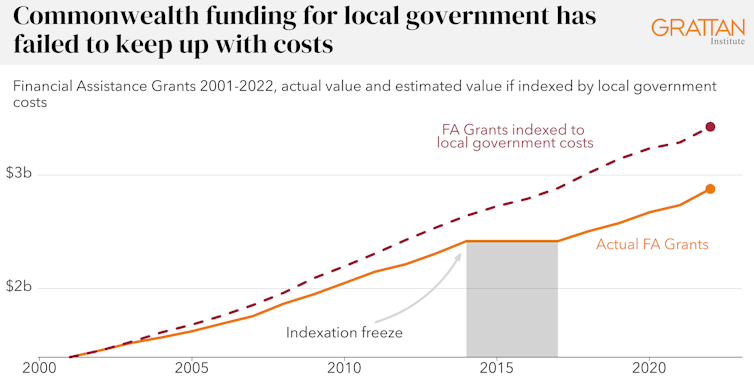
But their value has not kept pace with rising costs. If they had kept pace, on our estimates they would be 20% higher, at $3.6 billion per year.
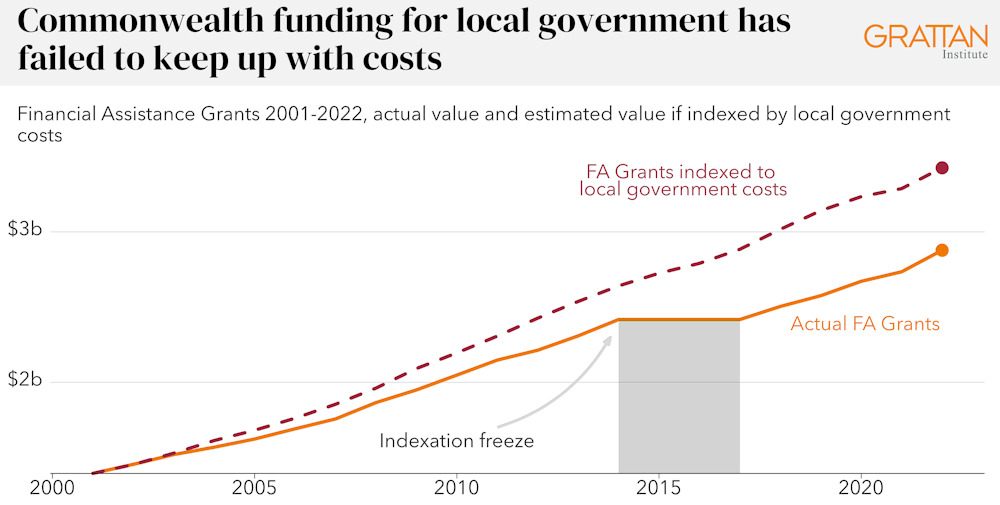
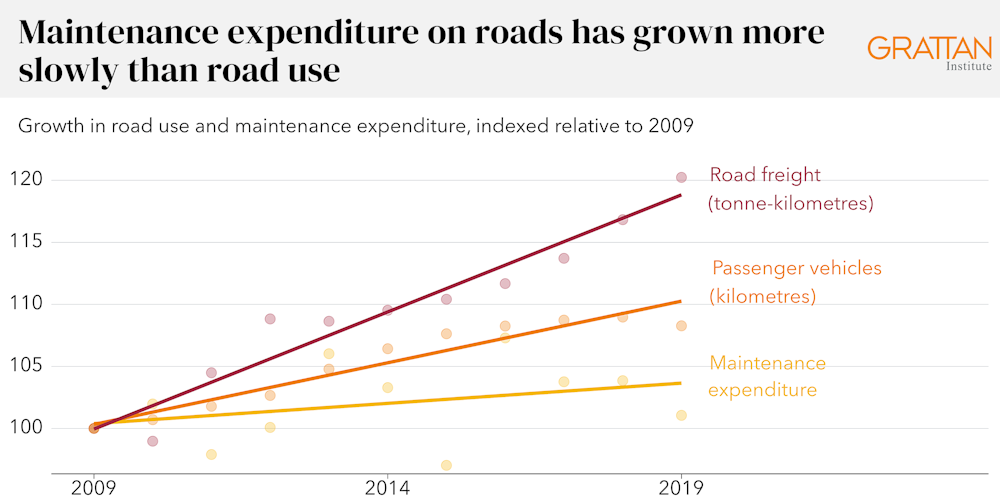
Grattan Institute, 2023[4] Road use is growing, but maintenance isn’t Another reason for the underspend is that even as funding dries up, we’re using roads more. A growing population means both more cars on our roads and more trucks needed to keep our shelves stocked. But despite the extra damage to our roads, spending on maintenance has stalled. Grattan Institute, 2023[5] Councils are spending more on other things Another reason roads are underfunded is that councils are coming under increasing pressure to fund other services. The legislation governing councils doesn’t clearly define what councils are responsible for, and there is no shortage of services communities want. Spending on transport has fallen from almost half of local government spending in the 1960s to 21% today. Environmental protection was only identified as its own area of spending for councils in 2018, but it now makes up 15% of all council spending. ABS Government Finance Statistics, Annual[6] Delaying will cost us more If we don’t act now and start spending more to fix our roads, the pothole plague is going to spread. Australia is getting hotter, with more rain and floods. The Local Government Association expects the cost of repairing flood and rain-damaged roads in the eastern states and South Australia to top $3.8 billion[7]. Tight budgets make it tempting to delay maintenance. But delaying will only end up costing more in the long run, leaving taxpayers paying more to fix more badly damaged roads. Read more: The government just killed 50 infrastructure projects – what matters is whether it will fund them on merit from now on[8] Finally, a circuit-breaker Some might argue that now is not the time for more spending on roads, given pressures on the budget. But plenty is being spent on big roads and new roads. Infrastructure Minister Catherine King’s recent announcement of a funding boost[9] of for local roads is a very welcome circuit-breaker. She announced the Roads to Recovery program will increase gradually from $500 million to $1 billion per year, the Black Spot program from $110 million to $150 million per year, and funding for an amalgamated Bridges Renewal and Heavy Vehicle Safety and Productivity program will climb form $150 million to $200 per year. This decision is important. Not only will councils receive more funding for maintenance, but it will be predictable funding, enabling better stewardship of long-lived assets. The money can’t start flowing soon enough. References^ Grattan Institute research (grattan.edu.au)^ Grattan Institute (grattan.edu.au)^ Financial Assistance Grants (www.infrastructure.gov.au)^ Grattan Institute, 2023 (grattan.edu.au)^ Grattan Institute, 2023 (grattan.edu.au)^ ABS Government Finance Statistics, Annual (www.abs.gov.au)^ $3.8 billion (alga.com.au)^ The government just killed 50 infrastructure projects – what matters is whether it will fund them on merit from now on (theconversation.com)^ funding boost (minister.infrastructure.gov.au)
Read more https://theconversation.com/think-potholes-on-our-roads-are-getting-worse-youre-right-and-heres-why-217784

Times Magazine

AI is failing ‘Humanity’s Last Exam’. So what does that mean for machine intelligence?

How do you translate ancient Palmyrene script from a Roman tombstone? How many paired tendons ...

Does Cloud Accounting Provide Adequate Security for Australian Businesses?

Today, many Australian businesses rely on cloud accounting platforms to manage their finances. Bec...

Freak Weather Spikes ‘Allergic Disease’ and Eczema As Temperatures Dip

“Allergic disease” and eczema cases are spiking due to the current freak weather as the Bureau o...

IPECS Phone System in 2026: The Future of Smart Business Communication

By 2026, business communication is no longer just about making and receiving calls. It’s about speed...

With Nvidia’s second-best AI chips headed for China, the US shifts priorities from security to trade

This week, US President Donald Trump approved previously banned exports[1] of Nvidia’s powerful ...

Navman MiVue™ True 4K PRO Surround honest review

If you drive a car, you should have a dashcam. Need convincing? All I ask that you do is search fo...

The Times Features

What the RBA wants Australians to do next to fight inflation – or risk more rate hikes

When the Reserve Bank of Australia (RBA) board voted unanimously[1] to lift the cash rate to 3.8...

Do You Need a Building & Pest Inspection for New Homes in Melbourne?

Many buyers assume that a brand-new home does not need an inspection. After all, everything is new...

A Step-by-Step Guide to Planning Your Office Move in Perth

Planning an office relocation can be a complex task, especially when business operations need to con...

What’s behind the surge in the price of gold and silver?

Gold and silver don’t usually move like meme stocks. They grind. They trend. They react to inflati...

State of Play: Nationals vs Liberals

The State of Play with the National Party and How Things Stand with the Liberal Party Australia’s...

SMEs face growing payroll challenges one year in on wage theft reforms

A year after wage theft reforms came into effect, Australian SMEs are confronting a new reality. P...

Evil Ray declares war on the sun

Australians love the sun. The sun doesn't love them back. Melanoma takes over 1,300 Australian liv...

Resolutions for Renovations? What to do before renovating in 2026

Rolling into the New Year means many Aussies have fresh plans for their homes with renovat...

Designing an Eco Conscious Kitchen That Lasts

Sustainable kitchens are no longer a passing trend in Australia. They reflect a growing shift towa...