The revamped Prime Minister's Literary Awards reward 'fresh ways of seeing' in 2023
- Written by: Alexander Howard, Senior Lecturer, Discipline of English, University of Sydney
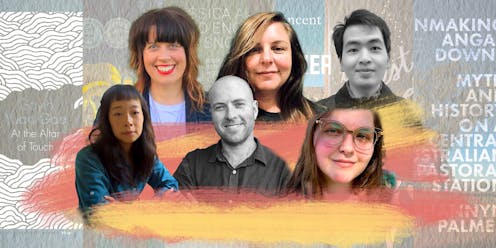
Jessica Au’s precise, poetic novella, Cold Enough for Snow[1] (Giramondo), an elegant meditation on its unnamed narrator’s trip to Japan with her ageing mother, continues its sweep of major literary awards.
Tonight, it won the 2023 Prime Minister’s Literary Award for Fiction[2], worth $80,000 – bringing the prize money for this book to more than $200,000 in total.

 Vincent’s account of agricultural practices in 21st-century Australia first appears to be “a light and comical portrait of his farming apprenticeship”, wrote Catie Greisser in her review for The Conversation[6]. “Yet, by weaving together the personal and political, Vincent provides a wealth of information on Australia’s settler history, industrial agriculture, and the regenerative turn.”
Interestingly, both adult non-fiction prizes this year were awarded to narratives exploring legacies of Australian farming and land regeneration – in different ways.
Shannyn Palmer’s Unmaking Angas Downs[7] (Melbourne University Press), winner of the Australian History Prize, tracks the practices of pastoralism and possession associated with the traumatic history of colonisation in Central Australia.
Palmer listens to Tjuki Tjukanku Pumpjack and Sandra Armstrong, two Anangu with deep and abiding connections to Angas Downs, a pastoral station in Central Australia. Through this process, a very different understanding of place emerges from that conjured in myths and histories of pioneers and pastoralists.
Sarah Winifred Searle won the Young Adult Fiction prize for their graphic novel The Greatest Thing[8] (Allen & Unwin). Centred on adolescent reinvention and self-acceptance, it explores complex themes – including gender questioning and mental health.
Vincent’s account of agricultural practices in 21st-century Australia first appears to be “a light and comical portrait of his farming apprenticeship”, wrote Catie Greisser in her review for The Conversation[6]. “Yet, by weaving together the personal and political, Vincent provides a wealth of information on Australia’s settler history, industrial agriculture, and the regenerative turn.”
Interestingly, both adult non-fiction prizes this year were awarded to narratives exploring legacies of Australian farming and land regeneration – in different ways.
Shannyn Palmer’s Unmaking Angas Downs[7] (Melbourne University Press), winner of the Australian History Prize, tracks the practices of pastoralism and possession associated with the traumatic history of colonisation in Central Australia.
Palmer listens to Tjuki Tjukanku Pumpjack and Sandra Armstrong, two Anangu with deep and abiding connections to Angas Downs, a pastoral station in Central Australia. Through this process, a very different understanding of place emerges from that conjured in myths and histories of pioneers and pastoralists.
Sarah Winifred Searle won the Young Adult Fiction prize for their graphic novel The Greatest Thing[8] (Allen & Unwin). Centred on adolescent reinvention and self-acceptance, it explores complex themes – including gender questioning and mental health.
 The Children’s Literature Prize winner, Dharug author Jasmine Seymour’s Open Your Heart to Country[9] (Magabala Books), was praised for its exquisitely illustrated and “moving account of re-connection to Country from a First Nations perspective”.
And Gavin Yuan Gao’s debut collection At the Altar of Touch[10] (University of Queensland Press), which won the 2023 Poetry Prize, explores the complexities of cross-cultural and queer identity. The judges praised it as an “achingly beautiful, rewarding ode to persistence and passion”, marking the arrival of a distinctive new voice in Australian poetry.
Read more:
A witty memoir of taking on the family farm reckons with Indigenous dispossession and climate change[11]
Controversy, change and diversity
The awards, which were established by Kevin Rudd’s Labor government in 2008, have attracted significant critical[12] and political[13] attention.
Last year, six of the ten judges had close links with The Australian newspaper. Peter Rose, editor of Australian Book Review, criticised[14] the 2022 judging panels for being too Sydney-centric, as well as being generally unrepresentative.
This year, judges have been drawn from across Australia and only two seem to have links to the Australian or News Limited. Another change is that the judging panels for poetry and fiction, and non-fiction and Australian history, each once shared, are now separately staffed.
This is the first time the awards have been delivered by Creative Australia[15] (formerly known as the Australia Council for the Arts), rather than the government’s Office for the Arts[16]. The move is designed to make them more independent.
In the government’s cultural policy, Revive[17], released in January, Prime Minister Anthony Albanese said: “Our artists help us celebrate what makes us different, and rejoice in what we share.”
In other words, the cultural sector – if and when properly supported – can play a crucial role in bridging divides. This happens when diversity is recognised and promoted.
I believe this is positive. If culture is to be truly shared, surely it’s good that this year’s awards have recognised the many and varied players – writers, publishers and critical voices alike – that give life to contemporary Australian literature.
References^ Cold Enough for Snow (theconversation.com)^ Prime Minister’s Literary Award for Fiction (creative.gov.au)^ Reviewing it for The Conversation (theconversation.com)^ The responsibilities of being: Jessica Au's precise, poetic meditation on mothers and daughters (theconversation.com)^ My Father and Other Animals (theconversation.com)^ in her review for The Conversation (theconversation.com)^ Unmaking Angas Downs (www.mup.com.au)^ The Greatest Thing (www.allenandunwin.com)^ Open Your Heart to Country (magabala.com)^ At the Altar of Touch (www.uqp.com.au)^ A witty memoir of taking on the family farm reckons with Indigenous dispossession and climate change (theconversation.com)^ critical (thewest.com.au)^ political (theconversation.com)^ criticised (www.australianbookreview.com.au)^ Creative Australia (creative.gov.au)^ Office for the Arts (www.arts.gov.au)^ Revive (www.arts.gov.au)
The Children’s Literature Prize winner, Dharug author Jasmine Seymour’s Open Your Heart to Country[9] (Magabala Books), was praised for its exquisitely illustrated and “moving account of re-connection to Country from a First Nations perspective”.
And Gavin Yuan Gao’s debut collection At the Altar of Touch[10] (University of Queensland Press), which won the 2023 Poetry Prize, explores the complexities of cross-cultural and queer identity. The judges praised it as an “achingly beautiful, rewarding ode to persistence and passion”, marking the arrival of a distinctive new voice in Australian poetry.
Read more:
A witty memoir of taking on the family farm reckons with Indigenous dispossession and climate change[11]
Controversy, change and diversity
The awards, which were established by Kevin Rudd’s Labor government in 2008, have attracted significant critical[12] and political[13] attention.
Last year, six of the ten judges had close links with The Australian newspaper. Peter Rose, editor of Australian Book Review, criticised[14] the 2022 judging panels for being too Sydney-centric, as well as being generally unrepresentative.
This year, judges have been drawn from across Australia and only two seem to have links to the Australian or News Limited. Another change is that the judging panels for poetry and fiction, and non-fiction and Australian history, each once shared, are now separately staffed.
This is the first time the awards have been delivered by Creative Australia[15] (formerly known as the Australia Council for the Arts), rather than the government’s Office for the Arts[16]. The move is designed to make them more independent.
In the government’s cultural policy, Revive[17], released in January, Prime Minister Anthony Albanese said: “Our artists help us celebrate what makes us different, and rejoice in what we share.”
In other words, the cultural sector – if and when properly supported – can play a crucial role in bridging divides. This happens when diversity is recognised and promoted.
I believe this is positive. If culture is to be truly shared, surely it’s good that this year’s awards have recognised the many and varied players – writers, publishers and critical voices alike – that give life to contemporary Australian literature.
References^ Cold Enough for Snow (theconversation.com)^ Prime Minister’s Literary Award for Fiction (creative.gov.au)^ Reviewing it for The Conversation (theconversation.com)^ The responsibilities of being: Jessica Au's precise, poetic meditation on mothers and daughters (theconversation.com)^ My Father and Other Animals (theconversation.com)^ in her review for The Conversation (theconversation.com)^ Unmaking Angas Downs (www.mup.com.au)^ The Greatest Thing (www.allenandunwin.com)^ Open Your Heart to Country (magabala.com)^ At the Altar of Touch (www.uqp.com.au)^ A witty memoir of taking on the family farm reckons with Indigenous dispossession and climate change (theconversation.com)^ critical (thewest.com.au)^ political (theconversation.com)^ criticised (www.australianbookreview.com.au)^ Creative Australia (creative.gov.au)^ Office for the Arts (www.arts.gov.au)^ Revive (www.arts.gov.au)