Engineered stone kills tradies. Bunnings and IKEA stopping its sales is a big win for public health
- Written by: Renee Carey, Senior Research Fellow, School of Population Health, Curtin University
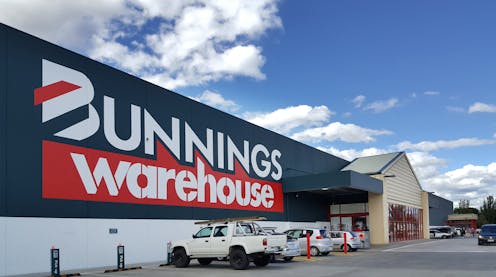
Major retailers Bunnings and IKEA have announced this week they will discontinue selling engineered stone[1]. While this might mean you have to rethink your plans for your new kitchen benchtops, it’s a positive step that will protect the health of tradespeople exposed to this dangerous product.
Engineered stone contains up to 95% crystalline silica dust[2]. This superfine dust is released into the atmosphere when workers cut, grind or drill engineered stone.
Breathing this dust into the lungs has been linked to serious long-term damage[3], including breathing difficulties, lung cancer and silicosis (scarring of the lungs).
We got to this point through a concerted campaign backed by strong scientific evidence. Let’s take a look.
Silicosis is preventable
In Australia, nearly one in four[4] engineered-stone workers employed in the industry before 2018 have already developed silicosis or other silica dust-related diseases as a result of their exposure.
Silicosis is caused by breathing in silica dust[5] which becomes embedded in the lungs and causes scarring. This means the person’s lungs can no longer function to their full capacity. Silicosis is a progressive disease, and there’s no cure.
We’ve known about silicosis for many years. Although engineered stone is a particularly potent source of silica dust, it can come from other sources too, such as rock, sand and concrete. It was historically a disease of miners due to their exposure to high dust levels.
Until the past few years, we were seeing a decline in silicosis numbers in Australia and internationally. But we’re now seeing a significant resurgence, due in a large part to the popularity of engineered stone[6].
My colleagues and I released a report[7] last year which looked at how many Australian workers would develop silicosis and lung cancer as a result of their exposure to silica dust. We also looked at the effect of possible interventions to reduce or eliminate this exposure.
Our analysis found the lives of around 1,000 workers could be saved[8] from silicosis if a ban on engineered stone was implemented. In addition, around 100 lung cancers would also be prevented over the lifetime of these workers.
Read more: Banning artificial stone could prevent 100 lung cancers and 1,000 cases of silicosis, where dust scars the lungs[9]
While some lives could be saved by other measures, such as wearing well-fitted respirators and using water when cutting engineered stone to reduce the dust levels, we calculated that the impact of a ban was much greater. These control measures also rely on compliance to be effective.
How did we get here?
The move – first taken by Bunnings, and soon after by IKEA – follows a concerted effort led by the Australian Council of Trade Unions (ACTU) over the past few years. The ACTU formed a consortium of organisations all working towards a ban on engineered stone[10] to protect workers’ lives.
These organisations included the Lung Foundation[11], the Cancer Council[12], the Australian Institute of Occupational Hygienists[13] and the Public Health Association of Australia[14]. Our report was used to inform the campaigning by these organisations.
Members of the Construction Forestry Mining and Energy Union (CFMEU) staged protests at Bunnings stores[16] earlier this year to encourage them to stop the sale of engineered stone products in their stores. In addition, the CFMEU and the wider union movement have vowed to stop their members from using engineered stone if a wider ban is not instituted[17].
Alongside this effort, we’ve seen numerous stories of everyday Australians – people who have worked with engineered stone[18], quarry workers[19] and others – who have been diagnosed with silicosis. In many cases these have been young and otherwise healthy people.
No safe level
Our research added to evidence gathered by the Australian Institute of Occupational Hygienists that showed there was no practical way[20] this product could be used safely. Based on the weight of this evidence, Safe Work Australia[21] recently recommended a complete ban on engineered stone.
State and territory ministers in the portfolio of work health and safety met late last month[22] to discuss the possibility of a ban. So far, governments in New South Wales[23] and the Australian Capital Territory[24] have indicated they will move towards a ban on engineered stone in the coming months if the federal government does not. It is thought that several other states would also support it.
Read more: Renovating your kitchen? Help Australia's tradies avoid silicosis by not choosing artificial stone[25]
There is clear momentum towards a ban on engineered stone, and we urge the federal government to implement this as soon as possible. This will ensure a unified, nationally consistent response. We would also encourage other businesses to follow the lead of Bunnings and IKEA.
While ministers deferred their decision on a ban when they met last month[26], we hope this issue will be resolved when they next meet in December. Continued use of engineered stone will only result in more illness and death among Australia’s tradies. There’s a real opportunity here to make a big difference to public health.
References
- ^ discontinue selling engineered stone (www.abc.net.au)
- ^ up to 95% crystalline silica dust (theconversation.com)
- ^ long-term damage (theconversation.com)
- ^ nearly one in four (www.health.gov.au)
- ^ breathing in silica dust (theconversation.com)
- ^ popularity of engineered stone (onlinelibrary.wiley.com)
- ^ a report (www.curtin.edu.au)
- ^ 1,000 workers could be saved (theconversation.com)
- ^ Banning artificial stone could prevent 100 lung cancers and 1,000 cases of silicosis, where dust scars the lungs (theconversation.com)
- ^ a ban on engineered stone (beta.actu.org.au)
- ^ Lung Foundation (lungfoundation.com.au)
- ^ Cancer Council (www.cancer.org.au)
- ^ Australian Institute of Occupational Hygienists (www.aioh.org.au)
- ^ Public Health Association of Australia (www.phaa.net.au)
- ^ brizmaker/Getty (www.gettyimages.com.au)
- ^ protests at Bunnings stores (www.dailymail.co.uk)
- ^ if a wider ban is not instituted (www.australianunions.org.au)
- ^ worked with engineered stone (www.abc.net.au)
- ^ quarry workers (www.9news.com.au)
- ^ no practical way (www.aioh.org.au)
- ^ Safe Work Australia (www.safeworkaustralia.gov.au)
- ^ met late last month (www.dewr.gov.au)
- ^ New South Wales (greekherald.com.au)
- ^ the Australian Capital Territory (www.abc.net.au)
- ^ Renovating your kitchen? Help Australia's tradies avoid silicosis by not choosing artificial stone (theconversation.com)
- ^ they met last month (www.dewr.gov.au)