final polls suggest NZ First likely kingmaker as the left makes late gains
- Written by: Adrian Beaumont, Election Analyst (Psephologist) at The Conversation; and Honorary Associate, School of Mathematics and Statistics, The University of Melbourne
After political polls between March and August showed a clear trend towards the right[1], polls since late August have shown the reverse. Remove a resurgent NZ First from the mix, and the left and right blocs are now polling closely.
The emergence of NZ First as potential kingmaker has seen warnings, particularly from the National Party, of an indecisive result and even the possible need for a second election[2] if coalition negotiations broke down.
We’ll only have a clearer picture once polling booths close[3] at 7pm (5pm AEDT) on Saturday, when all ordinary votes cast at early voting centres or on election day will begin to be counted.
There are also “special votes[4]”, usually cast by voters outside their home electorate (similar to absent votes in Australia). In the past, these have benefited parties on the left, which can take another one or two seats over the preliminary results.
If past practice is a guide, however, there will be no updates to the published results after election night until the official results (which include special votes) are released on November 3.
If NZ First is just above or just below the 5% threshold on election night, we’ll have to wait three weeks to know if it has made it into parliament – and what that means for the balance of power.
Left and NZ First gain in final polls
For the purposes of this analysis, the right coalition is defined as National and ACT, and the left as Labour, the Greens and Te Pāti Māori/the Māori party. NZ First has sided with both left and right in the past, and supported the left from 2017 to 2020, so it is not counted with either left or right.
Although Te Pāti Māori is well under the 5% threshold normally required to enter parliament, it is expected to win single-member seats on the Māori electoral roll[5]. In fact, the party could benefit from an “overhang” (see below).
Since my previous analysis[6] two weeks ago, there have been two 1News-Verian polls[7], a Newshub-Reid Research poll, a Guardian-Essential poll, a Curia poll for the Taxpayers’ Union, and a Talbot Mills poll.
Read more: NZ Election 2023: from one-way polls to threats of coalition ‘chaos’, it’s been a campaign of two halves[8]
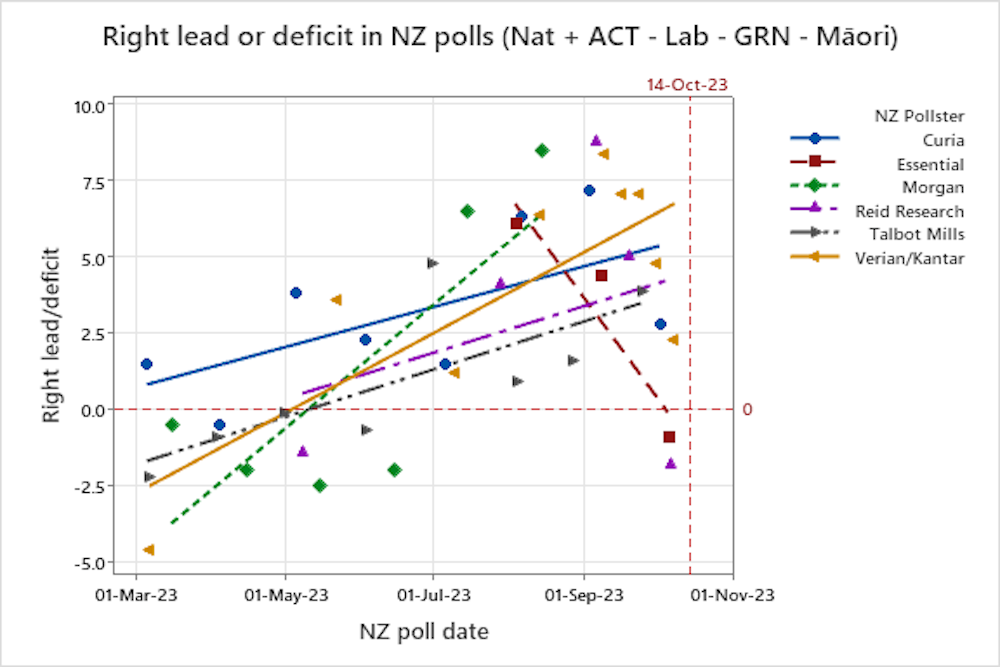
Other than the Talbot Mills poll (which appeared to have been a leftward outlier last time), there has been a clear trend of a fall in the right’s lead over the left. Essential and Reid Research now have the left just ahead.
But with NZ First between 6% and 8% in all recent polls – above the 5% threshold – neither right nor left are likely to have a majority, and so NZ First will be the kingmaker.
Two graphs illustrate these poll trends. The first, as before, shows all polls conducted since March. As the right made gains in July and August, the trends still suggest it is gaining.
The second graph only covers polls conducted since late August, showing a clear trend to the left in all except the Talbot Mills poll.
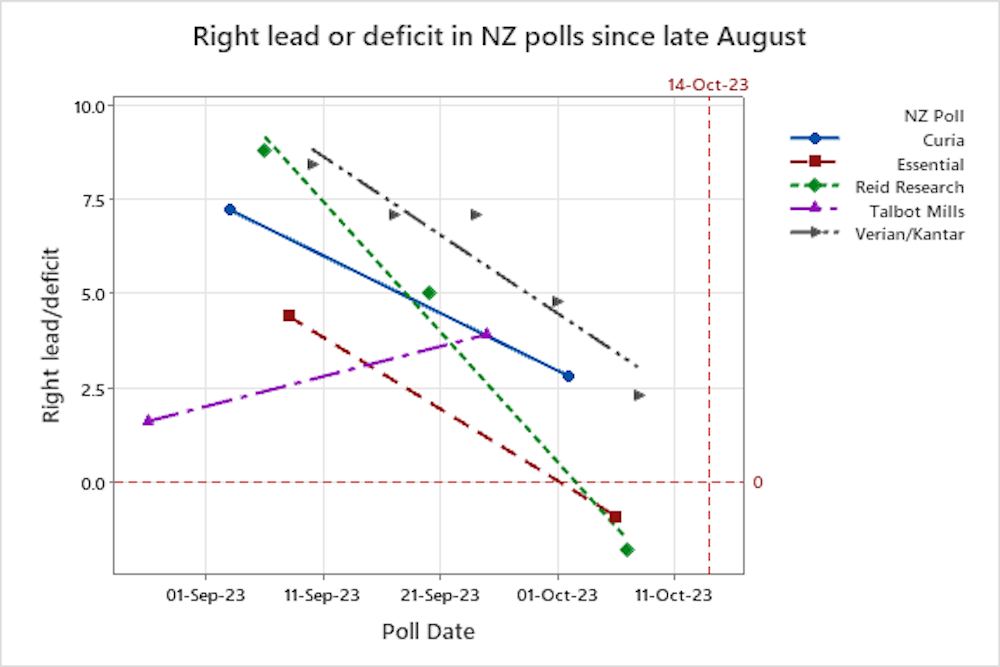 New Zealand polls since late August.
Fieldwork for the Verian and Reid Research polls ended Tuesday, four days from the election. Voting intentions can still change in these final days.
In international elections, there have sometimes been large poll errors. Where they have occurred, the right is often understated – such as at the Greek election[9] in May. But at the 2020 New Zealand election[10], the left was understated. The left parties in 2023 will hope the results are more favourable than polls imply.
Read more: How to read the political polls: 10 things you need to know ahead of the NZ election[11]
Te Pāti Māori could benefit from an ‘overhang’
In New Zealand’s mixed member proportional (MMP[12]) system, an “overhang” occurs when a party wins more single-member seats than its total seat entitlement would be on the party vote alone. If this occurs, that party is allowed to keep its extra seats and the size of parliament is increased.
There are seven Māori-roll single-member seats. At the 2020 election[13], Labour won six and Te Pāti Māori one. But Labour’s vote has crashed since 2020, so it’s plausible Te Pāti Māori could win more single-member seats.
In 2020 the party won 1.2% of the party vote, but its one electorate victory entitled it to two of parliament’s 120 total seats. But if it picked up five single-member electorates and less than 2% of the party vote, for example, it would result in a three-seat overhang: parliament would be expanded to 123 seats, with Te Pāti Māori holding five.
Read more: After the election, Christopher Luxon’s real test could come from his right – not the left[14]
Candidate’s death will help National
To add to the uncertainty, there will be a November 25 by-election in Port Waikato after the death on Monday of an ACT candidate.
According to the electoral rules[15], only the party vote in that seat will be counted on election night. The by-election will determine the electorate candidate, meaning parliament will be expanded to 121 seats (ignoring any other overhangs).
Saturday’s election will only allocate seats in proportion to the 120 total seats that will be elected at that time. The winner of the Port Waikato by-election will take the additional 121st seat.
Although the 2020 election was a Labour landslide, National held Port Waikato[16], so it will almost certainly win the by-election, giving the party one seat more than it should be entitled to on the party vote. But current polls indicate this one seat won’t be enough for a National-ACT majority.
Read more: What makes a good political leader – and how can we tell before voting?[17]
References
- ^ clear trend towards the right (theconversation.com)
- ^ second election (www.1news.co.nz)
- ^ polling booths close (vote.nz)
- ^ special votes (vote.nz)
- ^ Māori electoral roll (elections.nz)
- ^ previous analysis (theconversation.com)
- ^ 1News-Verian polls (en.wikipedia.org)
- ^ NZ Election 2023: from one-way polls to threats of coalition ‘chaos’, it’s been a campaign of two halves (theconversation.com)
- ^ Greek election (en.wikipedia.org)
- ^ 2020 New Zealand election (en.wikipedia.org)
- ^ How to read the political polls: 10 things you need to know ahead of the NZ election (theconversation.com)
- ^ MMP (elections.nz)
- ^ 2020 election (en.wikipedia.org)
- ^ After the election, Christopher Luxon’s real test could come from his right – not the left (theconversation.com)
- ^ electoral rules (www.1news.co.nz)
- ^ Port Waikato (en.wikipedia.org)
- ^ What makes a good political leader – and how can we tell before voting? (theconversation.com)