Australia's teacher workforce has a diversity problem. Here's how we can fix it
- Written by: Suzanne Rice, Senior Lecturer, Education Policy and Leadership, The University of Melbourne
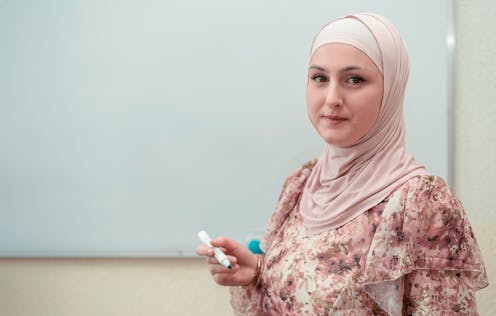
Australia’s teaching workforce does not reflect the diversity of the Australian community, a situation that has far-reaching implications for our education system.
As we outline in our new research[1], published today, teachers are predominantly Australian-born, female, and non-Indigenous.
Most hail from middle-class backgrounds with urban upbringings, and are less likely to have disabilities.
So why is this lack of diversity a problem? And what can be done to help overcome it?
Read more: Australia has a plan to fix its school teacher shortage. Will it work?[2]
Teacher shortages and student achievement
Australia is in the midst of a teacher shortage[3], which is affecting schools in unequal ways.
Schools in rural, remote areas, and those with higher levels of disadvantage[4] have been shown to bear the brunt of this issue.
Our research suggests diversifying the teaching workforce can help address attaining and retaining teachers in schools and strengthen student outcomes across the board.
Diversity makes a difference
Research[5] shows teachers from minority groups, such as teachers of colour, can increase student achievement, especially for students from the same groups.
Evidence[6] also suggests teachers from minority groups often hold higher expectations for their minority students compared with majority teachers[7]. For example, Black teachers tend to have higher expectations than white teachers of Black students, and students respond to this with greater effort.
Teachers from minority groups can act as role models[8] for people from similar backgrounds.
Teachers from minority groups can also act as cultural “bridges”[9] to parents and students from these groups, fostering a sense of belonging and facilitating cultural understanding among students and colleagues.
Teachers from minority groups are also more likely to stay in hard-to-staff schools impacted the most during a staffing crisis.
For example, teachers from ethnic minorities are more likely[10] to teach and stay in schools with many minority students, and teachers from rural areas are more likely to teach and remain in rural schools[11].
So, how can we increase the diversity of the teaching workforce?

Grow-your-own programs
One approach we examined in our new report is known as a “grow-your-own program”, which focus on would-be teachers already working in schools. This is where would-be teachers are given financial assistance by governments, and other support such as a mentor or study groups. Upon finishing the program, they become fully qualified teachers in their local school.
The research[12] shows grow-your-own programs can increase teacher diversity and address staffing shortages. They can support people already working in hard-to-staff schools, such as teacher aides, to undertake teaching qualifications.
By recruiting people who already have ongoing connections with the community, grow-your-own programs produce graduates likely to take up and retain teaching positions in these communities.
New South Wales is currently trialling a similar program[13] targeting teacher aides. The Northern Territory and Queensland also have targeted grow-your-own programs for Indigenous people.
Teacher residency programs
Teacher residency programs bring candidates into schools from the beginning of their training, where they are closely mentored by experienced teachers.
Candidates teach actively from the start while completing their teaching qualification.
These programs are usually focused on increasing the supply of teachers, rather than increasing diversity.
But since they allow people to earn an income and train at the same time, they can remove barriers[14], such as the costs of full-time study, for those from minority groups.
 Teacher residency programs bring candidates into schools from the beginning of their training.
Shutterstock
Teacher residency programs bring candidates into schools from the beginning of their training.
Shutterstock
Targeted scholarships for teacher trainees
Scholarships can help meet the costs of studying to become a teacher, and have been used for decades, although mostly without an emphasis on teacher diversity.
Australian departments of education already offer scholarships targeted to Indigenous secondary and university students who want to become teachers, or who are in teacher training.
We know these scholarships do work[15] to support people into teaching and could be targeted to other minority groups as well.
Building bridges between VET and teacher training
Vocational education and training (VET) courses can be easier and cheaper to access than university courses.
For some students they feel like less of a cultural and financial “leap” than going to university.
Building pathways[16] between VET and teacher education courses can help diversify the teaching workforce. Victoria University[17] and Charles Darwin University offer good examples in Australia.
Overcoming barriers
Those wishing to become teachers in Australia already face several barriers.
One is a test known as the Literacy and Numeracy Test for Initial Teacher Education (LANTITE[18]), which aspiring teachers must pass.
While it’s important our teachers have strong literacy and numeracy skills, some people from diverse backgrounds can find tests threatening[19] and underperform. We need to consider whether there are alternatives that are equally valid.
School context and culture is also important. Encouraging a person from a minority group into teaching won’t help if the structures and cultures in the workplace don’t support them and cater for diversity.
School leadership, parents and students need to recognise that staff diversity strengthens the school, and support minority staff appropriately.
We need to make sure schools are places where diverse teachers feel valued and can flourish.
Policymakers and schools must recognise teacher workforce diversity is a key component of school quality.
Read more: How 'TeachTok' is helping teachers connect with their students on TikTok[20]
References
- ^ new research (education.unimelb.edu.au)
- ^ Australia has a plan to fix its school teacher shortage. Will it work? (theconversation.com)
- ^ teacher shortage (www.abc.net.au)
- ^ disadvantage (www.pc.gov.au)
- ^ Research (link.springer.com)
- ^ Evidence (citeseerx.ist.psu.edu)
- ^ majority teachers (psycnet.apa.org)
- ^ role models (unimelbcloud-my.sharepoint.com)
- ^ cultural “bridges” (journal.spera.asn.au)
- ^ more likely (journals.sagepub.com)
- ^ rural schools (scholarsjunction.msstate.edu)
- ^ research (files.eric.ed.gov)
- ^ similar program (education.nsw.gov.au)
- ^ barriers (www.rand.org)
- ^ do work (www.mdpi.com)
- ^ Building pathways (www.publicservicedegrees.org)
- ^ Victoria University (www.vu.edu.au)
- ^ LANTITE (teacheredtest.acer.edu.au)
- ^ threatening (psycnet.apa.org)
- ^ How 'TeachTok' is helping teachers connect with their students on TikTok (theconversation.com)