Australia tops the world for podcast listening. Why do we love them so much?
- Written by: Dylan Bird, PhD candidate, University of Tasmania
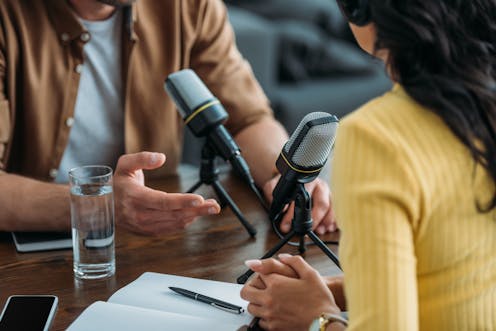
“We’re here because this moment demands an explanation.”
So begins the first ever episode of New York Times’ The Daily podcast, delivered by host Michael Barbaro in his now famous style. It arrived on Wednesday February 1, 2017 – less than a fortnight after Donald Trump’s inauguration as President of the United States.
By the end of Trump’s term, it was wildly popular, reportedly attracting some four million daily downloads[1] and referred to as the newspaper’s “new front page[2]”.
The Daily’s success inspired many other news outlets to develop podcasts, including in Australia, with the likes of ABC’s The Signal (since replaced by ABC News Daily), Schwartz Media’s 7am, and Guardian Australia’s Full Story launching from 2018.
According to 2023 data from The Infinite Dial – which tracks digital media use internationally – Australia has now surpassed the US to be a world leader in podcast listening[3], with 43% of the population aged 12 and over having listened to a podcast in the past month.
Australia also has the third highest rate of news podcast listening[4], behind the US and Sweden, with 14% of news consumers listening to news podcasts in the past month.
Despite these trends, there’s been limited research on news podcast listening in Australia. My recent research[5], published in June, found news podcast listeners in Australia tend to be politically left-leaning, wealthier, and more highly educated than average.
I also found they tend to be politically active, and value news podcasts for enabling them to better participate in democratic life.
Interestingly, listeners didn’t appear to trust podcasts more than other forms of news in general, with 61.1% reporting “the same” level of trust. However, they reported a high level of trust in news they choose to consume.
The rise of news podcasts happened amid a volatile political climate. In 2023, as Trump prepares for another run for president, and with a political storm brewing in Australia as we approach a referendum on an Indigenous Voice to parliament, there are good reasons to consider the role this podcast genre plays in democracy.
Read more: Michelle Obama, podcast host: how podcasting became a multi-billion dollar industry[6]
From radio to podcast news
Radio news developed slowly following the invention of mass broadcasting in the early 1920s. It began with announcers reading press agency reports on air, giving rise to an authoritative and detached presenting style, reflecting the journalistic value of objectivity. While formats have differed, this has characterised radio news for much of its history.
Podcasting emerged in the early 2000s out of the disruption caused by the internet, and particularly the ability of users to generate and share content.
The lack of time constraints compared to radio meant podcast episodes could go for any length. And because they could be downloaded, listeners could engage with content in their own time, on their own terms.
Slate’s Political Gabfest (2005-) was one of the first “native” podcasts – that is, produced specially for digital consumption – exploring news and politics. But it wasn’t until 2014, with podcasting’s breakout moment in true-crime sensation Serial, that news podcasts began to take off.
The Daily grew out of the New York Times’ election podcast The Run-Up. It pioneered the format known as the “daily deep dive” – defined by the Reuters Institute as “heavily produced using sound design and narrative storytelling techniques”.
Many news podcasts since have similarly deployed narrative storytelling and immersive sound design to explore issues in the news. This has been championed as offering a more “human” approach[7] to the news, featuring personal presenting styles and the harnessing of emotion.
Media fragmentation and politics
Reuters’ 2023 Digital News Report notes[8] how in the podcasting sphere “news jostles for attention with lifestyle and specialist shows”. This may explain the degree of ambivalence around trust in news podcasts, with a wide variety of offerings categorised as “news” in podcast players such as Apple Podcasts.
Podcasting is difficult to regulate, and there’s a risk of the medium being used to spread dangerous messages[9], as has happened across social media generally.
Read more: Misinformation is rife and causing deeper polarisation – here's how social media users can help curb it[10]
In his new book[11], Bruce Wolpe, Senior Fellow at the United States Studies Centre, considers what a second Trump presidency would mean for Australia. He notes the corrosive influence of Trump and his Fox News acolytes on public trust, and warns that Australia should prepare for an emboldening of the populist right-wing sentiment that accompanied his rise on the political scene.
In the face of this, independent and rigorous journalism, supported by a well-funded ABC, has an important role to play.
As my study highlights, it’s important to acknowledge news podcast listeners tend to be from the higher social classes. There’s an impetus, then, to ensure coverage includes the perspectives of those who might not otherwise be well represented across the media sphere.
This has particular importance in relation to issues like the upcoming referendum, with a risk of it being used to fan the flames of culture wars[12].
Read more: Who is Joe Rogan, and why does Spotify love him so much?[13]
At their best, news podcasts can engage us meaningfully in important issues, transporting us to unexpected places and highlighting the human impact at the heart of news stories, supported by facts and informed analysis.
With Australians among the most active news podcast listeners globally, there’s reason to have hope they can play a productive role in helping us navigate politically uncertain times.
References
- ^ four million daily downloads (edition.cnn.com)
- ^ new front page (www.theguardian.com)
- ^ to be a world leader in podcast listening (www.commercialradio.com.au)
- ^ third highest rate of news podcast listening (reutersinstitute.politics.ox.ac.uk)
- ^ recent research (intellectdiscover.com)
- ^ Michelle Obama, podcast host: how podcasting became a multi-billion dollar industry (theconversation.com)
- ^ approach (www.tandfonline.com)
- ^ notes (reutersinstitute.politics.ox.ac.uk)
- ^ spread dangerous messages (www.theguardian.com)
- ^ Misinformation is rife and causing deeper polarisation – here's how social media users can help curb it (theconversation.com)
- ^ new book (www.allenandunwin.com)
- ^ culture wars (www.theguardian.com)
- ^ Who is Joe Rogan, and why does Spotify love him so much? (theconversation.com)