Giant old trees are still being logged in Tasmanian forests. We must find ways of better protecting them
- Written by: Jamie Kirkpatrick, Professor of Geography and Environmental Studies, University of Tasmania
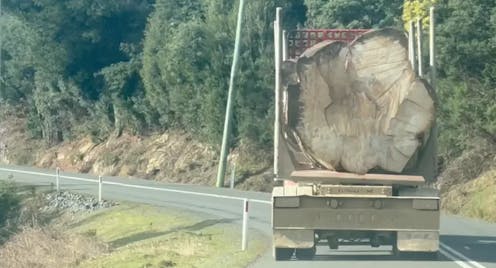
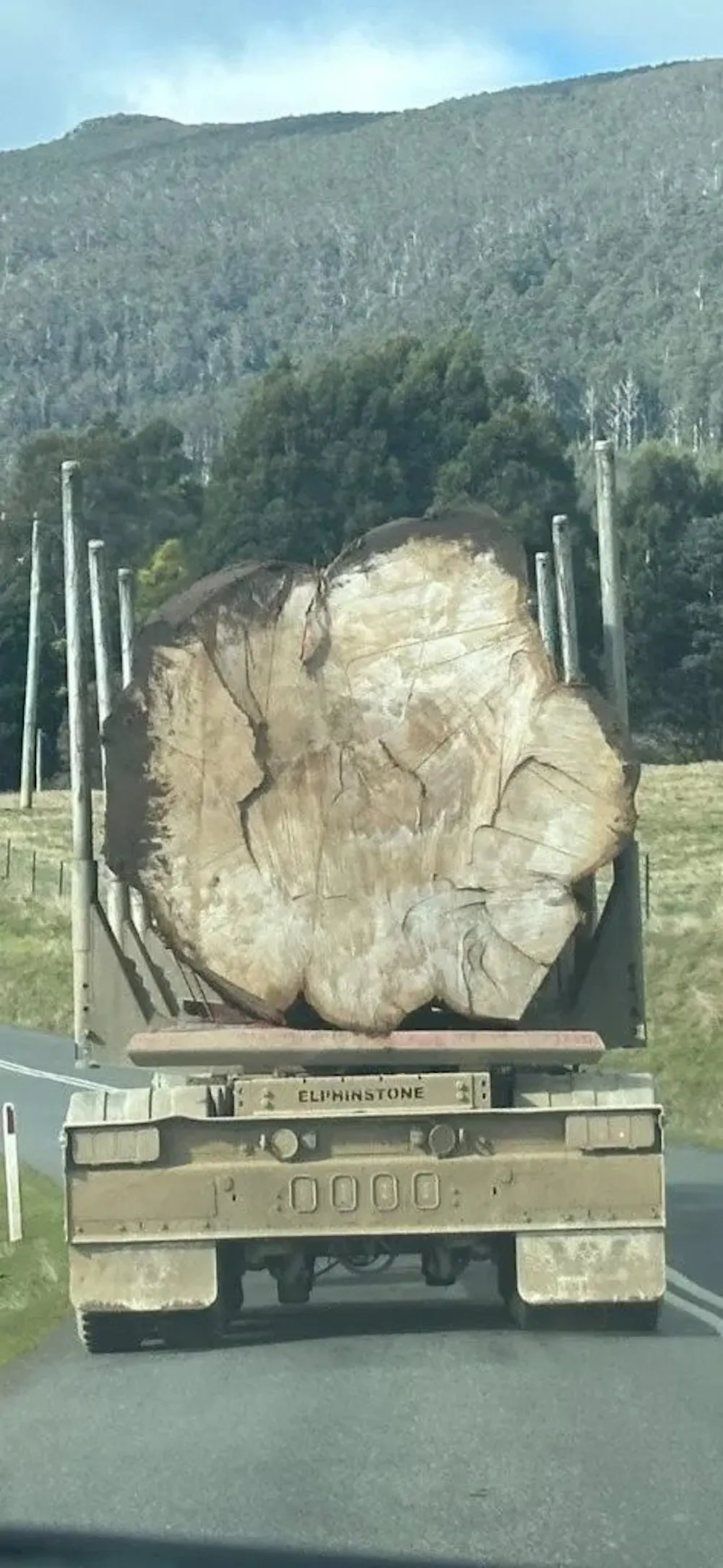
The photo said it all. On the back of a logging truck, a tree so large it could barely fit. It was cut down in Tasmania’s Florentine Valley, not far from Mount Field, where it had started life as a seedling over a century ago.
The photo triggered outrage from conservationists and the public. Greens founder Bob Brown called the felling[1] “a national disgrace” and urged a halt to the felling of old growth giants.
Giant trees are supposed to be protected as a matter of normal process. Trees over 85 metres high or with a trunk volume of 280 cubic metres should be retained with a 100 metres radius of uncleared bush around them. The loggers say this one was cut down for “safety reasons”. We don’t know if this one met those criteria.
Whether or not that’s true, the felling has sparked a new battle in Tasmania’s long-running forest wars. Unlike in Victoria, old growth logging in Tasmania doesn’t look like ending any time soon. But we must find ways to better protect these giants of nature, the tallest flowering trees in the world. They store huge amounts of carbon in their trunks and in the soil, provide habitat for many forest creatures and produce awe in humans who see them.
Why was this giant logged?
The truck transporting the trunk of the tree was seen exiting Tasmania’s Florentine Valley. This valley has been the site of many protests over the years. Part of it is in the World Heritage Area, but logging is still allowed in other parts of it.
Why was a tree this size cut down? Safety.
“On occasion, it may be necessary for Sustainable Timber Tasmania to remove a large tree where it presents an access or safety risk,” a spokeswoman told news.com.au[3].
That is possible. Giant old trees can hollow out as they age and become a safety risk if people are allowed near them. But the trunk in the published photo shows no sign of hollowing out. If it was a giant, the mandatory 100 metre protection zone would eliminate almost all risk.
At the very least, the felling suggests not all of Tasmania’s ancient trees are adequately protected. What it shows is the need for independent assessment of areas slated for logging likely to be home to giants – and to ensure trees felled for “safety” reasons" genuinely need to be removed.
And what about trees that are not quite big enough to be protected? As ecologist and tall-tree expert Dr Jennifer Sanger has observed[4], the 85-metre figure is arbitrary. We need to plan for the giant trees of the future by keeping the almost giant trees of now.
Read more: After the chainsaws, the quiet: Victoria's rapid exit from native forest logging is welcome – and long overdue[5]
Ancient giants matter
Mountain ash (Eucalyptus regnans) is the world’s largest flowering plant. The trees can live up to 700 years and reach over 100 metres in height.
Do they matter more than other trees? Yes. That’s because big old trees begin to decay in interesting ways, creating hollows for possums and birds to nest in, and even hollowing out inside the trunk, which makes habitat for bats. They play an outsized role in ecosystems in providing shelter, hollows and food.
Ironically, these processes of decay can make these giants all but useless for timber. If you’re logging a giant to turn it into large structural beams, you might find it’s hollow inside and all but useless.
The sheer size of these trees also means they have more habitat to offer for other forms of life. Native animals, birds and invertebrates rely on these trees. Plus, they store massive amounts of carbon, both above ground and in the soil. Cutting down the old growth forests of which these trees are a part and turning them into production forests results in a substantial ongoing leakage of soil carbon for many generations.
The trees induce awe and wonder in most who see them. People are passionate about keeping them on the planet – one of the reasons for the forest wars in the first place. These huge trees attract tourists to walk beneath them or up in their canopies.
 Giant trees like Gandalf, this 84 metre mountain ash, are vital to ecosystems.
Steve Pearce/The Tree Projects, Author provided (no reuse)
Giant trees like Gandalf, this 84 metre mountain ash, are vital to ecosystems.
Steve Pearce/The Tree Projects, Author provided (no reuse)
Haven’t Tasmania’s forest wars stopped?
Sadly, no. The decades-long battle between loggers and conservationists in Tasmania has certainly become less intense after many old growth forests such as the Weld, Styx, Florentine and Great Western Tiers gained World Heritage protection[6] in 2013.
But native forest logging in Tasmania shows no sign of stopping entirely. Old-growth logging continues around the state, including in the Florentine Valley where this giant tree was felled. Rainforest trees in some reserves are available for logging.
In May, Victorian Premier Daniel Andrews announced[7] his state would this year end native forest logging, which has long been a loss-making industry. Instead, plantation logging will be expanded.
Why can’t Tasmania do this? It mostly comes down[8] to politics. Tasmania is the poorest state in Australia, and the few jobs logging native forests are politically important.
Also, the wood from larger trees are better for ends such as veneer, exposed beams and furniture than most plantation-sourced wood. Their felling can be rewarding financially for the companies that do it, as no-one has to pay to grow them and they can contain large volumes of high quality wood.
But overall, cutting down old growth forests may not stack up economically, with the quasi-government enterprises managing production forests often making losses. It didn’t make much financial sense[9] in Victoria, and may not[10] in Tasmania.
Will the felling of this giant bring change? Don’t bet on it. Probably the best we can hope for is to preserve as many giants – and near-giants – as we can. And to do that, we’ll need independent assessments of old growth forest slated for logging to double-check measurements of these precious trees.
Read more: Photos from the field: capturing the grandeur and heartbreak of Tasmania's giant trees[11]
References
- ^ called the felling (www.theguardian.com)
- ^ CC BY-ND (creativecommons.org)
- ^ news.com.au (www.news.com.au)
- ^ has observed (www.theguardian.com)
- ^ After the chainsaws, the quiet: Victoria's rapid exit from native forest logging is welcome – and long overdue (theconversation.com)
- ^ gained World Heritage protection (www.smh.com.au)
- ^ announced (theconversation.com)
- ^ comes down (theconversation.com)
- ^ financial sense (www.smh.com.au)
- ^ may not (www.theguardian.com)
- ^ Photos from the field: capturing the grandeur and heartbreak of Tasmania's giant trees (theconversation.com)