


here's a radical approach to building a sustainable and just society
- Written by: Mark Diesendorf, Honorary Associate Professor, UNSW Sydney
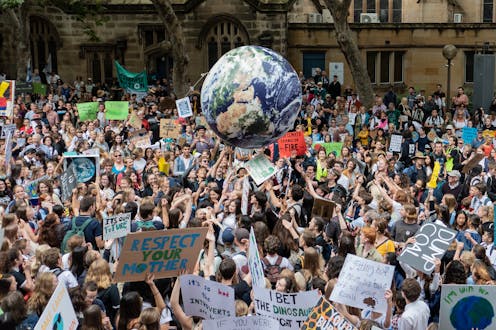
Collectively we are driving Earth and civilisation towards collapse. Human activities have exceeded planetary boundaries[1]. We are changing the climate, losing biodiversity, degrading land, contaminating freshwater, and damaging the nitrogen and phosphorus cycles upon which we all depend.
We ask how this could happen. Also, why democratically elected governments ignore the wishes of the majority of their people. Why some governments continue to export fossil fuels despite commitments to climate mitigation. Why some go to war in distant lands without any debate in parliament or congress. Why some give tax cuts to the rich while those on the dole struggle below the poverty line.

The answers to these questions all come down to one thing: decision-makers and influencers are captured by vested interests. That is the inconvenient truth revealed in our new book[3], The Path to a Sustainable Civilisation: Technological, Socioeconomic and Political Change. But these forces can be overthrown.
We argue it is not sufficient for citizen organisations and governments to address specific environmental, social justice and peace issues. It’s certainly necessary, but we must also struggle for systemic change. This means challenging the covert driving forces of environmental destruction, social injustice and war, namely, “state capture” and the dominant economic system.
It’s 90 seconds to midnight on the Doomsday Clock[4], so there’s no time to waste.
Read more: Australia has overshot three planetary boundaries based on how we use land[5]
Confronting state capture
Political scientists[6] and political economists[7] argue governments, public servants, the media and indeed the majority of decision-makers and influencers become captured by vested interests.
This is known as state capture[8], where state means the nation-state. The captors include fossil fuel, armaments, finance, property and gambling industries.
State capture can also involve foreign governments. There is justifiable concern in Australia and elsewhere about subversion by the Chinese Communist Party[9].
Yet there is little discussion of the fact that, since 2015, six “retired” US admirals[10] worked for the Australian government before the AUKUS[11] announcement on nuclear powered submarines.
 The forces driving the collapse of civilisation, in a nutshell.
Mark Diesendorf, Author provided
The forces driving the collapse of civilisation, in a nutshell.
Mark Diesendorf, Author provided
State capture could explain why Australia’s defence is being shifted to the South China Sea under US sovereignty[12].
Confronting state capture involves reversing several undemocratic practices. Of particular concern is the funding of political parties[13] by corporate interests as well as the revolving-door jobs[14] between government and corporate interests.
There is also the concentration of media ownership and the influence of so-called “think tanks”[15] funded by vested interests.
The first step is to set up coalitions or networks to oppose the power of vested interests. This would bring together diverse civil society organisations with common interests in democratic integrity and civil liberties.
One example is the Australian Democracy Network[16], which campaigns for “changes that make our democracy more fair, open, participatory, and accountable”. The Network was founded in 2020 by the Human Rights Law Centre, the Australian Conservation Foundation and the Australian Council of Social Service.
Read more: A monster rally for climate change, but divergent goals hinder the fight[17]
Challenging economic ideology
Conventional economic theory failed us[18] when it came to recovery from the Global Financial Crisis[19] of 2007–09 and the COVID pandemic[20]. Nevertheless, many governments still accept its prescriptions.
The dangerous and destructive myths of conventional economics include the claims that:
- economic theory can treat the natural environment as an infinite resource and infinite waste dump
- endless economic growth on a finite planet is feasible and desirable
- wealth trickles down from the rich to the poor
- wellbeing and welfare can be measured by GDP
- government intervention in the market must be avoided.
Although these myths have been refuted many times, even by world famous economist Joseph Stiglitz[21], they still determine much government policy.
Australian economist Steve Keen first published Debunking economics[22] in 2001. The financial crisis of 2007 gave him plenty of material for a revised edition in 2011. Richard Denniss gave us Econobabble[23]: How to Decode Political Spin and Economic Nonsense in 2021. Yet, as John Quiggin so eloquently puts it, dead ideas still stalk the land (Zombie Economics[24].
They have devastating impacts on our life support system (the biosphere) and social justice. One of the principal destroyers of our planet is excessive consumption, especially consumption by rich individuals and rich countries[25].
Read more: Affluence is killing the planet, warn scientists[26]
A more appropriate economic framework for human and planetary wellbeing is the interdisciplinary field of ecological economics[27].
Unlike neoclassical economics, ecological economics gives priority to ecological sustainability and social justice over economic efficiency. It works towards a transition to a steady-state economy. That is, one with no global increase in the use of energy, materials and land, and no increase in population.
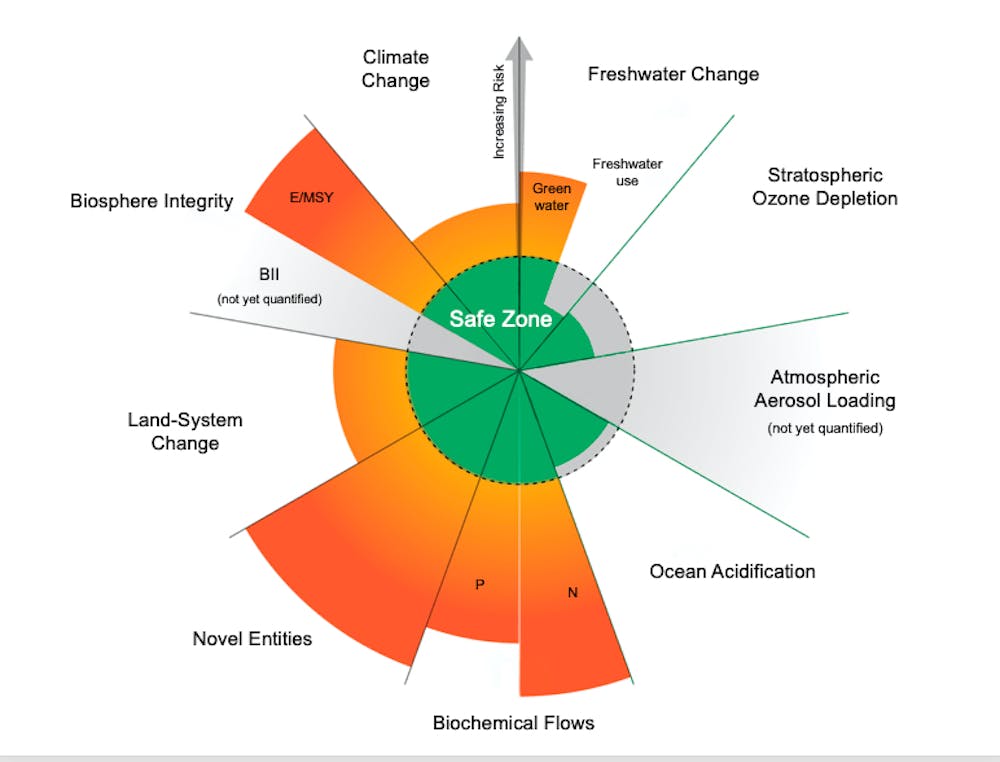 Human activity is crossing planetary boundaries. E/MSY is Extinctions/Mammal Species Years; the biogeochemical flows beyond the safe operating limits are nitrogen (N) and phosphorus (P). Some sectors are not yet quantified.
Azote for Stockholm Resilience Centre/Stockholm University, Author provided
Human activity is crossing planetary boundaries. E/MSY is Extinctions/Mammal Species Years; the biogeochemical flows beyond the safe operating limits are nitrogen (N) and phosphorus (P). Some sectors are not yet quantified.
Azote for Stockholm Resilience Centre/Stockholm University, Author provided
Since planetary boundaries have already been exceeded and low-income countries must develop, social justice demands that the rich countries undergo planned degrowth[28].
On the pathway to a sustainable civilisation, environmental protection and social justice must be addressed together. Because the rich are responsible for the biggest environmental impacts, reducing the gap between rich and poor is critical.
Universal basic services[29] such as improved public health, education, housing and transportation – and a government-funded job guarantee[30] – can achieve greater equality and give people incentives to support the transition.
Citizen action
Why would governments free themselves from state capture and discard economics ideology? Former US President Franklin D. Roosevelt once told a delegation: “OK, you have convinced me. Now get out there and make me do it!” In other words, pressure from voters is needed to make government action politically feasible.
That’s why we need citizen-based environmental, social justice, public health and peace groups to form alliances to challenge the overarching issues of state capture and flawed economics ideology.
Read more: Building the new economy: alternative strategies for the 99%[31]
References
- ^ exceeded planetary boundaries (www.stockholmresilience.org)
- ^ Palgrave Macmillan (link.springer.com)
- ^ our new book (link.springer.com)
- ^ Doomsday Clock (thebulletin.org)
- ^ Australia has overshot three planetary boundaries based on how we use land (theconversation.com)
- ^ Political scientists (books.google.com.au)
- ^ political economists (www.researchgate.net)
- ^ state capture (australiandemocracy.org.au)
- ^ subversion by the Chinese Communist Party (clivehamilton.com)
- ^ six “retired” US admirals (www.washingtonpost.com)
- ^ AUKUS (www.defence.gov.au)
- ^ under US sovereignty (www.quarterlyessay.com.au)
- ^ funding of political parties (www.abc.net.au)
- ^ revolving-door jobs (australiandemocracy.org.au)
- ^ so-called “think tanks” (independentaustralia.net)
- ^ Australian Democracy Network (australiandemocracy.org.au)
- ^ A monster rally for climate change, but divergent goals hinder the fight (theconversation.com)
- ^ failed us (newrepublic.com)
- ^ Global Financial Crisis (www.themonthly.com.au)
- ^ COVID pandemic (www.theguardian.com)
- ^ world famous economist Joseph Stiglitz (archive.vanityfair.com)
- ^ Debunking economics (archive.org)
- ^ Econobabble (www.blackincbooks.com.au)
- ^ (Zombie Economics (press.princeton.edu)
- ^ rich individuals and rich countries (theconversation.com)
- ^ Affluence is killing the planet, warn scientists (theconversation.com)
- ^ ecological economics (islandpress.org)
- ^ planned degrowth (www.jasonhickel.org)
- ^ Universal basic services (ubshub.files.wordpress.com)
- ^ job guarantee (www.fullemployment.net)
- ^ Building the new economy: alternative strategies for the 99% (theconversation.com)










