What does it mean to play sport on First Nations land? Ellen van Neerven explores sovereignty and survival on the sporting field
- Written by: Chelsea Watego, Professor of Indigenous Health; Executive Director, Carumba Institute, Queensland University of Technology
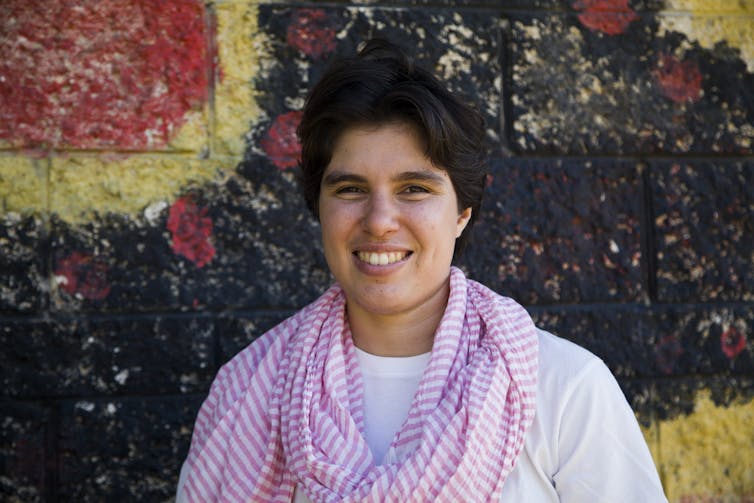
This is not a beautifully written book about decolonising Australian sport. This is an ugly book that was born of the ugly language I grew up hearing in this country. This book is me scratching my way out of the scrap of the schoolyard, just trying to stay alive.
So writes Ellen van Neerven in the introduction to their latest book, Personal Score[1]. “I have a score to settle,” they continue.
In this book, they well and truly settle the score – as a Blackfulla, an athlete and as well as a former amateur player, a self-proclaimed “armchair enthusiast of the sport we call ‘the world game’: football, sometimes called soccer in this country”.
Review: Personal Score: Sport, Culture, Identity – Ellen van Neerven (UQP)
Weaving together race, Indigeneity, sports, sexuality, gender, class and Country, they offer something no sport historian has.
Ellen shows both another side of themself and a unique perspective of the sporting field, asking: “What does it mean to play sport on First Nations land?”
Perfect Score, through a mix of memoir and poetry, cleverly invites us to question what it means to play on a “Country that is rich in story”, on a playing field that is almost always uneven for Blackfullas.
Prominent and personal Black sporting moments
The sporting field as a site has offered many iconic moments for mob, both in victory and as victims of racial violence visited upon us – from spectators, selectors, and sporting clubs and associations.
Many of us are familiar with Cathy Freeman’s gold-medal-winning lap of honour with the Aboriginal flag, or Donell Wallam’s match-winning goal on debut for the Diamonds. And with Aboriginal men’s innumerable, yet memorable, defiant stances against racism in both rugby league and Aussie rules.
Van Neerven doesn’t visit those familiar iconic moments. Instead, they take us into the private moments they’ve experienced as a soccer player and as a queer non-binary Blackfulla growing up in Brisbane.
Van Neerven reflects on the humiliating readings of their body, of being deemed too “masculine appearing”, of secondhand uniforms, and being ethnically othered. All the while, they reflect on their own relationship to the Country on which they were competing, in any given moment.
They reveal the intimate relationship our bodies have with Country, and the significance of sport as an expression of an embodied sovereignty.
Van Neerven takes us to the everydayness of the battlefield that is the sporting field: from the dressing sheds, to late-night training sessions, to their own backyard. And they share their innermost insecurities.
There’s an honesty, and an intimacy, to this text that I am not sure we deserve.
Van Neerven takes us to places I’m sure they’ve long held as memories, as trauma, as guilt and incongruities, as questions about themself. They share the concessions they’ve made, from shaving their body hair, to their silence on issues of Indigeneity.
But like the best Blackfulla texts, van Neerven reclaims their power through reclaiming their own narrative, much in the way Nicky Winmar did when he stood defiantly to claim, “I’m Black and I’m proud”.
Strategising survival on the sporting field
Now, I don’t get soccer, nor do I understand the passion people have for it – but van Neerven makes me wish I did. In reading their story, I felt perhaps I had missed something in not loving the game like they do. The iconic soccer names and events were lost on me, but van Neerven’s clever use of sporting analogies to chart their personal journey of acceptance and defiance spoke so very clearly to me as a Black reader.
Van Neerven most powerfully demonstrates their skills – as a writer and soccer player – in the chapter titled “Skills”. They poetically step us through each technique, from controlling the ball with their chest, to chipping the keeper, to taking on a player using the famous “Cruyff turn” move. Each skill is juxtaposed with the parallel life lesson it taught them: binding their chest, chipping away at self doubt, and taking on the world.
The skill of heading the ball, as taught by their father through kicking “balls at my face until it gets dark” speaks clearly to the experience of Blackfullas – whatever their sporting code – as we experience the never-ending barrage of racial violence and indignities.
Van Neerven contrasts the technique of heading the ball with how to head a player.
This is how you head a player …
If they slander your people
chin down
forehead first
all the power from your waist
 Van Neerven draws parallels between heading a soccer ball and the experience of Blackfullas.
Carlos Felipe Ramirez/Unsplash, CC BY[2]
Van Neerven draws parallels between heading a soccer ball and the experience of Blackfullas.
Carlos Felipe Ramirez/Unsplash, CC BY[2]
Perfect Score offers something crucial to Black readers whose bodies have been misread in all kinds of violent ways: a space to exist, perfectly. And van Neerven honours Black theorising throughout the text, as they make sense of survival, sovereignty and sporting fields.
It’s not just the players Van Neerven is concerned with – they take us to the people who form the backbone of local sporting clubs, protecting them in the face of floods and fires. Like Sterling McQuire, a Darumbal and South Sea Islander man, former player and groundskeeper of Pilbeam Park, home to the Nerimbera Magpies Soccer Club in Rockhampton.
He states:
here at Pilbeam Park – that might just be a little piece of ground but I’m looking after country […] Nerimbera, it’s a Darumbal name: I’m where I’m supposed to be.
With Perfect Score, van Neerven reminds us that sport, for Blackfullas – pre- and post-1788 – has never been just for recreation. It is a calling, as McQuire so powerfully points out. A responsibility that compels us to compete on and care for our people and our land: a land that also tells an ugly story of fires, floods, and colonial violence.
Though van Neerven describes her book as “ugly”, their story isn’t an ugly one. It is a beautiful story of Blackfulla love – for sport, for Country. Most importantly, it’s a story of finding love for ourselves.
Ellen van Neerven will appear Melbourne Writer’s Festival[3], where they are curator of the Big Debate: Sports vs Literature[4] on 6 May, and at Brisbane Writers Festival[5] on 11 and 13 May.
References
- ^ Personal Score (www.uqp.com.au)
- ^ CC BY (creativecommons.org)
- ^ Melbourne Writer’s Festival (mwf.com.au)
- ^ Big Debate: Sports vs Literature (mwf.com.au)
- ^ Brisbane Writers Festival (bwf.org.au)