What happens when you flush a toilet on a plane?
- Written by: Doug Drury, Professor/Head of Aviation, CQUniversity Australia
What happens when you flush a toilet on a plane? –Lily, aged 6, Harcourt

Lily this is a great question! It doesn’t work like your toilet at home, which uses gravity[1] to remove waste from our toilets into the sewer system. An aeroplane toilet uses a vacuum system[2] along with a blue chemical that cleans and removes odours every time you flush.
A smelly tank
The waste and blue cleaning fluid ends up in a storage tank under the floor, in the very back of the cargo hold of the aeroplane. With so many people on the plane using the toilets, you can imagine how big the storage tank is!
The system is designed very much like the vacuum cleaners we use around the house to remove dirt and dust from our floors. This dirt and dust ends up in a container that we empty into a garbage bin. Similarly, the aeroplane’s toilets need the vacuum pressure system to move all the waste from the toilet into the plumbing pipe that connects the toilet to the storage tank, and finally into the tank.
There is a valve on the storage tank that opens when a toilet is flushed and closes when the toilet is not in use – to prevent odours from leaving the tank. This helps to keep the smell down from so many people using the toilet during a flight. The blue chemical helps to keep the smell down as well.
Where does it go once the plane lands?
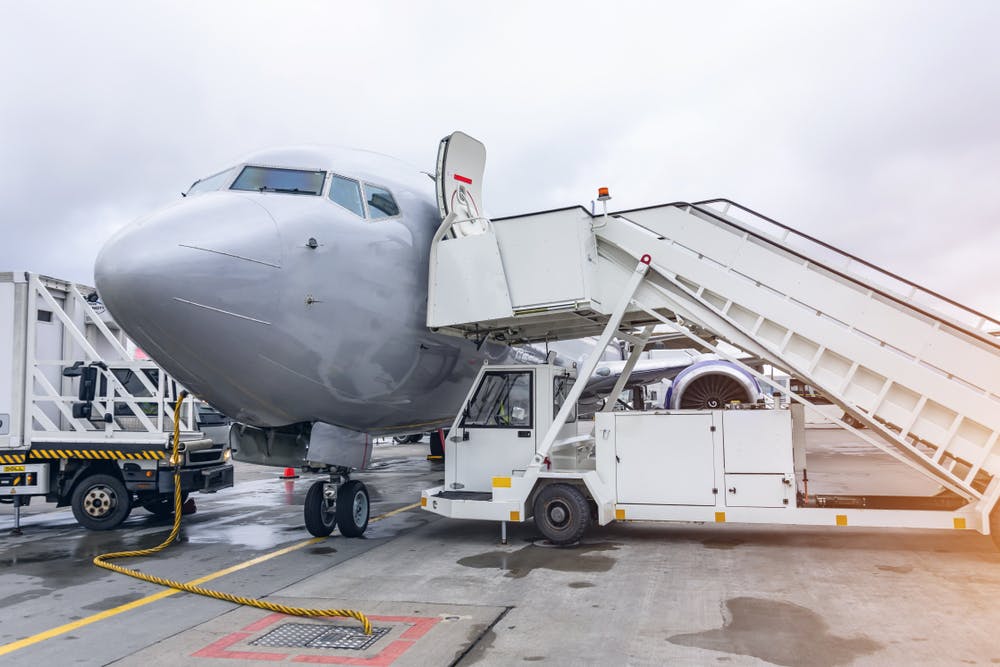
A special truck[3] comes to the aircraft after it lands and connects a hose to remove the waste and blue cleaning chemical into a storage tank on the truck. The truck plugs a hose into the airplane’s waste tank valve and removes all of the waste into the tank on the back of the truck.
The truck then takes the waste to a special area at the airport reserved for the waste from all aeroplanes, and the toilet waste is emptied into the sewer system for that airport. The training to operate the truck takes three days.
Watch out for blue ice
It has also been reported that sometimes, particularly on older planes, the valve where the waste truck connects to the aeroplane can leak a small amount[4] of the waste and blue chemical. This turns to ice as the temperature at normal cruising altitude of 30,000 feet is normally around -56℃ and the chemical turns to “blue ice[5]”. This blue ice remains attached to the plane as long as the temperature remains below freezing.
Once the aeroplane begins to descend to land at the destination airport, the blue ice begins to thaw and may even fall off. There have been several occasions reported in the news[6] where people have witnessed this flying poo[7]!
In case you were wondering, the captain of the plane doesn’t have a button to release the waste from the storage tank while the plane is flying. Any waste that might leak out of the plane would be totally accidental.
Some people do think aeroplane contrails[8] (the white lines planes sometimes leave in the sky) are either a special mind-control chemical or toilet waste. This is not true! What you are actually seeing are water vapours coming from the engine becoming ice crystals[9] – like a thin cloud in the sky.
Read more: Curious Kids: where do clouds come from and why do they have different shapes?[10]
References
- ^ which uses gravity (sciencing.com)
- ^ vacuum system (essuir.sumdu.edu.ua)
- ^ special truck (www.jstage.jst.go.jp)
- ^ can leak a small amount (en.wikipedia.org)
- ^ blue ice (www.abc.net.au)
- ^ reported in the news (timesofindia.indiatimes.com)
- ^ flying poo (www.ctvnews.ca)
- ^ aeroplane contrails (www.newscientist.com)
- ^ ice crystals (www.nationalgeographic.co.uk)
- ^ Curious Kids: where do clouds come from and why do they have different shapes? (theconversation.com)
Read more https://theconversation.com/curious-kids-what-happens-when-you-flush-a-toilet-on-a-plane-201464