Won’t somebody please think of the children? Their agency is ignored in the moral panic around drag storytime
- Written by: Sarah Austin, Lecturer in Theatre, The University of Melbourne
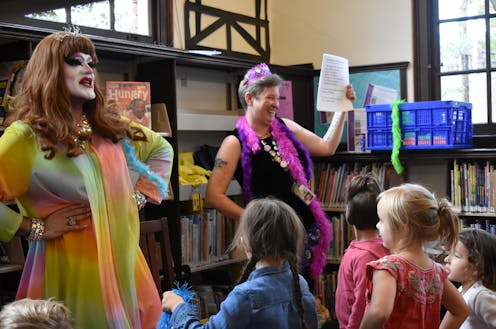
Protesters derailed[1] a Monash City Council meeting on Wednesday, demanding the cancellation of a sold-out drag storytime event at Oakleigh Library in Melbourne’s south-east.
This is just the latest in a string of drag performances for children throughout Victoria being cancelled or postponed in response to protest.
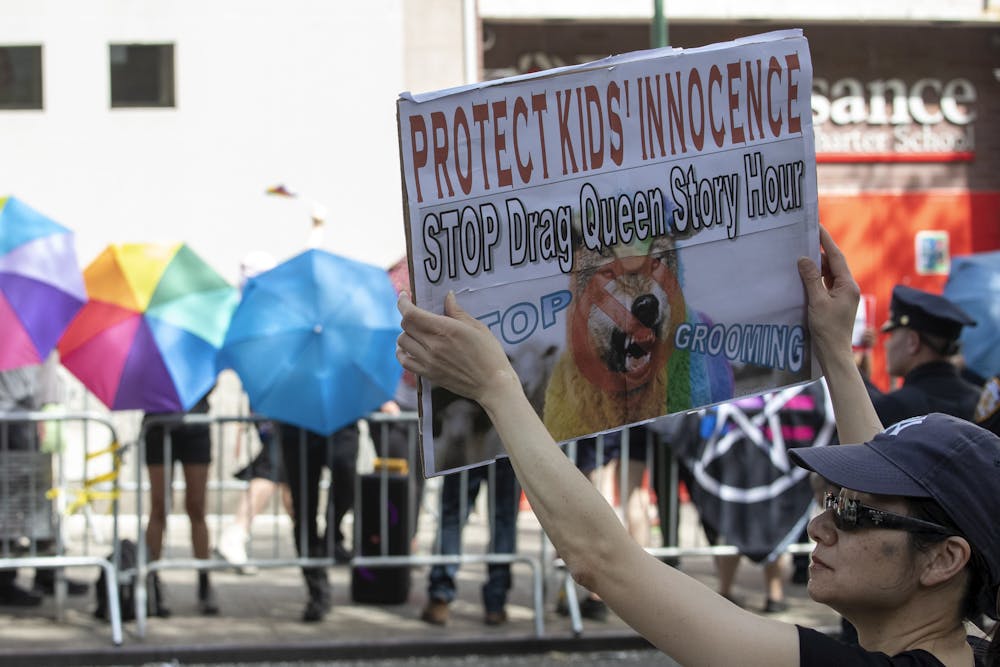
The central message of these campaigns (accompanied by varying levels of vitriol) is the same: “let our kids be kids”, “protect our children” and “hands off our kids”, while simultaneously labelling performers and supporters of the events “paedophiles”.
This is part of a global backlash. Similar protests and cancellations have happened in New Zealand[2], the United Kingdom[3] and the United States[4].
The argument in support of drag emphasises the impact on the performers at the centre of these events and queer community, arguing that the cancellation of these events is a form of discrimination and a contravention of human rights[5].
But the debate so far overlooks the agency and rights of the events’ intended audiences: children and young people.
Children as citizens
Calls to “protect the children” from drag performers and trans people assume children are, in fact, in need of safeguarding.
Such messaging is rooted in a tendency for Western societies to reduce childhood to an idyllic innocence[6], which positions children as “in need of protection” and amplifies their constant vulnerability.
Children’s vulnerability played a critical role in motivating the adoption of the United Nations’ Convention on the Rights of the Child[7] in 1989.
Since the adoption of the charter, new laws and policies have been established in Australia to criminalise forced marriage, to remove children from detention and to change the Family Law Act to better protect the rights of children.
The charter details children’s need for safeguarding and special care. But it also confirms the evolving capacity of children to assert their rights as cultural citizens and their need for freedom of thought and expression.
The power of drag and imaginative play
Drag as a form of creative, physical and spiritual expression has existed within theatre and cultural performance for millennia[8].
Drag and queer performance studies have given rise to understandings of gender as an everyday performance: from the clothes we pick out, to the products we gravitate towards in supermarkets, to our repeated physical and vocal gestures.
Drag pokes fun at the gender binary and, in doing so, it aims to blur the boundaries and expose the artificiality of gender roles.
While the success of television shows like RuPaul’s Drag Race have established drag as something more accessible and relatable for a range of audiences, the visibility of queerness that comes with drag – especially when moving outside designated queer spaces – is an apparent step too far.
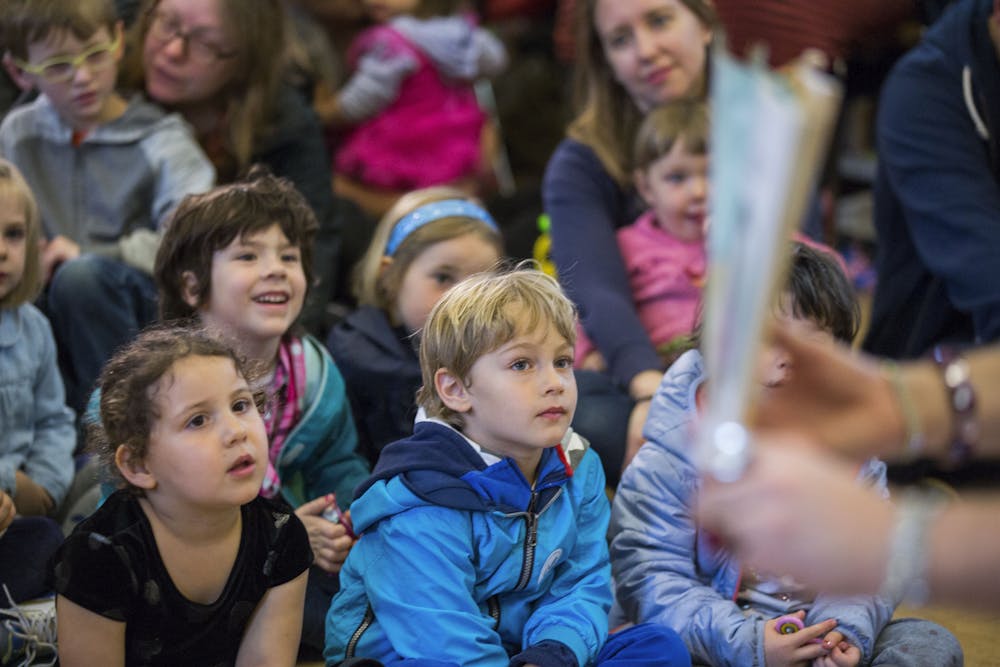 Children enjoying drag story hour.
Mary Altaffer/ AP
Children enjoying drag story hour.
Mary Altaffer/ AP
Read more: Explainer: the difference between being transgender and doing drag[9]
But the way drag asks us to question the socially constructed nature of gender offers children a vision of self-determination. You can do what you want to do, you can be who you want to be.
The potentiality within the play of drag engages the power of children’s imaginations today to conceive better tomorrows.
Philosopher David Harvey refers to moments of “free play[10]” as fertile ways of exploring and expressing a vast range of ideas, of taking on power structures and social practices, and imagining new possibilities for how we structure and support community.
The insights of the child
In post-plebiscite Australia, the success of targeted campaigns against drag-themed events for children exposes certain conditions around what are “acceptable” encounters of queer expression for children.
The all-too-familiar campaign messages that swirled around the marriage debate – “protect the sanctity of marriage”, “protect families” – are rearing up again with only a minor rhetorical shift.
The more obvious difference now is that the messages have been co-opted by extreme groups who are targeting individuals and threatening violence.
The drag storytime event at the centre of the protests at Monash City Council remains scheduled to take place at Oakleigh Library on May 19. At the time of writing, an online petition to cancel the event has 820 supporters, while another in support of the event has over 3,300 signatures.
Perhaps, then, the social temperature is not as heated towards drag performers as recent cancellations suggest. Instead, a minority of vocal and visible dissenters are dictating the rights and freedoms of the majority.
 A drag queen reads children’s stories at the drag story hour in Saint John, Canada.
Shutterstock
A drag queen reads children’s stories at the drag story hour in Saint John, Canada.
Shutterstock
The image of a drag performer in relation to a child elicits violent responses for some because it is an image of progress and change and of queer acceptance and love set against a long history of homophobia and transphobia in this country.
But there are two figures in this image and one has been kept silent.
In debating rights and agency, perhaps it’s time to ask and be guided by the insights of the child.
References
- ^ Protesters derailed (www.news.com.au)
- ^ New Zealand (www.nzherald.co.nz)
- ^ United Kingdom (www.bbc.com)
- ^ United States (www.theguardian.com)
- ^ discrimination and a contravention of human rights (fortune.com)
- ^ idyllic innocence (www.cambridge.org)
- ^ Convention on the Rights of the Child (www.ohchr.org)
- ^ for millennia (www.grunge.com)
- ^ Explainer: the difference between being transgender and doing drag (theconversation.com)
- ^ free play (academic.oup.com)