Beneath the Trump circus, American democracy faces up to a vital challenge
- Written by: Emma Shortis, Lecturer, RMIT University
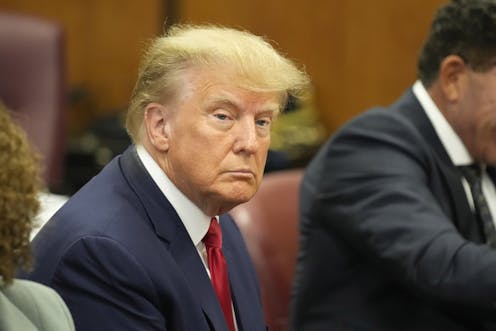
Former US President Donald J Trump has been charged with 34 felony counts in New York. In the words of Manhattan district attorney Alvin Bragg[1], Trump is accused of making “34 false statements”, themselves “made to cover up other crimes”. Those crimes include a “conspiracy to promote a candidacy by unlawful means” and to “scheme with others to influence the 2016 presidential election”.
The charges in New York add to the network of cases[2] focused on Trump’s efforts to subvert and undermine democratic processes in the United States, now stretching all the way back to his 2016 candidacy and across the duration of his presidential administration.
The charges shouldn’t really come as a surprise. As recently as December 2022, Trump called for the “termination[3]” of the Constitution so that he could return to power. The former president has always been brazen in his contempt for the rule of law.
But it is genuinely, historically significant that a former president is facing criminal charges and trial. This is an enormous shift[4] in the norms and standards that have governed American politics for decades.
Trump’s arraignment proceeded as expected: he arrived at court, was processed, and pleaded not guilty to those 34 charges. Amid a media frenzy, he left court and flew home to safer ground in Florida. At Mar-a-Lago, he made a standard stump speech listing his grievances and dramatically mischaracterising the investigations into his conduct.
As Trump’s indictment and arraignment have played out, he and his supporters have employed now distressingly familiar techniques for inciting their followers. Last week, Trump threatened[5] “death and destruction”, posting a picture of himself wielding a baseball bat next to a picture of the Manhattan district attorney’s head. His son, Donald Trump Junior, posted a picture of the daughter of Judge Juan Merchan[6]. This week, in the shadow of yet another school shooting in Nashville, Fox News host Tucker Carlson[7] warned viewers that the indictment meant it was “probably not the best time to give up your AR-15”.
Read more: Trump has changed America by making everything about politics, and politics all about himself[8]
Posts and statements like these can only be read for what they are: clear attempts to foment further racist violence against anyone cast as an enemy.
Such calls fit into a pattern of incitement that has led to violence in the past and will likely do so again. Trump and his supporters have given no indication that they are concerned about inciting unrest; they are actively and knowingly encouraging it.
It is more than likely that they will continue to do so, using events like the arraignment today to double down on conspiracy theories. And they will have plenty of chances: the trial in New York could drag on, potentially, for over a year[9], and indictments in other state and federal investigations now seem more likely.
As I have written before[10], political violence is a feature, not a bug, of American politics. That’s partly why widely held perceptions of impending Civil War are so concerning; not necessarily because Civil War is likely, but because growing certainty that it is coming can give further license[11] to violence now perceived as inevitable anyway.
Read more: What does Trump's indictment mean for his political future – and the strength of US democracy?[12]
Much of the coverage and analysis of American politics will describe the nation as “divided” or “polarised”. But polarisation isn’t really an accurate way to characterise the state of US politics today. Polarisation implies a kind of equality – that sides are divided into equal but opposite extremes, willing to take the same measures to win power; that there are “two sides” or that “both sides” are as dangerous as each other. This is also sometimes described as the “horseshoe theory[13]” of politics.
In the modern United States, the evidence does not support this framing. One side is facing over 30 felony charges, in what is likely only the start of an impending wave of indictments across state and federal investigations. Those investigations, collectively, paint a damning picture of a conspiracy to subvert the world’s most important democracy. In the United States, the “other side” – which is far from immune from critique – is at least attempting to get on with the business of democratically elected government.
The focus instead has of course been on the Trump media circus, now very familiar to us all. The black, armoured SUVs crawling across New York City streets; “plane watch”; the t-shirts; the farcical, gold-tinted press conferences. The mainstream press may well be falling, once again, into the traps Trump has laid so carefully.
But it’s also much more than that, this time around. How this all plays out will be yet another litmus test for the strength of American democracy. And it’s an essential one: simply put, the United States can not, must not, fail this test. The consequences of failure aren’t just domestic. Viewed from afar, we might be tempted to dismiss this as just more hijinks in the compelling but distant drama of American politics. But the outcome will affect us all. So we will – we must – keep watching.
References
- ^ Manhattan district attorney Alvin Bragg (www.politico.com)
- ^ network of cases (www.nytimes.com)
- ^ termination (edition.cnn.com)
- ^ enormous shift (theconversation.com)
- ^ threatened (www.news.com.au)
- ^ daughter of Judge Juan Merchan (newrepublic.com)
- ^ Tucker Carlson (newrepublic.com)
- ^ Trump has changed America by making everything about politics, and politics all about himself (theconversation.com)
- ^ over a year (www.aljazeera.com)
- ^ written before (theconversation.com)
- ^ give further license (www.theatlantic.com)
- ^ What does Trump's indictment mean for his political future – and the strength of US democracy? (theconversation.com)
- ^ horseshoe theory (theconversation.com)