China’s spiritual market is going digital
- Written by: Haoyang Zhai, PhD Candidate, The University of Melbourne

Since its inception in 1921, the Chinese Communist Party (CCP) has officially promoted an atheist and materialist ideology[1]. But belief systems in China are making a comeback – and this comeback is largely happening online.
From traditional Taoist rituals conducted via video call to Western-influenced practices like online tarot reading, the digital spiritual market is growing and new online cultures are emerging.
China has a diverse spiritual landscape with five officially recognised religions[2] including Taoism, Buddhism and Islam, as well as various folk belief systems.
Spiritual practices have evolved with political, social and cultural changes throughout China’s history. The origins of Chinese spirituality can be found in a variety of sources like ancestor worship[3], Heavenly worship[4], and traditional philosophies[5], shaped by the nation’s multi-ethnic nature[6] and cultural integration[7].
Now, China’s spiritual landscape is undergoing a transformation in the digital age.
Read more: Finding your essential self: the ancient philosophy of Zhuangzi explained[8]
Diversity and evolution
Identifying this increasing spiritual trend through official government data is challenging.
Many Chinese people practice spirituality without officially identifying with a religion or belief system. This is because most Chinese have learned practical ways of religion[9], without necessarily being taught these as part of a specific set of beliefs.
One common practice is burning incense money[10], believed to provide financial assistance to spirits in the afterlife.
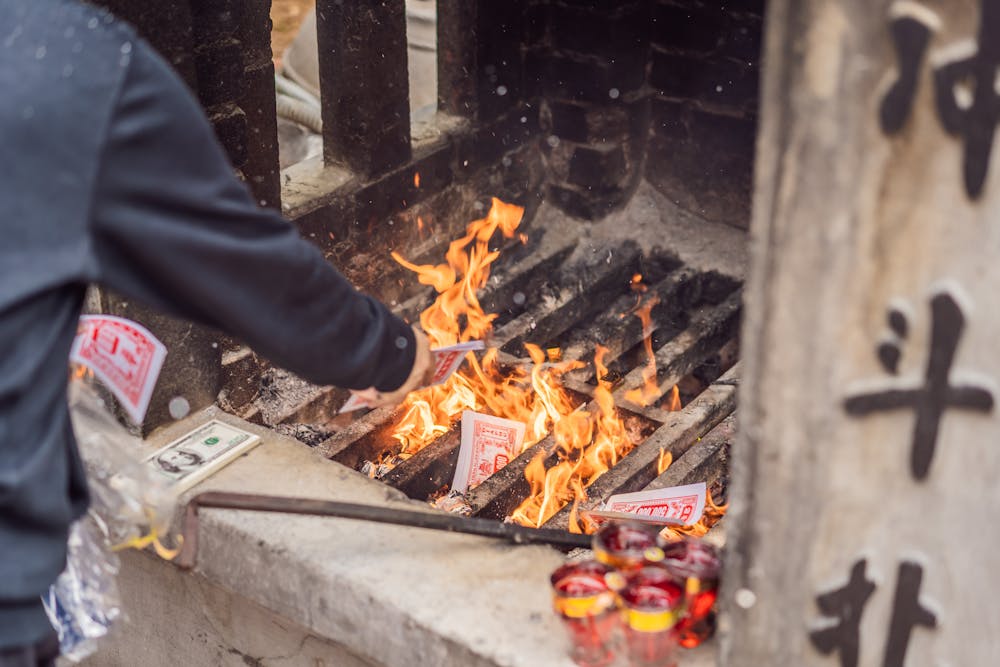
The growing popularity of online fortune-telling applications such as Cece[11], and spiritual influencers on social media, such as the astrologist Uncle Tongtao[12] with millions of followers, provide a glimpse into the diverse and vibrant spiritual landscape in modern China.
Online spiritual practice is associated[13] with youth culture, and the shift towards digital spaces is largely due to the growth of social media in China[14].
Before social media, online religions were limited to static websites with little interaction[15]. Now, social media platforms allow users to connect and engage with others who share similar spiritual interests and beliefs.
This has also enabled practitioners to reach a wider audience[16].
New practices
Currently, China’s online spirituality market comprises both old and new, indigenous and foreign practices.
Online spiritual services like Taoist talismans[17] and virtual rituals are making more money than traditional temple practices.
As part of my PhD research, Taoist Luosong* told me how 300 rituals were performed for people in the temple during Zhongyuan Jie (Hungry Ghost Festival). During the same time frame, they received more than 2,700 orders on WeChat.
In the past, Taoists would perform lengthy rituals in temple that required worshippers to kneel and bow.
Today, Taoists can offer their services more conveniently by sharing recordings or performing rituals via video call.
Tarot divination[18] is popular among young people. Yanzi*, a Buddhist and tarot reader, provides advice and guidance online for people’s emotions, career and education.
Yanzi explained her service process to me. Texting on WeChat, Yanzi asks her clients what questions they would like to ask. She then texts back a picture of the tarot spread[19] with an interpretation and report.
 Tarot readings can now be shared online.
Shutterstock
Tarot readings can now be shared online.
Shutterstock
The online divination market in China has created new and unique businesses such as “fortune-telling outsourcing”. Some social media fortunetellers secretly outsource divination work to religious personnel in traditional institutions such as Taoist temples via agents.
Luosong introduced this business to me and showed me his chat with an agent who forwarded birth time and other information of the seeker to him for a financial fortune reading.
Regulation and self-censorship
Despite the rising popularity of spirituality in China, practitioners of both officially recognised and folk belief systems face strict censorship and moderation[20].
The Chinese government tightly controls online content related to religion and spirituality. Websites and applications that display such content must clearly label it as “entertainment only”.
Online platforms have to actively monitor and remove[21] any material deemed to be in violation of government laws and regulations.
As a result, some spiritual practitioners self-censor[22] their discussions around sensitive topics to avoid being flagged.
This could mean replacing sensitive keywords in text content and using heavy filters in video content. They also avoid posting on specific days such as March 15[23], a day for cracking down on fraudulent practices. Such measures are taken to prevent their services or products being labelled as fraudulent or in violation of the law.
While there is a tension between the diversified spiritual practices and mainstream ideology in China, the flourishing spiritual market continues to highlight the ongoing evolution of China’s spiritual landscape in the digital era.
Read more: There's a religious revival going on in China -- under the constant watch of the Communist Party[24]
*Names have been changed.
References
- ^ an atheist and materialist ideology (www.cfr.org)
- ^ officially recognised religions (www.cfr.org)
- ^ ancestor worship (www.taylorfrancis.com)
- ^ Heavenly worship (www.degruyter.com)
- ^ traditional philosophies (culturalatlas.sbs.com.au)
- ^ the nation’s multi-ethnic nature (academic.oup.com)
- ^ cultural integration (global.chinadaily.com.cn)
- ^ Finding your essential self: the ancient philosophy of Zhuangzi explained (theconversation.com)
- ^ practical ways of religion (www.tandfonline.com)
- ^ burning incense money (www.jstor.org)
- ^ Cece (pitchbook.com)
- ^ Uncle Tongtao (walkthechat.com)
- ^ is associated (chinamktginsights.com)
- ^ growth of social media in China (www.cnnic.com.cn)
- ^ static websites with little interaction (www.tandfonline.com)
- ^ wider audience (academic.oup.com)
- ^ Taoist talismans (www.bbc.co.uk)
- ^ Tarot divination (www.sixthtone.com)
- ^ tarot spread (www.womenshealthmag.com)
- ^ strict censorship and moderation (www.voanews.com)
- ^ monitor and remove (www.abc.net.au)
- ^ self-censor (www.gsb.stanford.edu)
- ^ March 15 (www.reuters.com)
- ^ There's a religious revival going on in China -- under the constant watch of the Communist Party (theconversation.com)