Israel is facing twin existential crises – what is Benjamin Netanyahu doing to solve them?
- Written by: Ran Porat, Affiliate Researcher, The Australian Centre for Jewish Civilisation, Monash University
Israel is facing one of the most serious crises in its history. And it could be the biggest test yet for Benjamin “Bibi” Netanyahu, just months after he resurrected his political career by returning to the prime minister’s office.
Netanyahu, the country’s longest-serving prime minister, had been ousted from power in 2021, but launched a political comeback last year and scraped together enough support to form a coalition government following November elections[1]. The coalition is made up of Netanyahu’s center-right Likud party, along with a group of far-right and ultra-orthodox religious parties.
It is considered the most right-wing government in Israel’s history. Moreover, these politicians are highly motivated to use their time in power to make swift and dramatic changes within Israel and to its policy on the Palestinians.
Initially, Netanyahu successfully rebranded himself as the “responsible adult” who would keep the radicals in his government in check. But his government is now exacerbating deep divisions in Israeli society and threatening the very essence of Israel as a liberal democracy.
At the same time, the conflict with the Palestinians may be heading towards an eruption.
Stripping the judiciary of power
One of the main issues driving public anger is the government’s proposed overhaul of the judicial system[2].
At the heart of this plan is a recalibration[3] of the power balance between the judiciary (with the Supreme Court as its flagship) and the executive and legislature.
Key aspects of the reform include:
giving politicians almost complete power over the selection process for judges
dramatically reducing judicial review[4] powers over laws and administrative decisions
allowing the Knesset (parliament) to overrule court decisions with a simple majority
turning the attorney-general and other government legal advisers into powerless consultants.
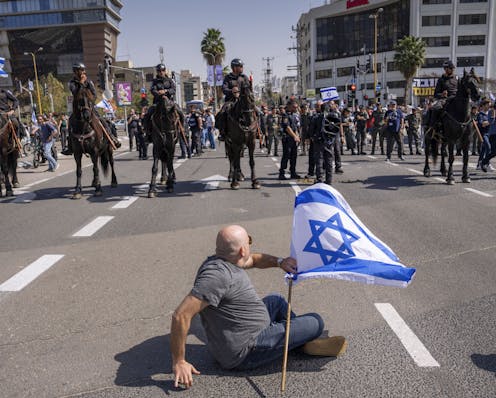
A massive backlash erupted immediately. For weeks now, hundreds of thousands of Israelis[5] have taken to the streets to protest against what they view as a constitutional revolution that would diminish Israel’s democracy.
Absent a basic document protecting human rights (Israel has no written Constitution), the Supreme Court is considered by many as the last bastion protecting the civil rights of citizens (and non-citizens, including Palestinians) against government actions and laws.
In addition, Netanyahu’s rivals see the proposed reforms as a tool the prime minister is using to try to undermine his upcoming corruption trial on charges of bribery, fraud and breach of trust.
Read more: Israel enters a dangerous period – public protests swell over Netanyahu's plan to limit the power of the Israeli Supreme Court[6]
The domestic crisis is hurting Israel’s economy. The Israeli shekel is weakening as investors and leading high-tech entrepreneurs pull their funds out of Israel[7], fearing a compromised court system and rule of law.
Top US officials have expressed deep reservations[8] about the scope and speed of the reform proposals.
Meanwhile, a divided, demoralised opposition has been reinvigorated by the huge wave of protests. Calls for civil disobedience and clashes with the police have been met with stark warnings from both sides, urging the government to compromise before public anger leads to more serious unrest.
Protesters and the police clashed this week on what the demonstrators called a “day of disruption”. National Security Minister Itamar Ben Gvir, leader of the far-right, extremist Jewish Power Party[9], has told police there should be “zero tolerance towards anarchists[10]”.
Violence in the West Bank
In the West Bank, increasing lawlessness[11] is causing explosive instability and terror.
On the Palestinian side, the weak and corrupt Palestinian Authority is increasingly unable to govern, especially in the northern Shomron area, from Jenin to Nablus.
The vacuum is being filled by armed local militant groups (such as the notorious “Lion’s den[12]”) backed[13] by the Gaza-based militant organisations Hamas and Palestinian Islamic Jihad.
These groups and other militants are supported by the local population, fuelled by hateful incitement against Jews, especially on social media, and by Palestinian Authority payments[14] to prisoners and families of “martyrs” that critics say reward attacks on Israelis.
Facing a rise in terror attacks and the failure of the Palestinian Authority to stop it, the Israeli army has been increasingly entering West Bank cities itself.
The tally is gloomy for both sides – 30 Israelis and 146 Palestinians (most of them militants, according to the army) died in terror attacks, military raids and clashes[15] between the sides in 2022. Two months into 2023[16], more than 60 Palestinians and 14 Israelis have lost their lives.
On the Israeli side, a small number of Jewish settlers[17] in the West Bank are increasingly wreaking havoc.
The ideologically charged “hilltop youth[18]” – a fringe group of violent vigilantes among the estimated 700,000 total settlers – are attacking Palestinians, vandalising Palestinian property and destroying crops.
These rampages have been going on for years, but Israel has not made a serious attempt to stop them.
The violence has surged again[19] in recent days in response to the killings of three Israelis[20] by Palestinian gunmen. Right-wing politicians stood idly by and some even cheered on the violent vigilantes[21].
Illegal outposts in the West Bank are often, though not always, retroactively approved by right-wing governments. And the current tensions have certainly been exacerbated by the current government, with the hilltop youth potentially feeling more emboldened[22] by its ideological makeup.
Can Netanyahu return Israel to stability?
Despair and anger are rife, yet compromise looks like a non-starter on both fronts.
Setting the tone are Ben Gvir and his ally, Treasurer Bezalel Smotrich. Both advocate for tougher measures against the anti-reform protesters and Palestinian militants, including the passage of a new bill[23] that would allow courts to impose the death penalty for terror attacks against Israeli citizens.
Netanyahu is currently facing his most serious leadership challenge ever. It is unclear if he is able, or even willing, to find a way to return Israel to the stability that was once a hallmark of his previous terms in office.
After another day of protests, he tried to appeal for calm this week, calling on Israelis to “stop the violence.” But even this was met with outrage from his opponents, after he drew parallels[24] between the protest movement and settler violence.
At this stage, Netanyahu is committed to keeping his government alive[25] more than standing up to Ben Gvir or Smotrich. However, the peaking violence in recent days may finally be starting to bring new initiatives[26] to reach a compromise[27] within the government.
Israeli democracy is strong, but this is a big test for its vitality.
Read more: Israel's new hard-line government has made headlines – the bigger demographic changes that caused it, not so much[28]
References
- ^ following November elections (lens.monash.edu)
- ^ proposed overhaul of the judicial system (lens.monash.edu)
- ^ recalibration (www.theguardian.com)
- ^ judicial review (www.armstronglegal.com.au)
- ^ hundreds of thousands of Israelis (edition.cnn.com)
- ^ Israel enters a dangerous period – public protests swell over Netanyahu's plan to limit the power of the Israeli Supreme Court (theconversation.com)
- ^ pull their funds out of Israel (www.wsj.com)
- ^ have expressed deep reservations (www.jpost.com)
- ^ leader of the far-right, extremist Jewish Power Party (www.nytimes.com)
- ^ zero tolerance towards anarchists (www.timesofisrael.com)
- ^ lawlessness (lens.monash.edu)
- ^ Lion’s den (www.aljazeera.com)
- ^ backed (apnews.com)
- ^ payments (www.nytimes.com)
- ^ died in terror attacks, military raids and clashes (www.washingtonpost.com)
- ^ 2023 (www.bbc.com)
- ^ a small number of Jewish settlers (apnews.com)
- ^ hilltop youth (www.washingtonpost.com)
- ^ violence has surged again (www.haaretz.com)
- ^ killings of three Israelis (www.bbc.com)
- ^ cheered on the violent vigilantes (www.haaretz.com)
- ^ emboldened (www.washingtonpost.com)
- ^ new bill (www.timesofisrael.com)
- ^ he drew parallels (www.timesofisrael.com)
- ^ keeping his government alive (www.timesofisrael.com)
- ^ initiatives (www.jpost.com)
- ^ compromise (www.timesofisrael.com)
- ^ Israel's new hard-line government has made headlines – the bigger demographic changes that caused it, not so much (theconversation.com)