where do cold sores come from and what can you do about them?
- Written by: Christian Moro, Associate Professor of Science & Medicine, Bond University
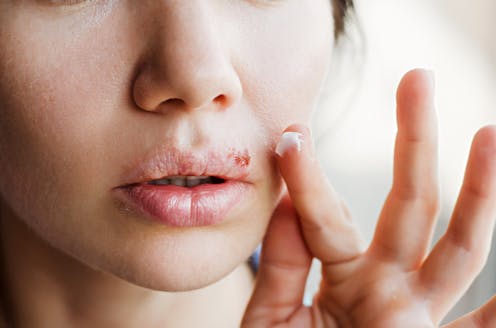
Three quarters of Australians[1] are living with herpes simplex virus type 1 (HSV-1[2]), an infection which causes cold sores. These tiny fluid-filled lesions[3] and blisters sit along the mouth and nose area.
This is not the same virus that causes genital herpes, HSV-2[4], which is present in about 13% of people worldwide.
In most cases, the body is quite good at suppressing HSV-1 with help from the immune system. This means that not everyone with the virus knows they have it.
However, sometimes the virus can overwhelm the system and present as a cold sore, which is a highly contagious sore on the mouth.
Read more: What causes dry lips, and how can you treat them? Does lip balm actually help?[5]
Always at the worst time
Around 92% of us have viruses inside our systems from past infections[6]. For most people, these are latent viruses[7], which do not cause any concerns until reactivated.
While we can keep these viruses from reactivating[8] and causing any issues, most of the time, exhaustion, physical exertion, as well as psychological stress, can suppress[9] elements of the immune system. This leaves our body weakened, and opens the door for viruses.
Common reactivation of latent viruses include those that cause glandular fever[10], as well as chicken pox[11]/shingles[12].
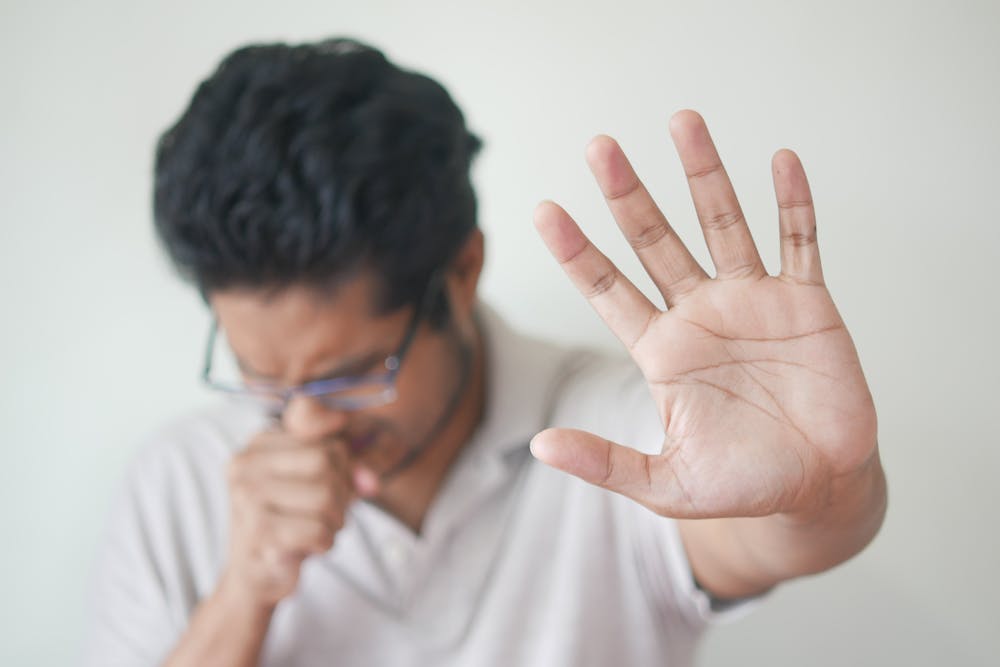
When HSV-1 reactivates, it may present as cold sores.
This usually starts as a tingling, itching, or burning sensation around the mouth, lips, or nose. Fluid-filled blisters will subsequently form, which dry out and leave a crust after about a week. The scab then flakes off and will typically heal within one to two weeks[15] without leaving a scar.
Along with cold sores, other common symptoms of an active HSV-1 infection can include fever, nausea, headaches, sore throat, or swollen glands.
Read more: Curious Kids: how do scabs form?[16]
Cold sores can get anyone
Viruses can be spread quickly and easily. As such, if we do have an infection, preventing its spread is important.
Babies and children are particularly vulnerable. Around 38%[17] of mothers kiss their babies on the lips, and 14% share a spoon with them. These practices can spread HSV-1, particulary in the first four weeks after birth[18], when a baby has the weakest immune defences.
As a general rule, to prevent spreading any infections, always avoid kissing a baby on the lips.
Sun exposure[19] and cool weather encourage cold sores to appear, as the conditions can dry out the lips and damage the skin, creating a favourable environment for the virus.
Some treatments are available. If you are having trouble with cold sores, you can ask a doctor or pharmacist to outline some options for antiviral[20] medicines. These impact the virus’ ability to reactivate, replicate, and divide.
Read more: Why are my hands and feet always cold? And when should I be worried?[21]
So I have a cold sore, what should I do?
Unfortunately, there is no cure for the underlying virus. But if you do have a cold sore, here are some things you can do to help:
- keep your hands clean and don’t touch the sores
- avoid spicy[22] or acidic foods to minimise burning sensations
- seek over-the-counter or prescription antiviral[23] tablets or creams
- remain hydrated
- wear sunscreen and avoid direct sun exposure
- cover-up during cold[24] or dry weather
- avoid kissing or sharing anything with your saliva to minimise spreading.
If you are concerned about your cold sores (for example, if the gums become swollen, the wound weeps pus, or you get a fever[25]), seek advice from your family doctor.
While many people carry HSV-1, not everyone will get cold sores. For those who do, looking after yourself is key. Eating[26] healthy, sleeping well[27], and noticing when our bodies are telling us to take a step back and relax goes a long way towards keeping latent viruses at bay.
Read more: What position should I sleep in, and is there a ‘right’ way to sleep?[28]
References
- ^ Australians (conditions.health.qld.gov.au)
- ^ HSV-1 (www.who.int)
- ^ lesions (www.mayoclinic.org)
- ^ HSV-2 (www.who.int)
- ^ What causes dry lips, and how can you treat them? Does lip balm actually help? (theconversation.com)
- ^ infections (bmcbiol.biomedcentral.com)
- ^ latent viruses (www.ncbi.nlm.nih.gov)
- ^ reactivating (www.ncbi.nlm.nih.gov)
- ^ suppress (www.sciencedirect.com)
- ^ glandular fever (www.betterhealth.vic.gov.au)
- ^ chicken pox (pubmed.ncbi.nlm.nih.gov)
- ^ shingles (www.mayoclinic.org)
- ^ Unsplash (unsplash.com)
- ^ CC BY (creativecommons.org)
- ^ two weeks (www.ncbi.nlm.nih.gov)
- ^ Curious Kids: how do scabs form? (theconversation.com)
- ^ 38% (www.ncbi.nlm.nih.gov)
- ^ after birth (www.nhs.uk)
- ^ exposure (www.sciencedirect.com)
- ^ antiviral (linkinghub.elsevier.com)
- ^ Why are my hands and feet always cold? And when should I be worried? (theconversation.com)
- ^ spicy (theconversation.com)
- ^ antiviral (linkinghub.elsevier.com)
- ^ cold (theconversation.com)
- ^ fever (www.youtube.com)
- ^ Eating (synapse.koreamed.org)
- ^ sleeping well (theconversation.com)
- ^ What position should I sleep in, and is there a ‘right’ way to sleep? (theconversation.com)