The Times Australia
Google AI
The Times World News

.

Covering your baby's pram with a dry cloth can increase the temperature by almost 4 degrees. Here's what to do instead

  • Written by James Smallcombe, Post-doctoral Research Associate, University of Sydney
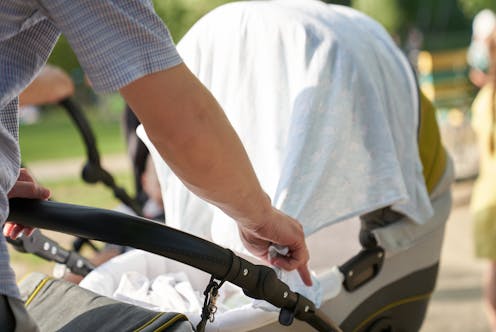
Covering your baby's pram with a dry cloth can increase the temperature by almost 4 degrees. Here's what to do instead

We like to think of babies as tiny versions of ourselves. But babies aren’t simply miniature adults, especially when it comes to coping in the heat. Babies are at greater risk of overheating and need different cooling strategies to those that work for adults.

Parents have long covered prams and strollers with cloth to shade the carriage from the hot sun. However, our recent study[1] showed[2] this can substantially increase temperatures inside the stroller.

After just 20 minutes – the time it takes to go to the shop or drop your child off at daycare – the stroller carriage was 3.7℃ hotter than outside when draped with a dry flannelette cloth and 2.6℃ when draped with dry muslin.

Attaching a battery-operated fan to the stroller wasn’t very effective either at reducing the stroller temperature, cooling the carriage by just 0.1℃ relative to outside.

But dampening the cloth can reduce the temperature in the carriage.

Read more: Top 10 tips to keep cool this summer while protecting your health and your budget[3]

Why are babies vulnerable in the heat?

There are three main reasons why babies might struggle more in hot weather compared to adults.

First, their body shape is very different. Infants have a much greater area of skin surface available to exchange heat with the surrounding environment, compared to their body mass. This means in very hot conditions their body temperature can warm up at a much faster rate.

Woman pushes pram with muslin cloth
Babies can’t regulate their own temperature. Shutterstock[4]

Second, infants can’t sweat as much as mum or dad and are therefore less able to cool down by sweat evaporation. This is the main physiological disadvantage that places them at greater risk in hot weather.

Finally – and possibly most importantly – babies are almost entirely dependent on someone else to keep them cool. Other than crying, babies can’t communicate that they are too hot. On a hot day, it is the parents who have to check for signs of distress, choose suitable clothing, and make sure shade is found during the hottest part of the day (normally noon to 3pm). Babies can’t do any of this for themselves.

Read more: Curious Kids: What happens in the body when we sweat?[5]

So, what can be done to keep baby strollers cool?

In our same study, we also showed some strategies are really effective at cooling strollers down even on hot and sunny days.

Loosely draping a damp muslin cloth over the stroller reduced the temperature inside the stroller by 3℃.

This cooling effect was even greater when a damp cloth was combined with a clip-on fan, reducing the stroller temperature by 4.7℃ compared with outside.

This method harnesses the power of evaporation. Just like we lose body heat when sweat evaporates from our skin, the evaporation of water from the damp cloth removes heat from the air inside the stroller and lowers the temperature inside.

Using a spray bottle to regularly top-up the water in the cloth every 15-20 minutes will prevent it drying out and increase the amount of time this method will provide cool relief.

Author provided How else can I protect my baby from the heat? Minimise the time spent outside with your infant during hot weather – get from A to B as quickly as possible. Babies should never be left in a stationary stroller in the sun (even if covered with a damp cloth) as this reduces air movement through the stroller and increases the speed at which it heats up. Any time infants or children are exposed to the heat, it’s important to keep them well hydrated. Drinking water or breastfeeds should be offered frequently. Infants will need more fluids during hot weather. Baby laughs after drinking water from a bottle Make sure babies are well hydrated when it’s hot. Shutterstock[6] It’s also important to regularly check infants for signs of heat illness. The most common are: being overly warm to touch hot, red and dry skin irritability looking generally unwell and/or lethargic. If your baby is showing signs of heat illness, find cool relief immediately and seek medical help. Read more: Evacuating with a baby? Here's what to put in your emergency kit[7] References^ study (pubmed.ncbi.nlm.nih.gov)^ showed (www.sydney.edu.au)^ Top 10 tips to keep cool this summer while protecting your health and your budget (theconversation.com)^ Shutterstock (www.shutterstock.com)^ Curious Kids: What happens in the body when we sweat? (theconversation.com)^ Shutterstock (www.shutterstock.com)^ Evacuating with a baby? Here's what to put in your emergency kit (theconversation.com)

Read more https://theconversation.com/covering-your-babys-pram-with-a-dry-cloth-can-increase-the-temperature-by-almost-4-degrees-heres-what-to-do-instead-199099

Times Magazine

With Nvidia’s second-best AI chips headed for China, the US shifts priorities from security to trade

This week, US President Donald Trump approved previously banned exports[1] of Nvidia’s powerful ...

Navman MiVue™ True 4K PRO Surround honest review

If you drive a car, you should have a dashcam. Need convincing? All I ask that you do is search fo...

Australia’s supercomputers are falling behind – and it’s hurting our ability to adapt to climate change

As Earth continues to warm, Australia faces some important decisions. For example, where shou...

Australia’s electric vehicle surge — EVs and hybrids hit record levels

Australians are increasingly embracing electric and hybrid cars, with 2025 shaping up as the str...

Tim Ayres on the AI rollout’s looming ‘bumps and glitches’

The federal government released its National AI Strategy[1] this week, confirming it has dropped...

Seven in Ten Australian Workers Say Employers Are Failing to Prepare Them for AI Future

As artificial intelligence (AI) accelerates across industries, a growing number of Australian work...

The Times Features

I’m heading overseas. Do I really need travel vaccines?

Australia is in its busiest month[1] for short-term overseas travel. And there are so many thi...

Mint Payments partners with Zip Co to add flexible payment options for travel merchants

Mint Payments, Australia's leading travel payments specialist, today announced a partnership with ...

When Holiday Small Talk Hurts Inclusion at Work

Dr. Tatiana Andreeva, Associate Professor in Management and Organisational Behaviour, Maynooth U...

Human Rights Day: The Right to Shelter Isn’t Optional

It is World Human Rights Day this week. Across Australia, politicians read declarations and clai...

In awkward timing, government ends energy rebate as it defends Wells’ spendathon

There are two glaring lessons for politicians from the Anika Wells’ entitlements affair. First...

Australia’s Coffee Culture Faces an Afternoon Rethink as New Research Reveals a Surprising Blind Spot

Australia’s celebrated coffee culture may be world‑class in the morning, but new research* sugge...

Reflections invests almost $1 million in Tumut River park to boost regional tourism

Reflections Holidays, the largest adventure holiday park group in New South Wales, has launched ...

Groundbreaking Trial: Fish Oil Slashes Heart Complications in Dialysis Patients

A significant development for patients undergoing dialysis for kidney failure—a group with an except...

Worried after sunscreen recalls? Here’s how to choose a safe one

Most of us know sunscreen is a key way[1] to protect areas of our skin not easily covered by c...