Review bombing is about power, politics and revenge
- Written by: Claire Whitley, PhD Candidate, Flinders University
In the video game turned HBO adaptation The Last of Us, human survivors must contend with hordes of zombie-like “infected” called “clickers” in a battle for survival. Now, the show itself is facing a similar problem: disgruntled fans of the adapted video game are using the simple act of “clicking” to sabotage the show’s success.
The Last of Us has become the latest in a growing number of media franchises to fall victim to the nefarious fan practice of “review bombing”. On the surface, it seems an unlikely target. So why did it attract the ire of its own fans?
Spoilers ahead for The Last of Us episode three.
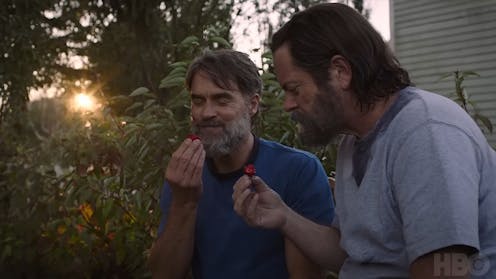
The third episode of HBO’s adaptation of the popular video game was met with near-universal critical acclaim when it was released, with particular praise reserved for its moving depiction of the relationship between Bill (Nick Offerman) and Frank (Murray Bartlett). Although minor characters in the game, The Last of Us devoted much of its feature-length episode to developing Bill and Frank’s romance through a collection of intimate moments spanning their first meeting to their joint suicide.
The result was lauded as “magical[1]” and “masterful[2]” television.
Elsewhere on the internet, however, angry fans were mobilising to ensure their voices were heard through an increasingly common practice called review bombing.
What is review bombing?
Review bombing occurs when scores of like-minded internet users flock to aggregator sites like Rotten Tomatoes[3] and Metacritic[4] to leave low ratings and negative reviews. Often, these attacks are coordinated, and one person may use multiple accounts to further skew numbers.
Similar tactics are also used to organise mass disliking or downvoting on sites like YouTube. Up until 2021[5], the most disliked video on YouTube was a dubious honour bestowed upon all manner[6] of content[7], including overly catchy children’s songs[8], Justin Bieber’s divisive song Baby[9], and controversial movie trailers that often featured women or underrepresented groups in major roles, as in Ghostbusters: Answer the Call.
The trailer for Ghostbusters: Answer the Call became the most-disliked movie trailer on YouTube in 2016 following a campaign of downvoting from fans unhappy with the all-female cast.Review bombing has its roots in online fan communities. When the internet was first rolled out for general public use, fans were some of the first to carve out special spaces dedicated to sharing knowledge about their favourite media objects. Where it was once hoped that these communities could be havens for marginalised groups who felt underrepresented or pushed out of their favourite media franchises, the anonymity of the internet has emboldened particular factions to voice their opinions through increasingly intense methods.
Sometimes, this can have somewhat constructive results. An allegedly[10] fan-driven campaign demanding the release of Zack Snyder’s cut of Justice League[11] was successful in getting the movie released on HBO Max in 2021.
At other times, however, it has manifested in practices like review bombing. While there is nothing nefarious in itself about leaving a critical review when you haven’t enjoyed a show or film, review bombing generally doesn’t come from a desire to meaningfully engage with art.
It most commonly occurs when longtime fans feel that their ownership of their favourite media franchise has been wrested away from them to soothe the political sensibilities of a more “sensitive”, “PC” or “woke” contemporary audience.
Often, users have not even seen the media they’re reviewing. If they have, their objections are generally based on a perception that their favourite franchise or character has been fundamentally tampered with rather than a particular creative choice.
Read more: The Rings of Power is suffering a racist backlash for casting actors of colour – but Tolkien's work has always attracted white supremacists[12]
The power of review bombing
There’s also a strategic element to this practice. Even if a show or film has excellent critical reviews – which is often the case with media targeted by review bombers – it is hoped that the drastically low audience score will deter potential viewers. This, in turn, will presumably affect the show’s audience numbers or the film’s box office returns.
At the very least, scores of negative reviews will serve as a PR nightmare[13] for streamers and studios trying to get their content to break through an increasingly fragmented media landscape.
To this end, industry has started to intervene. In 2019, Rotten Tomatoes[14] made it impossible for users to post audience reviews before a film’s release date in an effort to curb review bombing.
Who and what gets review bombed?
Review bombing is often targeted at media aimed at and made by women[15], people of colour[16], and the LGBTIQ+ community[17]. It is no coincidence that despite being praised for its faithful adaptation of the game, a gay love story has made The Last of Us a target.
It also most often happens to media with large and dedicated fan bases. The Lord of the Rings spin-off Rings of Power was review bombed because it dared to cast black actors as elves and other mythical creatures, causing Amazon Prime[18] to temporarily suspend user-generated reviews on its site. Marvel’s She-Hulk: Attorney At Law series, which was directed, written and produced by women, was similarly targeted[19].
It’s tempting to dismiss review bombing as a desperate act that occurs in an echo chamber and ultimately has no effect. However, its significance is clear – particularly in an increasingly online world. Ultimately, it serves as another obstacle for marginalised artists and reinforces longstanding hierarchies of power in the industry.
References
- ^ magical (www.theguardian.com)
- ^ masterful (www.ign.com)
- ^ Rotten Tomatoes (www.rottentomatoes.com)
- ^ Metacritic (www.metacritic.com)
- ^ 2021 (blog.youtube)
- ^ all manner (www.digitaltrends.com)
- ^ content (www.theguardian.com)
- ^ children’s songs (www.youtube.com)
- ^ Baby (www.youtube.com)
- ^ allegedly (www.rollingstone.com)
- ^ Justice League (www.imdb.com)
- ^ The Rings of Power is suffering a racist backlash for casting actors of colour – but Tolkien's work has always attracted white supremacists (theconversation.com)
- ^ nightmare (www.hollywoodreporter.com)
- ^ Rotten Tomatoes (editorial.rottentomatoes.com)
- ^ women (www.hollywoodreporter.com)
- ^ people of colour (screenrant.com)
- ^ LGBTIQ+ community (www.forbes.com)
- ^ Amazon Prime (www.hollywoodreporter.com)
- ^ targeted (www.forbes.com)