top economists' forecasts for 2023
- Written by: Peter Martin, Visiting Fellow, Crawford School of Public Policy, Australian National University
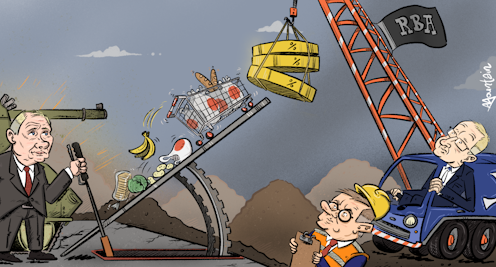
Australia’s Reserve Bank is set to push up rates once again at its first meeting for the year on Tuesday, according to all but two[1] of the 29 leading economists surveyed by The Conversation at the start of 2023.
Those experts predict we will still be living with higher rates by the end of the year, although they should start to come down in 2024.
Their average forecast is an increase in the bank’s cash rate target[2] from 3.1% to 3.6% during 2023. That’s enough to add an extra A$190 to the monthly cost of servicing a $600,000 variable mortgage, bringing the total increase in the cost of servicing such a mortgage since the bank began hiking rates in May 2022 to more than $1,000.
All but three of the specialists surveyed expect the Reserve Bank’s cash rate target to peak during 2023, and on average the panel expects it to fall back to close to its present level during 2024.
Panelist Jo Masters of Barrenjoey Capital says the bank’s keenness to bring down inflation will be tempered by the knowledge that a large number of borrowers are set to exit the very cheap three-year fixed-rate loans they took out early in the pandemic and are facing very steep increases indeed.
The highest forecast for a peak in the cash rate is from former Reserve Bank research manager Peter Tulip, who expects a cash rate of 5% by December 2024 – enough to add a further $725 to the monthly cost of servicing a $600,000 mortgage.
The panel assembled by The Conversation includes macroeconomists, economic modellers, former Treasury, International Monetary Fund and financial market economists, and a former member of the Reserve Bank board.
Most expect inflation to fall sharply from here on, with all but five believing the quarterly rate will turn out to have peaked at 7.8% in December 2022[3].
Financial markets economist Warren Hogan says the food and fuel prices pushed up by Russia’s invasion of Ukraine are already falling, and the only question is how quickly inflation falls, and how soon it returns to the Reserve Bank’s 2-3%[4] target band.
Former federal Labor minister Craig Emerson says, unlike in the 1970s, wage rises aren’t helping sustain inflation. Then, more than half the Australian workforce was unionised and wage setting was centralised. Today only one-eighth[5] of the workforce is unionised and most wages are not set centrally.
The panel expects real wages to go backwards for the third consecutive year in 2023, as wages growth of 3.9% is overpowered by prices growth of 4.5%.
Wage growth is expected to fall back to 3.6% in 2024 as the economy weakens and as an increase in immigration helps fill labour shortages. But the average forecast is wage growth to outstrip price rises next year for the first time since 2020, as inflation falls back to 3.2%.
Recession unlikely at home, more likely abroad
The panel assigns a 26% probability to a recession[6] in the next two years, an increase on the 20%[7] it assigned in mid-2022.
Former Department of Foreign Affairs and Trade chief economist Jenny Gordon says if Europe goes into a recession in its 2023-24 winter and China’s recovery is slow, a recession in Australia will become more likely.
While the panel expects China’s decision to end COVID lockdowns will lift its growth rate from 3% in 2022 to 4.7% in 2023, it does not expect anything like a return to the previous growth rates of 8% or more.
Industry economist Julie Toth says China is facing resource depletion and population decline[8], as well as a cyclical downturn in industrial and residential investment. COVID-19 presents an immediate threat to its people and economy.
Read more: China's population is now inexorably shrinking, bringing forward the day the planet's population turns down[9]
The panel assigns a 42% probability to a recession in the United States within the next two years, a 57% probability to a recession in the European Union, and a 73% probability to a recession in the United Kingdom.
Four of the economists surveyed believe the UK recession has already started. As in the US, it is likely to result from the run of interest rate increases put in place to contain inflation.
University of Tasmania economist Mala Raghavan expects the US to skirt an outright recession and instead experience a “rolling recession”, in which different parts of the economy take time to turn down.
KPMG forecaster Sarah Hunter says while Australia should avoid a recession as commonly described (two consecutive quarters in which production shrinks) economic growth could well turn negative for one quarter at the start of the year, as household spending turns down and mining shipments are disrupted by floods.
Regardless, the economy will be “very weak by historic standards” in 2023. The panel expects economic growth of only 1.7% in 2023, climbing to 2.5% by 2026.
The panel is forecasting very weak growth in household spending of 2.2%[10] over the year to December, and a further decline in the household saving ratio from 6.9 to 5.1%.
Non-mining business investment is expected to hold up, climbing 2.8% over the year to December, up from 1.75%. Mining investment is expected to climb 3.4%, with much depending on demand from the rest of the world.
Read more: How housing made rich Australians 50% richer, leaving renters and the young behind – and how to fix it[11]
Home prices are expected to fall further in 2023 in response to higher interest rates, slipping another 7% in Sydney and 6% in Melbourne.
AMP economist Shane Oliver says the buying power of someone on average full-time earnings with a 20% deposit has fallen by more than one quarter as a result of interest rate hikes, and prices are yet to fully reflect this.
Jobs to hold up
Australia’s unemployment rate dipped below 4% for the first time in five decades in 2022. It is expected to stay below 4% (at 3.96%) in 2023 and then remain below 5% in 2024 even as immigration builds up, in part because low unemployment has made previously unemployed Australians employable[12].
As former Deloitte Access director Chris Richardson puts it, previously hard to employ Australians have been “polishing their skills and their resumes”.
Federation University economist Margaret McKenzie also points to the large amount of sick leave[13] being taken, creating demand for workers to fill the gaps.
On average, the panel is expecting a flat share market in the year ahead, but the forecasts range from growth of 8% to a decline of 17%, led down by weaker bank stocks and household spending as interest rate increases bite.
The panel expects the iron ore price to remain roughly steady at US$105 throughout 2023, rather than falling to the US$55 assumed in the budget.
Partly as a result, the panel is forecasting a budget deficit of A$29.4 billion[14] in 2022-23, down from the officially forecast $36.9 billion.
The Conversation’s Economic Panel
Click on economist to see full profile.
References
- ^ all but two (cdn.theconversation.com)
- ^ cash rate target (www.rba.gov.au)
- ^ December 2022 (theconversation.com)
- ^ 2-3% (www.rba.gov.au)
- ^ one-eighth (www.abs.gov.au)
- ^ recession (www.rba.gov.au)
- ^ 20% (theconversation.com)
- ^ population decline (theconversation.com)
- ^ China's population is now inexorably shrinking, bringing forward the day the planet's population turns down (theconversation.com)
- ^ 2.2% (cdn.theconversation.com)
- ^ How housing made rich Australians 50% richer, leaving renters and the young behind – and how to fix it (theconversation.com)
- ^ previously unemployed Australians employable (theconversation.com)
- ^ sick leave (theconversation.com)
- ^ A$29.4 billion (cdn.theconversation.com)
- ^ Download the 2023 economic survey (cdn.theconversation.com)