From Bachelor to The Bachelors – why Australia's longest running dating show has updated the old formula
- Written by: Jodi McAlister, Senior Lecturer in Writing, Literature and Culture, Deakin University
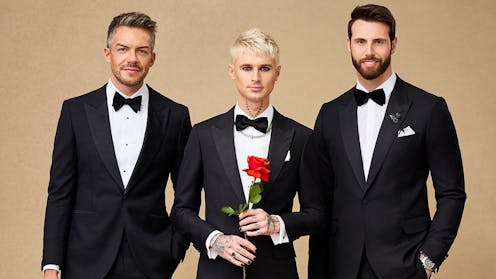
This week marks the beginning of the tenth season of The Bachelor Australia, Australia’s longest running reality romance franchise.
Often, anniversaries like this provoke nostalgia, a desire to look back at what’s gone before, and to return to a format’s roots. But despite a montage of Bachelor history at the beginning of Monday’s premiere, this is not the approach this new season has taken.
Rather, as it is at pains to remind us repeatedly, it has thrown most of its conventional structures and trappings away. The French-chateau-inspired Sydney mansion is out, replaced by a modern one on the Gold Coast. The fairy lights and candles are conspicuously absent.
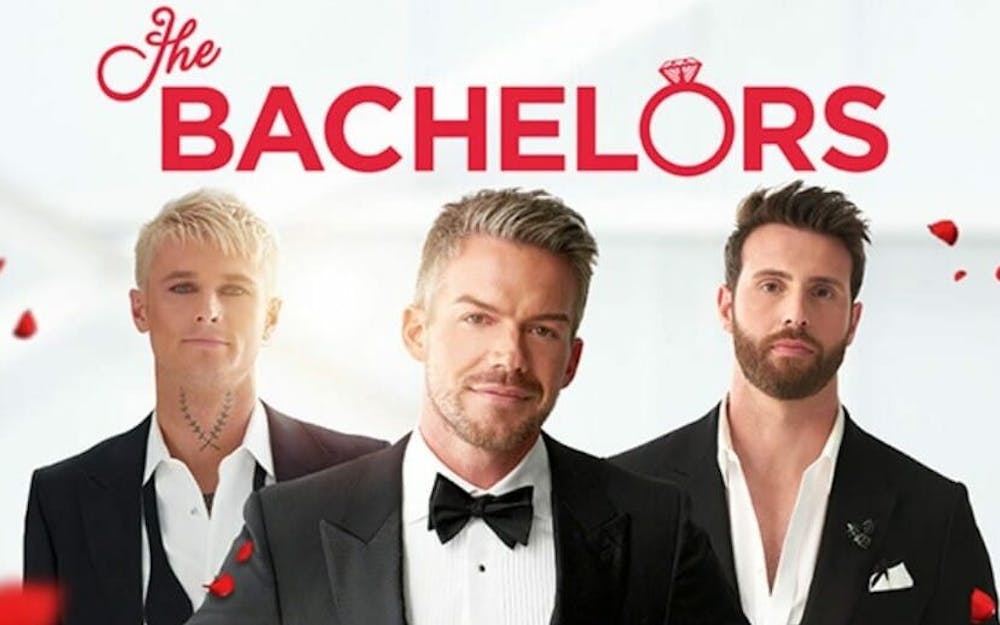
And in the most obvious change, instead of having only one man at its centre, there are three: Jed McIntosh, Felix Van Hofe, and Thomas Malucelli. The Bachelor has become The Bachelors.
Commitment and choice: innovating with the format
While the parent Bachelor franchise in the US has remained relatively consistent over the 20 years it has been running, the Australian franchise has been far more open to experimentation. (One might even speculate that it is used to trial innovations that might then be adopted in the extremely popular American version.)
Brooke Blurton’s groundbreaking 2021 season of The Bachelorette Australia[1], which featured both male and female contestants, was an excellent example of this. Blurton was both the first First Nations and the first openly queer person to ever lead a Bachelor/ette season anywhere in the world.
In Blurton’s season, innovation was based on inclusion. This is not the case in The Bachelors Australia, in which the vast majority of the cast appear to be heterosexual and white (a step backwards, in a franchise which has enormous problems around diversity, nationally and internationally).
Read more: The first bisexual Bachelorette and the messy history of bisexual representation on reality TV[2]
In the latest season, the innovation is with the underlying structures and mechanics of the franchise, creating new opportunities for the people participating in the show – and new storytelling possibilities for the people making it.
Rather than meeting their contestants upon their entrance to the Bachelor mansion like usual, the three Bachelors travelled around Australia, going on short blind dates with numerous women and inviting only the ten they liked best onto the show. While each of the thirty women is nominally dating the Bachelor who brought them, they are openly encouraged to explore the possibility of a relationship with any of the three men: as host Osher Günsberg tells them, they should “go on all the rides at the theme park before they find the one they’re going to stay on all day”.
This ties into a new rhetoric of choice. While contestants have always been able to refuse a Bachelor’s rose, the multiple-Bachelor format allows them options beyond leaving, giving them more power within the show’s structure.
The other major shift is in the show’s new approach to its endgame. While season-ending proposals are de rigueur in the American franchise, they have historically been rare in the Australian one (with the exception of Blake Garvey’s proposal to Sam Frost in 2014, which ultimately led to one of the franchise’s shortest-lived relationships).
In The Bachelors, this is not the case. All three Bachelors have been given engagement rings – with the expectation, one imagines, that they will use them.
Within the show, the rings are used as a visible symbol of the Bachelors’ commitment to commitment. The world of modern dating is presented as an environment where it is impossible to find a partner who will commit it to you. The show, then, becomes the solution.
A naked ratings grab?
These changes have clearly been made in response to viewer fatigue, and in an attempt to revive the show’s ratings[3], which have been in decline for some years (although it is worth noting that this has perhaps been overstated: overnight Nielsen ratings do not include streaming, where, for example, Blurton’s season performed quite well, especially for a younger demographic).
The Bachelor is a remarkably long-running reality romance format, both in Australia (where it has run since 2013) and overseas (the US version has run since 2002). For a long time, it was the only format to run for more than a few consecutive years.
However, in the 2010s, this began to change, with the local and global rise of formats like Love Island and Married at First Sight.
The influence of both is plain to see in this new iteration. The emphasis on contestant choice is reminiscent of Love Island, where participants are frequently encouraged to “recouple”. So too, arguably, is the new fluorescent lighting and bright colour palette.
And the emphasis on commitment, and on the show as the supposed solution to the toils of modern dating, is clearly drawn from Married at First Sight[4], in which the titular “expert”-arranged marriages are positioned as a way to guarantee a dedicated and compatible partner willing to work on a relationship, rather than one who will simply ghost or give up.
Similarly, this new iteration seems designed to encourage conflict – something in which Married at First Sight notoriously specialises.
Read more: Married at First Sight - a 'social experiment' all but guaranteeing relationship failure[5]
Whether or not this new version of The Bachelor Australia saves it from cancellation remains to be seen. The fact that it is being aired in January over a much shorter period than normal seems to suggest that the network does not have much faith in it.
However, it offers something new for old viewers who might have been experiencing fatigue; and something familiar for new viewers, who might be better acquainted with some of these other reality romance formats.
While The Bachelors has its flaws, its first week of episodes certainly did not lack entertainment value.
References
- ^ The Bachelorette Australia (theconversation.com)
- ^ The first bisexual Bachelorette and the messy history of bisexual representation on reality TV (theconversation.com)
- ^ show’s ratings (www.news.com.au)
- ^ Married at First Sight (theconversation.com)
- ^ Married at First Sight - a 'social experiment' all but guaranteeing relationship failure (theconversation.com)