A total lunar eclipse is set to dazzle tomorrow – along with some other stellar sights
- Written by: Tanya Hill, Honorary Fellow of the University of Melbourne and Senior Curator (Astronomy), The University of Melbourne
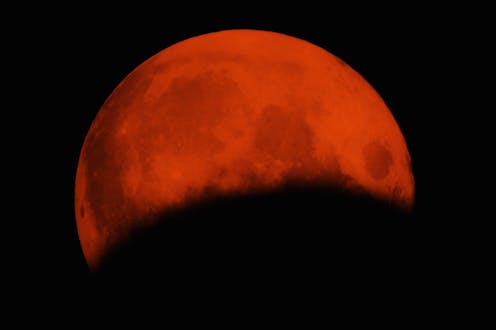
Tomorrow evening people across Australia and New Zealand will be treated to a total lunar eclipse, weather permitting. It’s an opportunity to not be missed, as the next one won’t be visible from our region until 2025.
A lunar eclipse happens when the Moon travels through Earth’s shadow. If the Moon only partly makes it into the shadow, that’s a partial eclipse. In a total eclipse, the Moon becomes fully immersed and takes on a reddish/orange glow.
In tomorrow’s eclipse the period of totality – when the Moon is fully immersed in shadow – will last a leisurely 85 minutes.
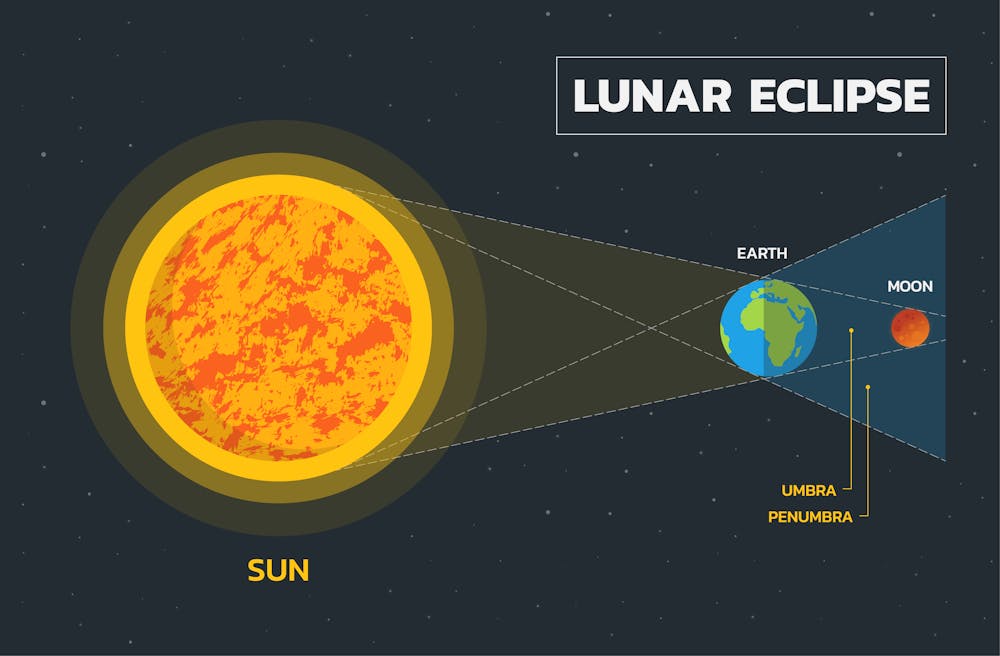
The only light reaching the Moon’s surface will first pass through Earth’s atmosphere, which is why the Moon will take on a red hue. Just how red it appears will depend on how dusty Earth’s atmosphere is at the time.
It will be a wonderful experience to share with family and friends, especially as you won’t need any equipment to see it. It’s also safe to look at – unlike solar eclipses[1], where special care must be taken when viewing the Sun.
Read more: Explainer: what is a lunar eclipse?[2]
A twilight moon or a midnight moon?
Everyone on the night side of the Earth will experience the lunar eclipse simultaneously. But what time that is for you will depend on your timezone.
In New Zealand the eclipse will happen late in the evening, and the eclipse maximum will be just before midnight. The Moon will be high in the northern sky.
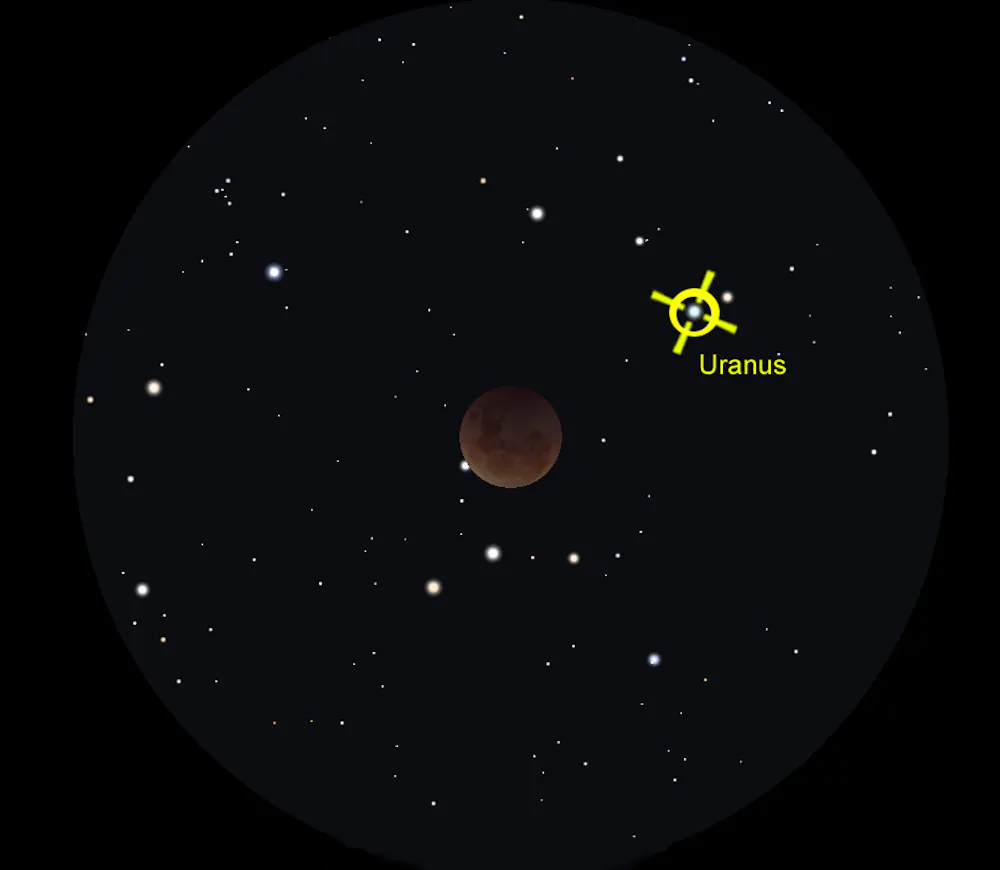 Binoculars will provide enough magnification and a wide field of view so the Moon can be used to locate planet Uranus.
Museums Victoria/Stellarium
Uranus will reach opposition[4] the day after the eclipse, on November 9, which means it will be – like the full Moon – in the opposite part of the sky to the Sun. This is when the planet is at its closest and brightest.
However, at a distance of 2.8 billion kilometres, Uranus is so far away that even through binoculars it will appear star-like. Only a large telescope will reveal it as a small blue-green dot.
One among the planets
But even without binoculars there are some lovely stars and planets to see. Bright Jupiter and Saturn will be easy to spot high overhead, above the eclipsed Moon.
Later in the evening, all viewers will be able to spot the constellation of Taurus rising in the north-east – with the lovely star cluster Pleiades and the red giant star Aldebaran – along with Orion and its red supergiant Betelgeuse.
Binoculars will provide enough magnification and a wide field of view so the Moon can be used to locate planet Uranus.
Museums Victoria/Stellarium
Uranus will reach opposition[4] the day after the eclipse, on November 9, which means it will be – like the full Moon – in the opposite part of the sky to the Sun. This is when the planet is at its closest and brightest.
However, at a distance of 2.8 billion kilometres, Uranus is so far away that even through binoculars it will appear star-like. Only a large telescope will reveal it as a small blue-green dot.
One among the planets
But even without binoculars there are some lovely stars and planets to see. Bright Jupiter and Saturn will be easy to spot high overhead, above the eclipsed Moon.
Later in the evening, all viewers will be able to spot the constellation of Taurus rising in the north-east – with the lovely star cluster Pleiades and the red giant star Aldebaran – along with Orion and its red supergiant Betelgeuse.
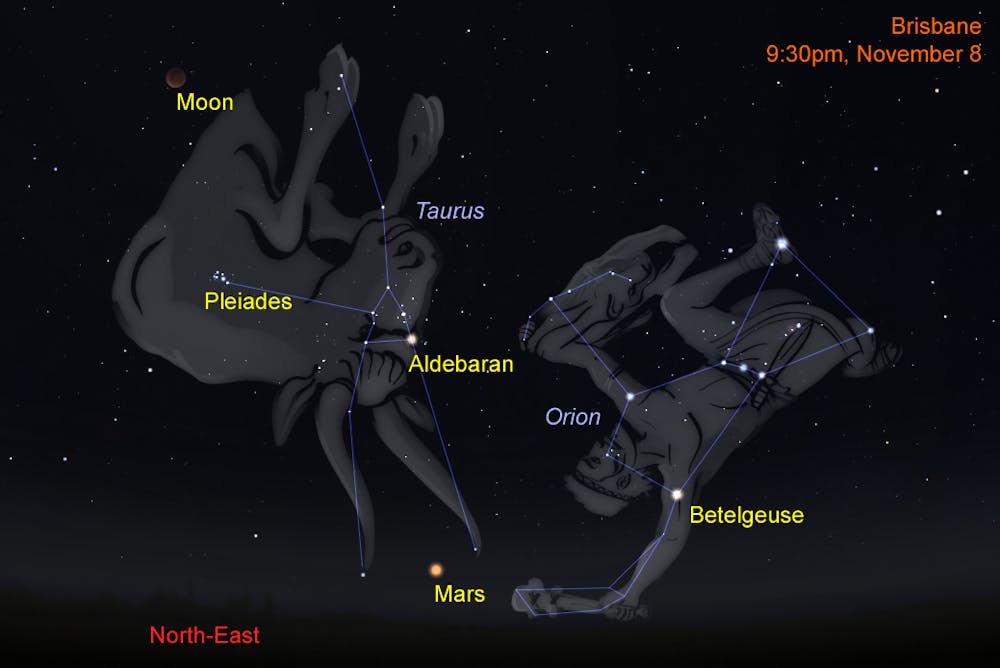 The eclipse occurs in a rich part of the sky, with the constellations of Taurus and Orion visible.
Museums Victoria/Stellarium
The red planet Mars will also make an appearance. People in New Zealand and Queensland will be well-placed to see four red objects in the sky together: the eclipsed Moon, Aldebaran, Betelgeuse and Mars low to the horizon.
Lunar eclipses are reminder that we live on a planet that’s moving through space. When I stare up at the Moon in shadow, I like to imagine what it would be like to stand on it, and see the Sun blocked out by the Earth.
Perhaps you’ll have your own moment of wonder and awe – of how astronomy can sometimes leave us feeling a little small, yet also connected to something much grander.
Read more:
Explainer: Socrates and the life worth living[5]
References^ solar eclipses (theconversation.com)^ Explainer: what is a lunar eclipse? (theconversation.com)^ Why does the Moon look close some nights and far away on other nights? (theconversation.com)^ reach opposition (in-the-sky.org)^ Explainer: Socrates and the life worth living (theconversation.com)
The eclipse occurs in a rich part of the sky, with the constellations of Taurus and Orion visible.
Museums Victoria/Stellarium
The red planet Mars will also make an appearance. People in New Zealand and Queensland will be well-placed to see four red objects in the sky together: the eclipsed Moon, Aldebaran, Betelgeuse and Mars low to the horizon.
Lunar eclipses are reminder that we live on a planet that’s moving through space. When I stare up at the Moon in shadow, I like to imagine what it would be like to stand on it, and see the Sun blocked out by the Earth.
Perhaps you’ll have your own moment of wonder and awe – of how astronomy can sometimes leave us feeling a little small, yet also connected to something much grander.
Read more:
Explainer: Socrates and the life worth living[5]
References^ solar eclipses (theconversation.com)^ Explainer: what is a lunar eclipse? (theconversation.com)^ Why does the Moon look close some nights and far away on other nights? (theconversation.com)^ reach opposition (in-the-sky.org)^ Explainer: Socrates and the life worth living (theconversation.com)