There’s something wrong with British politics. It’s called the Conservative Party
- Written by: Ben Wellings, Senior Lecturer in Politics and International Relations, Monash University
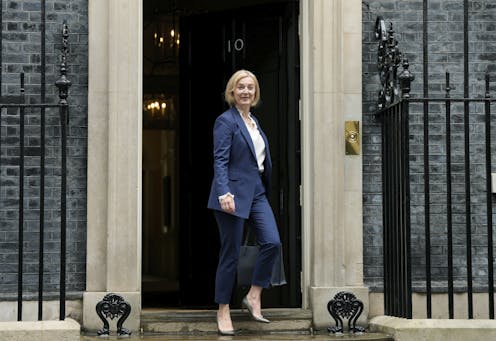
The current turmoil in British politics needs to be understood not just as a response to Liz Truss’s short time as prime minister, but as the result of problems within the governing Conservative Party since it came to power in 2010.
The Conservative party is a group of about 180,000[1] people who tend to be wealthier and older than the average UK citizen. It was this group, more than Truss’s fellow MPs, who chose her as leader of the Conservative Party. It was also this group that endorsed the policies she tried to impose on the country, causing outcry from the populace and the markets.
This method of selecting the leader[2] of the party needs to be changed. The current method was designed when the Conservatives were last in opposition (1997-2010). This means it was unwittingly designed for changes of leader while out of government.
Choosing the leader of the Conservative Party is strictly speaking a matter for the Conservative Party. This is fine when in opposition. When in government, a change of leader means a change of prime minister. This narrow franchise weakens the legitimacy of whoever becomes the new prime minister among the wider UK electorate.
Too much emphasis on leaders
The Conservative Party has also given itself up to an over-emphasis on leaders. This is part of the spirit of the times. But it is also the case that the prime minister is no longer “first amongst equals[3]”. Instead, he or she plays an increasingly important part in why people vote for a particular party.
The Conservatives supported Boris Johnson because he promised to “get Brexit done”. However, the 80-seat majority he won in 2019 gave the impression that the electorate was voting for a leader (Johnson) rather than a party (the Conservatives).
But if this new support was about Johnson and Brexit, rather than a more permanent switch to the Conservatives, it also meant it could not be counted on thereafter. This helps explain the urgency to oust Johnson and the poor reception for Truss’s policies.
Read more: Who is Liz Truss, the new UK prime minister?[4]
Johnson’s new pro-Brexit supporters did not have the same political instincts as most Conservatives. This group of voters likes it when the government intervenes. They liked Johnson when he promised to spend money and address persistent inequalities between northern and southern England – inequalities exacerbated by the actions of Margaret Thatcher’s governments of the 1980s.
So, when he was replaced by Truss, who models herself on Thatcher, the support rapidly evaporated in the north, where memories of the 1984-85 Miners’ Strike[5] persist. In the leafy suburbs of the south, normally rock-solid Conservative voters have seen their mortgage payments and energy bills rise as a result of Truss’s “small state” ideology. They are not amused, and were already drifting away[6] from the Tories as byelections held this year suggest.
No new ideas
Perhaps we should not expect a self-described conservative party to have many new ideas (after all, that’s the point). But the poverty of thinking among its leaders stands out. Brexit had a nostalgic element to it. The Truss-Kwasi Kwarteng mini-budget[7] was more 1980s than Stranger Things. Even the markets[8] couldn’t take the retro infatuation with trickle-down economics.
The Conservatives are stuck in a place where all their ideas are from Britain’s past. In the Conservative Party mindset, the past does not operate as a helpful guide for the future, but as a point of destination. It is a security blanket in the chaos of their own making.
They show no sign of learning from all of this. The instinct of new Chancellor Jeremy Hunt is to return not to the 1980s, but to the 2010s. If you don’t like trickle-down economics, you can have austerity[9] instead.
Austerity is where the current Conservative Party began its time in office back in 2010. Back then, David Cameron promised to address what he called “Broken Britain[10]”. Little did electors realise this was more predictive than descriptive. Cuts to public services punished the worst off while the government claimed “we are all in this together[11]” (in the way that everyone may be on an A380, but some people are in business class).
Admittedly, it has been hard to predict the mood of British voters. Brexit, another product of internal Conservative division and poor party management, bent political loyalties among the electorate out of usual shape. It was this voter volatility that led Theresa May to call an election in 2017 and lost the Conservatives a healthy majority[12], even though its vote share went up. This was the greatest miscalculation in British politics since as far back as the previous year, when David Cameron lost the Brexit referendum[13].
Read more: Liz Truss: what I told European colleagues when they asked me what on Earth is going on in British politics[14]
All of these problems are in some ways internal to the Conservative Party. Voters angered by austerity turned to the right-wing populist party UKIP, forcing Cameron to call a referendum on EU membership. To try to quell the low politics of the militant pro-Brexit wing of the Conservative party, Cameron gambled with the high politics of the UK’s membership of the EU, and lost.
To realise all the illusive and illusionary opportunities that Brexit should in theory create, its most ardent supporters latched onto Johnson to bring down May. Johnson created the parliamentary deadlock of Brexit and then appeared to solve this self-inflicted wound with an election victory built on shifting sands.
However, he soon became embroiled in scandal after scandal, and his behaviour was finally too much even for the vulnerable MPs in “red wall[15]” seats to stomach. Then, just when MPs thought it was safe to go back to their constituencies, Truss damaged already weakening support in the “blue wall” seats in southern England with the mini-budget: perhaps the most spectacular own-goal since Jamie Pollock [16]scored against Manchester City in 1998.
Finally, most Conservatives now think Truss should resign. Yet in a final fling of nostalgia – and harking back to the glory days of the first half of 2022 – their favoured candidate[17] to replace her is Boris Johnson.
The Conservatives have lost sight of where their interests and those of the country depart. By falling back on old certitudes that are no longer fit for purpose, they are behaving like a party that is already in opposition.
References
- ^ about 180,000 (commonslibrary.parliament.uk)
- ^ method of selecting the leader (commonslibrary.parliament.uk)
- ^ first amongst equals (www.definitions.net)
- ^ Who is Liz Truss, the new UK prime minister? (theconversation.com)
- ^ Miners’ Strike (www.youtube.com)
- ^ drifting away (www.bbc.com)
- ^ Truss-Kwasi Kwarteng mini-budget (www.economist.com)
- ^ the markets (www.cnbc.com)
- ^ austerity (www.civilserviceworld.com)
- ^ Broken Britain (www.france24.com)
- ^ we are all in this together (www.independent.co.uk)
- ^ lost the Conservatives a healthy majority (commonslibrary.parliament.uk)
- ^ Brexit referendum (www.theguardian.com)
- ^ Liz Truss: what I told European colleagues when they asked me what on Earth is going on in British politics (theconversation.com)
- ^ red wall (journals.sagepub.com)
- ^ Jamie Pollock (www.youtube.com)
- ^ their favoured candidate (yougov.co.uk)