


We studied the 'bibles' of jazz standards – and found sexism lurking in the strangest place
- Written by: Wendy Hargreaves, Senior Learning Advisor, University of Southern Queensland
We are two female jazz singers, jazz researchers and lovers of jazz. And we have discovered jazz gave us another shared experience – sexism.
We’d both experienced garden variety sexism. Wendy was asked by a male school principal if her recent marriage meant she would resign from teaching to start a family. Melissa received passionate advice from a male audience member to swap her comfortable outfit with a “glamorous dress” when she sang jazz.
But as university music students, neither of us imagined something as innocent as a key signature in a textbook might be a symptom of gender discrimination.
A key[1] tells musicians which set of notes a song uses. In singing, a key affects whether the notes will be sung in the low, middle or high part of the voice.
But when we looked at what keys the “bibles” of jazz standards used, we found a hidden form of sexism.
The Real books
This unusual story begins in 1975 at the Berklee College of Music in the United States. Two music students, tired of reading shoddy, error-filled song sheets, created The Real Book to accurately notate jazz songs. Sold illegally to avoid copyright fees, it was a phenomenal success.
After years in surreptitious worldwide circulation, publisher Hal Leonard transformed The Real Book into a legal edition[2]. In 1988, Sher Music joined the act and produced The New Real Book. Despite similar titles, Sher’s book was unrelated but mimicked the idea of clearly notating jazz songs.
Together the two books cornered the market.
The real books remain the bibles of jazz musicians[3] everywhere because they contain hundreds of songs called standards[4].
Standards are common jazz songs jazz musicians are expected to know. Knowing them is your ticket to participating in jazz ensembles, and so universities use these books to train students.
However, few educators realise one decision in 1975 about notating standards cemented a practice excluding women.
Jazz is valued as a “conversational” style of music where musicians express personal ideas and real stories. “Authentic” jazz singing is associated with the lower voice we use when speaking.
The human voice is a biological musical instrument[5] coming in a variety of sizes, with the male larynx (or voice box) generally larger than the female. This means men generally sing (and talk) in lower pitches, and keys that sit in the middle of the male voice are usually too low for women to sing.
When our Berklee students and Sher Music notated songs, they chose keys used by jazz musicians. And during that era, male instrumentalists and male singers dominated the jazz community.
So, when the real books were being developed, the editors didn’t choose keys that suited female voices.
Read more: Women in jazz still face many barriers to success – new research[6]
What’s in a key?
Our research[7] examined the recordings of 16 renowned female jazz vocalists, including Ella Fitzgerald[8] and Sarah Vaughan[9].
We sampled 20 songs from The Real Book and 20 songs from The New Real Book and compared the keys in the books with the keys of the female recordings.
Less than 5% of 248 recordings fully matched the printed key.
If women sing songs straight from The Real Book or The New Real Book, they are likely to be singing too low for their voices. And if they shift the male key up one octave[10], it will be too high.
Consequently, female jazz vocal students are disadvantaged. If they comply with the keys of the iconic texts, they won’t sound as “authentically jazz” as male students. The male voice will produce the conversational tone we have come to expect from jazz; the female voice will be too low or too high for this conversational style.
The female professional singers we studied transposed[11] the standards to keys that suited a jazz style. But this skill takes time for students to learn. Transposing requires understanding music theory and having confidence to advocate for your needs as a singer.
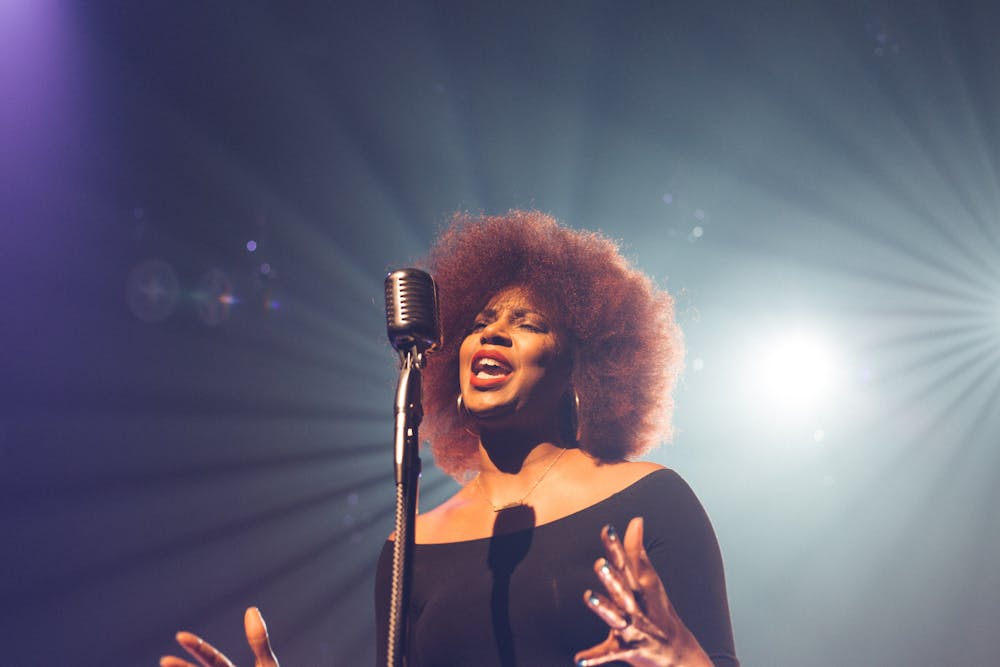 Female singers who don’t transpose the standards will be at a disadvantage.
Josh Rocklage/Unsplash
Female singers who don’t transpose the standards will be at a disadvantage.
Josh Rocklage/Unsplash
Experienced jazz singers inevitably acquire these skills, but what about novice female singers?
For many young female singers, their introduction to jazz is coloured by keys ill-suited to their voices. Place them in a band where the instrumentalists are predominantly male with little understanding of voice production, and it is an uncomfortable situation for aspiring singers.
Fortunately, technology has advanced to a point where many standards are available on phones and can be transposed instantly. But this won’t happen until music teachers and jazz musicians understand and respect female singers by using the appropriate keys.
So, can a key signature be sexist? Yes, it can when it’s presented as the only choice of key for female students learning jazz standards.
It’s time to update our jazz bibles with sources including keys used by Ella Fitzgerald and Sarah Vaughan, and acknowledge sexism has been hiding in the strangest place.
Read more: Male artists dominate galleries. Our research explored if it’s because ‘women don’t paint very well’ – or just discrimination[12]
References
- ^ key (www.britannica.com)
- ^ legal edition (officialrealbook.com)
- ^ bibles of jazz musicians (www.nytimes.com)
- ^ standards (www.jazzstandards.com)
- ^ biological musical instrument (soundbridge.io)
- ^ Women in jazz still face many barriers to success – new research (theconversation.com)
- ^ Our research (www.routledge.com)
- ^ Ella Fitzgerald (www.britannica.com)
- ^ Sarah Vaughan (www.britannica.com)
- ^ octave (www.britannica.com)
- ^ transposed (en.wikipedia.org)
- ^ Male artists dominate galleries. Our research explored if it’s because ‘women don’t paint very well’ – or just discrimination (theconversation.com)










