


Australia's reversal on recognising Jerusalem as Israeli capital is simply a return to status quo
- Written by: Tony Walker, Vice-chancellor's fellow, La Trobe University
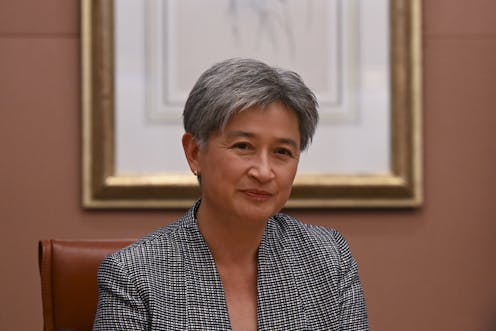
The Albanese Labor government’s decision[1] to reverse its predecessor’s recognition of West Jerusalem as Israel’s capital has elicited a predictable reaction from Israel and its supporters in Australia.
Israel’s Prime Minister Yair Lapid condemned[2] what he described as a “hasty response” to indications in the Australian media Canberra was about to shift ground on recognition of West Jerusalem.
Guardian Australia had noted[3] a change on the Department of Foreign Affairs and Trade website.
In Australia, Colin Rubenstein, spokesman for the Australia Israel Jewish Affairs Council (AIJAC), called[4] the reversal a “pointless own goal”.
This decision by the government is not only deeply disappointing, [it] risks denting Australia’s credibility with some of our closest allies.
Is this true?
The short answer is that it is unlikely Australia’s “credibility” will be harmed by a decision that reinstates what has been, until recently, a status quo policy under successive Labor and Coalition governments.
Rather, the decision announced by Foreign Minister Penny Wong will likely reinforce Canberra’s reputation as a middle power seeking to navigate its way in the shifting sands of Middle East politics.
Importantly, Australia’s neighbours in the region, including principally Indonesia[5], have welcomed the decision.
The simple fact is Australia has now realigned itself with all its friends and allies, with the exception of the United States, on this issue.
Under US President Donald Trump, Washington had diverted[6] from the policy of his predecessors and recognised West Jerusalem as Israel’s capital in 2017. The following year, the US embassy was moved there.
The Morrison government then followed the US lead[7], without moving the Australian embassy from Tel Aviv to Jerusalem. This was a half, or three-quarter, step towards all-out recognition.
Read more: Morrison's decision to recognise West Jerusalem the latest bad move in a mess of his own making[8]
Circumstances surrounding Canberra’s precipitate decision in 2018 to recognise west Jerusalem as Israel’s capital are relevant.
That decision coincided with the lead-up to a knife-edge by-election[9] in the Sydney seat of Wentworth, where there is a significant Jewish population. The byelection was called to fill a casual vacancy caused by the resignation from parliament of former Liberal leader Malcolm Turnbull.
As it turned out, the Morrison government’s decision to overturn what had been settled Australian policy did not yield the desired result. The independent Kerryn Phelps won the seat.
In all of this, history is important.
In the years since the founding of the state of Israel in 1948, successive Australian governments, Coalition and Labor, had adhered to a policy of not recognising West Jerusalem as Israel’s capital. This decision was made pending final status negotiations on the future of the city.
Until the 1967 six-day war[10], following Israel’s war of independence[11] in 1948, Jerusalem was a divided city between its west, which is the seat of the Israeli government, and east, then under the control of the Hashemite Kingdom of Jordan.
That ended with Israel’s smashing victory over the Arabs in 1967. Israel occupied east Jerusalem, the West Bank, Syria’s Golan Heights, the Gaza Strip until then under Egyptian mandate, and Egypt’s Sinai Peninsula.
In six days, Israel had turned the map of the Middle East upside down.
This was followed by the 1973 Yom Kippur war[12], in which Egypt sought to wrest back the Sinai from its Israeli occupiers. After making initial inroads along the Suez Canal, Egypt was on the verge of a heavy defeat when America brokered a ceasefire and laid the ground for what became the Camp David Accords of 1978[13].
This ushered in a cold peace between Israel and Egypt, with Israel withdrawing from virtually all of the Sinai.
In the years since Camp David, repeated attempted by successive American administrations to broker peace[14] between Israel and the Palestinians under a two-state formula have failed, even as Israel has continued to settle territory seized in 1967.
Read more: Moving the Australian embassy to Jerusalem makes sense: here's why[15]
This is the background to Wong’s announcement[16] that Australia had “reaffirmed’’ its
longstanding position that Jerusalem is a final status issue that should be resolved in any peace negotiations between Israel and the Palestinian people.
There was a sting in the tail to Wong’s announcement.
I regret that Mr Morrison’s decision to play politics resulted in Australia’s shifting position, and the distress these shifts have caused to many people in the Australian community who care deeply about this issue.
Labor’s own political interests are not absent from this statement. The government holds a swag of seats in western Sydney and north and west of Melbourne where the issue of Palestine is among voter concerns.
Much has been made of the messy way in which the Wong announcement was made. Due to diligent reporting by Guardian Australia, Labor’s pending shift was revealed.
Wong was then put in a position of first denying there had been a change without a cabinet decision, and then making her announcement. This clumsiness should not have happened on such an important policy shift, given the domestic political sensitivities involved.
All of this brings into focus Labor’s guiding policy[17] on the Israel-Palestine dispute.
At its 2018 National Conference and reaffirmed at its 2021 conference, its policy states that a Labor government:
supports the recognition and right of Israel and Palestine to exist as two states within secure and recognised borders
calls on the next Labor government to recognise Palestine as a state
expects that this issue will be an important priority for the next Labor government.
This does not mean Labor will be in any rush to recognise Palestine as a state separate from a full-blown peace process in which a two-state solution becomes a reality. Since there is little chance of that happening in the foreseeable future, Labor’s national conference policy will remain "on the books” as a potential irritant to Israel’s supporters in Australia, but no more than that for the time being.
This piece has been corrected: it originally said the government’s decision again recognises Tel Aviv as Israel’s capital. This is incorrect - it simply no longer recognises West Jerusalem as the capital.
References
- ^ decision (www.foreignminister.gov.au)
- ^ condemned (www.timesofisrael.com)
- ^ noted (www.theguardian.com)
- ^ called (www.jwire.com.au)
- ^ Indonesia (www.medcom.id)
- ^ diverted (www.nytimes.com)
- ^ followed the US lead (www.theguardian.com)
- ^ Morrison's decision to recognise West Jerusalem the latest bad move in a mess of his own making (theconversation.com)
- ^ knife-edge by-election (www.theguardian.com)
- ^ six-day war (www.britannica.com)
- ^ war of independence (history.state.gov)
- ^ 1973 Yom Kippur war (www.britannica.com)
- ^ Camp David Accords of 1978 (history.state.gov)
- ^ broker peace (www.britannica.com)
- ^ Moving the Australian embassy to Jerusalem makes sense: here's why (theconversation.com)
- ^ announcement (www.foreignminister.gov.au)
- ^ guiding policy (www.markdreyfus.com)










