Some survivors will find peace and healing in Bali 2002 – but others may find the series triggering
- Written by: Carmen Jacques, Research Officer, Edith Cowan University
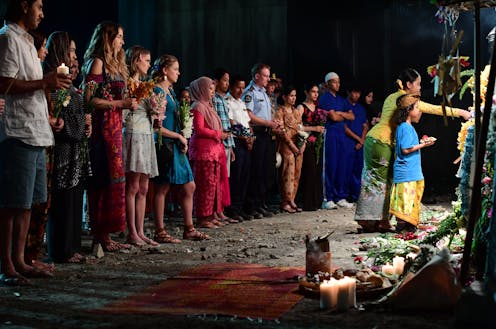
Around 11pm on October 12 2002, the first of three separate bombs detonated when a suicide bomber entered Paddy’s Bar in Kuta, Bali.
Another bomb detonated shortly after outside the Sari nightclub, before a final explosion in front of the US consulate.
Stan’s new series, Bali 2002, takes a look at these attacks and their aftermath. The physical and emotional traumas play out with desperation and intensity.
The series also shows how our humanity comes out to shine in desperate and violent times. It shows friends helping friends, people helping strangers, doctors on holiday rushing to the hospital to lend a hand and the Australian Federal Police’s directive to help everyone – and not only prioritise Australians.
While the series creators should be lauded for their close consultations with attack survivors in making the series, this dramatisation highlights the very public nature of terrorism. This public nature can have highly personal impacts.
In my research[1] into the events of this night and their aftermath, I have spoken to many people who were there or lost someone in the attack.
Some survivors will find solace in this sharing of their stories; others will struggle with the public commemoration.
Sharing stories
Some people affected by terrorism find telling their story can be harmful to their health and wellbeing. It locks them into a time and place of pain and suffering.
For others, telling their stories and of loved one’s experiences, lives and deaths is an important part of their healing processes.
Kev Paltridge lost his son Corey in the Bali bombings. He told me closure is “bullshit” and he still has “shit bad days”.
But he also said every time he tells his story, it helps him.
Kev doesn’t shy away from the darker side of his healing pathway – the three years of excessive drinking, his continued suffering and grief for Corey – because he knows there are some who were there who are still drinking and haven’t found an alternative pathway yet.
He hopes his story will help others as much as it helps him.
Journalist Nick Way was at the site of the Sari Club bombing hours after it occurred. He later worked as one of the producers on the documentary Cry Bali. During this process, working closely with survivors and their families, he told me “I learnt that very often, expressing feelings is part of the healing journey.”
Read more: The site of the Bali bombings has been a vacant lot for 16 years. It's time to build a proper memorial[2]
Before and after
When a terror attack occurs, the media can create[3] a sense of a “victim” identity, which divides a person’s life into one before and after terror, as if they came into being at that moment.
Bali 2002 buys into this division. It gives scant time to our survivors before the event, and these characters feel shallow.
The series also struggles in finding the right balance between the stories of the terrorists and the survivors. Too much focus is given to the individuals who undertook these attacks. More important are the stories of the victims, survivors, family members and first responders.
For some survivors I have spoken to, the trailer alone has triggered traumatic responses. Their capacity to watch the series is doubtful.
The series weaves together a dramatisation of the events alongside real footage. This raw footage adds realism, but the use of this footage is not signposted, and it could be triggering even to survivors who might feel up to watching a dramatised version of events.
Endurance
Bali 2002 is being released in advance of the 20th anniversary of the attacks.
In my research, I found recognising and remembering these events on fewer, more “significant” anniversaries we disavow the experience of living with terror after the experience of an event.
All the survivors I have spoken with endure every day. Kev told me he speaks to his son “every morning without fail”.
This endurance must be acknowledged and recognised.
The stories of their survival could have been stories of vengeance and hate and promoting more violence.
Instead, I have overwhelmingly found these stories are about hope and responsibility.
Nick told me he thinks “about building a new future for the people who feel oppressed and disadvantaged so that they might be [less] open to radicalisation”.
These are not saccharine stories about closure or forgiveness or forgetting. They are about living with and promoting an awareness of the effects that these attacks have upon everyday individual lives.
Read more: Remembering the Bali bombings ten years on[4]
Lasting impacts
Every person I have talked with is still deeply affected by their experience.
Bali 2002 takes us from the weeks before the bombing to the 2005 death of the bomb maker, Husin. Viewers with little connection to the event will more than likely come away without an understanding of how survivors, their family members and first responders are still impacted two decades on.
A terrorism bombing is a moment where one is made powerless. They are subject to the will of the terrorist. It is so far outside the normal daily experiences it can cause a deep identity shift.
My research shows survivors of terrorism, their family members and first responders must find a way to fold the experience into their ongoing lives.
Sometimes they walk the tightrope gracefully and are well-balanced, at other times they can’t find their footing and are swaying dangerously over the abyss.
I hope some will find peace and healing in the airing of Bali 2002 and the sharing of these stories, but this won’t be true for all.
Bali 2002 is streaming on Stan from September 25.
Read more: Is it wrong to make a film about the Port Arthur massacre? A trauma expert's perspective[5]
References
- ^ my research (ro.ecu.edu.au)
- ^ The site of the Bali bombings has been a vacant lot for 16 years. It's time to build a proper memorial (theconversation.com)
- ^ media can create (dartcenter.org)
- ^ Remembering the Bali bombings ten years on (theconversation.com)
- ^ Is it wrong to make a film about the Port Arthur massacre? A trauma expert's perspective (theconversation.com)