We can predict final school marks in year 11 – it's time to replace stressful exams with more meaningful education
- Written by: John Fischetti, Professor, Pro Vice-Chancellor of the College of Human and Social Futures, University of Newcastle
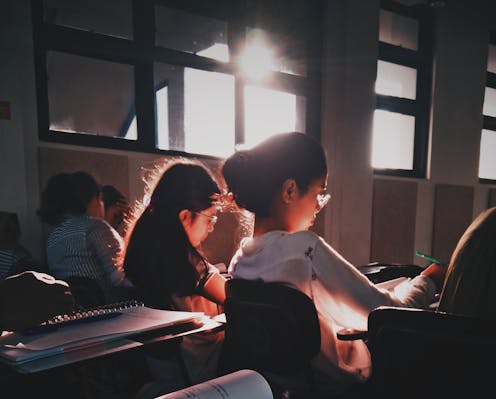
Year 12 students around Australia are preparing to sit their final exams. For many young people this is one of the most stressful parts of school, with their future supposedly coming down to one number[1].
This is an outdated way of finishing school and working out what students do in the next phase of their lives.
Universities and TAFEs are increasingly using other methods – such as interviews or portfolios – to offer places to school leavers. In 2021, more than 25,000 NSW students applied for an early offer[2] through the “schools recommendation scheme”, to lock in a university place before they sit their exams. This is up from 5,447 in 2014, suggesting year 12 exams may not be as necessary as we once thought.
Our research shows you can reliably predict a student’s year 12 results by year 11. This also suggests we don’t need a battery of stressful exams to work out if a student is suited for tertiary education.
This gives us the opportunity to radically rethink how the final years of school are structured.
Our research
Two years ago, we studied[3] more than 10,000 students in the Catholic Education Diocese of Paramatta, NSW. We have repeated the study and our work now includes 20,000 students across 21 exam areas.
We used predictive analytics[4] which links multiple pieces of information about student progression through school.
We used 17 variables including year 9 NAPLAN scores, Higher School Certificate subject choices and year 11 attendance. We also use demographic information, such as how long a student has lived in Australia and a school’s socioeconomic rating.
Across both our studies, we found we could predict year 12 results in year 11, with a 93% accuracy rate.
Our purpose here is not to label students, but to change the focus of school and the efforts of students and teachers.
What can we do differently in schools?
We are already seeing the beginnings of new ways[5] of “doing school” in Australia. Some schools are changing their focus from year 12 exams to students doing internships, creating portfolios of work, doing TAFE or university certificates, or doing an overseas exchange.
In British Columbia, Canada, final school assessments include a project that connects “real-world” applications of the curriculum for each student.
Read more: 3 things to help improve your exam results (besides studying)[6]
In Estonia, now among the world leaders in education, traditional “knowledge and understanding” approaches have been replaced with a strong emphasis on critical thinking, problem-solving, entrepreneurship, digital skills and citizenship. These are all qualities that fit with both employers’ needs and measures of success in the adult world.
Students undertake a cross-disciplinary creative project[7] to graduate from the equivalent of year 10 – an example might be studying the impact of music on managing the onset of dementia in older people. They then do a research project before finishing high school.
Year 12 exams are outdated
High school as we’ve known it has been dominated by high stakes, high-pressure exams that have outlived their usefulness. If we can reliably predict the results, we don’t need the tests.
We know young people’s mental health is already poor, and has suffered further[8] during COVID.
Read more: 40% of year 12s suffer high anxiety. At exam time, here's what parents can do to help[9]
We should be looking for ways to improve, rather than exacerbate this. We also know universities are increasingly open to other ways of admitting students.
There is an enormous opportunity here to reallocate resources and create a modern, meaningful school experience that excites young people. It can encourage them to seek career-building activities, study overseas, learn languages or follow passion projects – not just study for stressful exams that tell us what we already know.
The research for this piece is a continuation of the work initiated by Dr Raju Veranasi for his 2021 Phd at the University of Newcastle.
References
- ^ supposedly coming down to one number (www.abc.net.au)
- ^ early offer (www.smh.com.au)
- ^ studied (theconversation.com)
- ^ predictive analytics (www.igi-global.com)
- ^ new ways (www.bigpicture.org.au)
- ^ 3 things to help improve your exam results (besides studying) (theconversation.com)
- ^ creative project (www.thetimes.co.uk)
- ^ suffered further (www.aare.edu.au)
- ^ 40% of year 12s suffer high anxiety. At exam time, here's what parents can do to help (theconversation.com)