The retirement of Roger Federer is the abdication of tennis royalty
- Written by: David Rowe, Emeritus Professor of Cultural Research, Institute for Culture and Society, Western Sydney University
This is a time of endings. In the midst of the all-consuming media spectacle[1] surrounding the death of Queen Elizabeth II, “tennis royalty” in the form of Roger Federer will retire[2] in the same week and in the same city that she is laid to rest.
When the career of a sporting celebrity concludes, it is widely represented as if they have died, in what journalists call “sports obituaries”.
The person in question is usually still alive and will probably go on to be successful in the business, media and/or charity sectors. But the experience of watching them perform live at the stadium or on screen immediately mutates into nostalgic reflection.
So, what can be said about the sporting life of “Roger”, one the few people often known solely by their given name?
Read more: Serena Williams forced sports journalists to get out of the 'toy box' – and cover tennis as more than a game[3]
The final curtain
When the institution of sport emerged during the late industrial revolution in the 19th century, it changed, as Allen Guttmann famously put it, “from ritual to record[4]”. It became all about the numbers and the score.
By this measure, Federer’s sporting record is formidable[5] – world men’s number one for the best part of six years, 20 Grand Slam singles titles (including six Australian Opens), the only player to win at least ten titles on clay, grass and hard court surfaces, and sundry other tennis achievements.
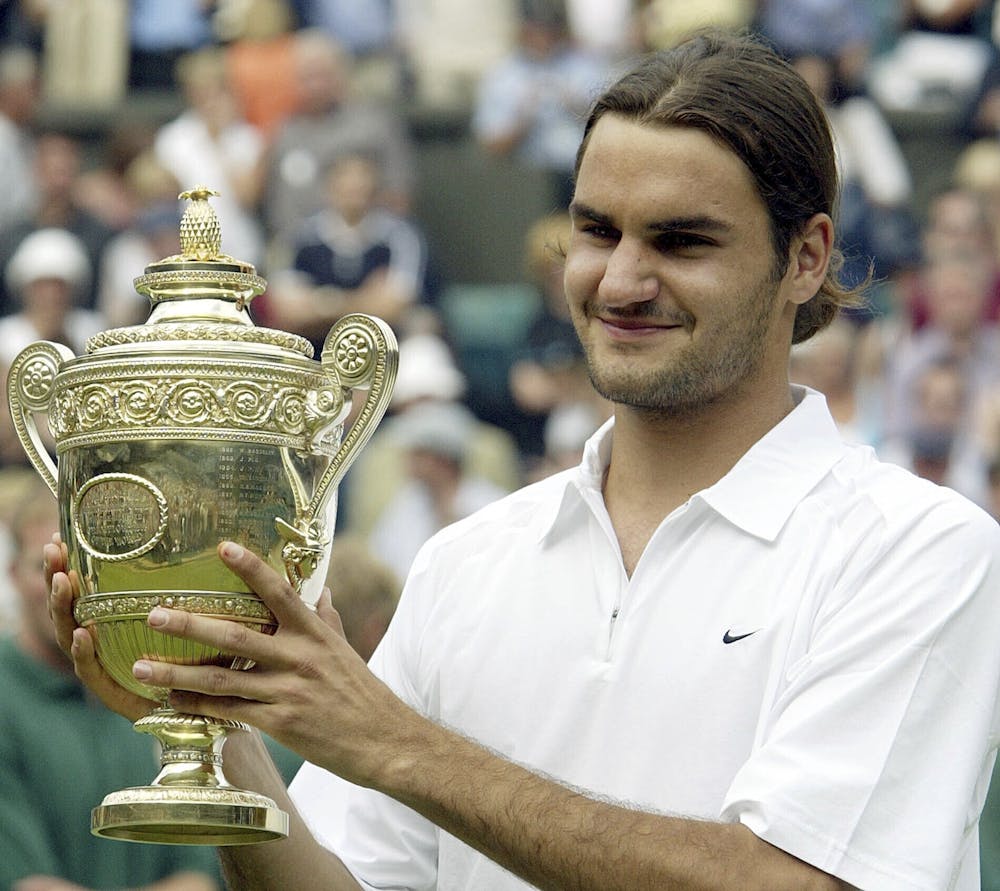
Of course, it has not all gone smoothly. The body that was his finely tuned instrument on the tennis court increasingly failed him, although the steely determination of the champion never wavered.
Until, facing one last hurrah but probably playing on one leg, he chose to lower the curtain at the event that he co-created.
Named after his tennis hero, the Laver Cup[6] is a testament to Federer’s unusually intense immersion in tennis history and, ultimately, his own place within it. Federer, who arrived as a teenage firebrand[7], admires not just the impressive tennis record but also the demeanour of Rod Laver[8].
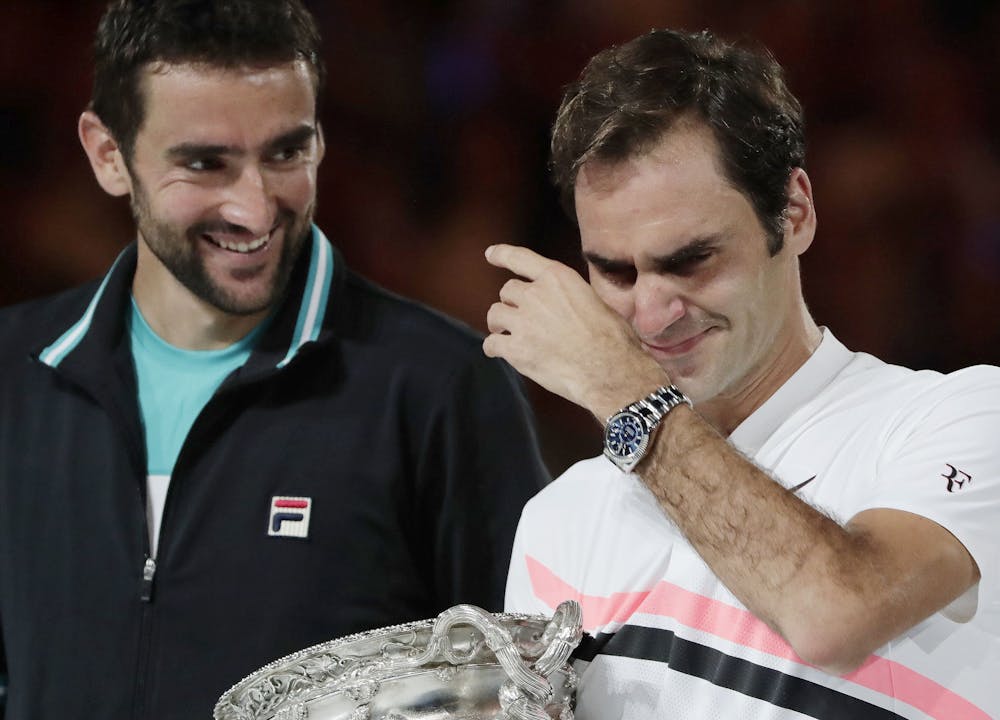 Federer, pictured here after winning at the Australian Open in 2018, often cried with joy.
AAP Image/Mark Cristino
Federer, pictured here after winning at the Australian Open in 2018, often cried with joy.
AAP Image/Mark Cristino
An elegant and courteous stylist who was instrumental in the professionalisation of tennis in the 1960s, he has been a significant role model for Federer.
Laver is not just acknowledged as a superlative tennis player, but widely respected and admired. In emulating him, Federer generally behaved well on and off court, although unlike Laver, he sometimes wept with frustration or joy.
In the pure aesthetics of tennis, Federer arguably eclipsed the master. No cold-eyed counting of tournament wins can capture the beauty of his backhand, the flourish of his forehand.
King Roger and the big three
In the early days of his career, the Swiss-South African Federer could have gone the way of Australian Nick Kyrgios[9], who is more than a decade younger. Both supremely talented and combustible, Federer and Kyrgios went in different directions.
Federer became “King Roger[10]”, as he was anointed by the august Times of London in 2018 – a player who trained hard, curbed his temper, and won Wimbledon at the age of 21.
Kyrgios, by contrast, emerged as “Nasty Nick[11]”, attracting media and spectator interest as much for his confrontational on-court antics as his sometimes sublime tennis.
Even if Kyrgios begins to win Grand Slams while continuing to fascinate younger tennis[12] fans, it is unimaginable he will come close to Federer’s elevated place in the pantheon.
Federer’s place in tennis history has been enhanced in part by his membership of the “Big Three[13]” alongside Rafael Nadal and Novak Djokovic – or the “Big Four” if Andy Murray is included.
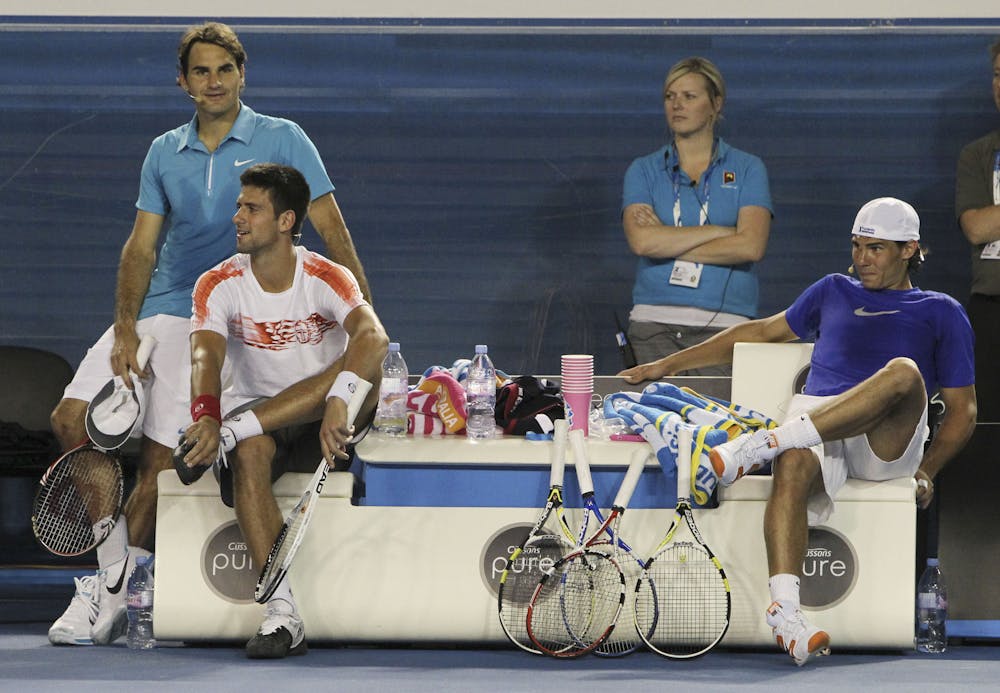 Roger Federer, Novak Djokovic and Rafael Nadal were ‘the big three’ of tennis.
AP Photo/Mark Baker, File
Roger Federer, Novak Djokovic and Rafael Nadal were ‘the big three’ of tennis.
AP Photo/Mark Baker, File
With more than 60 Grand Slams between them, the three rivals dominated men’s tennis, supplying the kind of “golden age” narrative so beloved of terminally sentimental sport fans.
Now, with Nadal also prone to injury and Djokovic sacrificing tournaments by refusing to be vaccinated[14] against COVID, Federer’s retirement signals the end of this era.
The departure of “Queen Serena Williams[15]” from the women’s game and the youth of the singles winners in the 2022 US Open is further evidence that the wheel has, perhaps mercifully, turned in favour of renewal.
But longevity is a major aspect of Federer’s status. He has been at or near the top of tennis for most of the 21st century.
Just as most people have only known one Queen of England, young and middle-aged tennis fans have had the comforting certainty of King Roger plying his trade on the world tennis circuit.
Unlike constitutional monarchies, though, those of the sporting world are produced by performance, not heredity. The new tennis regime is yet to take shape.
Read more: Who can break up the 'Big 3' monopoly on men's tennis? Here's what the numbers say[16]
Astonishing athleticism
I only saw Roger Federer in the flesh once.
It was two decades ago in London’s shiny NikeTown[17], and young Roger – an up-and-coming professional contracted to Nike – was playing an exhibition game with oversized tennis balls and undersized racquets. My initial cynicism was overwhelmed by the astonishing athleticism on display.
I thought he’d do well then, but had no idea I was witnessing the rise of the House of Roger.
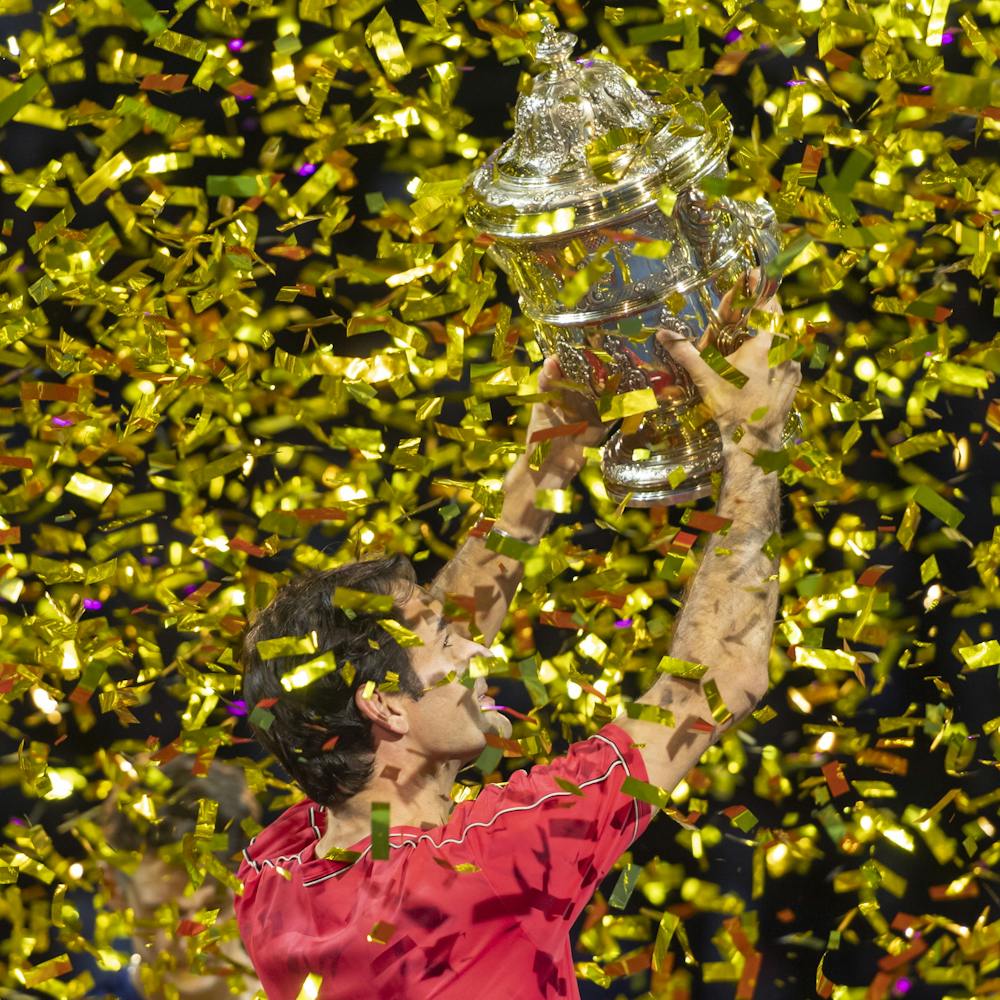 The last two decades saw the rise of the House of Roger.
EPA/GEORGIOS KEFALAS
The last two decades saw the rise of the House of Roger.
EPA/GEORGIOS KEFALAS
Federer, we are told, may return to such spaces to play post-retirement exhibition games. The Roger Federation Foundation[18], dedicated to alleviating child poverty through education, could use the money.
But before the next phase of King Roger’s life there must be the ceremonial media moment[19] of his appearance in the O2 arena in London, this week’s global capital of farewell ceremonies.
Read more: What the Ash Barty and 'Special K' tennis triumphs say about Australia and the buttoned-up sport industry[20]
References
- ^ media spectacle (theconversation.com)
- ^ retire (www.abc.net.au)
- ^ Serena Williams forced sports journalists to get out of the 'toy box' – and cover tennis as more than a game (theconversation.com)
- ^ from ritual to record (cup.columbia.edu)
- ^ formidable (www.reuters.com)
- ^ Laver Cup (lavercup.com)
- ^ teenage firebrand (www.google.com.au)
- ^ Rod Laver (www.tennisfame.com)
- ^ Nick Kyrgios (theconversation.com)
- ^ King Roger (www.thetimes.co.uk)
- ^ Nasty Nick (www.dailymail.co.uk)
- ^ fascinate younger tennis (www.crikey.com.au)
- ^ Big Three (www.theguardian.com)
- ^ vaccinated (www.bbc.com)
- ^ Queen Serena Williams (nypost.com)
- ^ Who can break up the 'Big 3' monopoly on men's tennis? Here's what the numbers say (theconversation.com)
- ^ NikeTown (www.nike.com)
- ^ Roger Federation Foundation (rogerfedererfoundation.org)
- ^ ceremonial media moment (www.google.com.au)
- ^ What the Ash Barty and 'Special K' tennis triumphs say about Australia and the buttoned-up sport industry (theconversation.com)