Penny Wong's diplomacy efforts in the Pacific begin to bear fruit with PNG security pact
- Written by: Michael O'Keefe, Director, Master of International Relations, Department of Politics, Media and Philosophy, La Trobe University
Papua New Guinea (PNG) has announced[1] it wants to establish a security agreement with Australia, welcome news for analysts wary of rising Chinese influence.
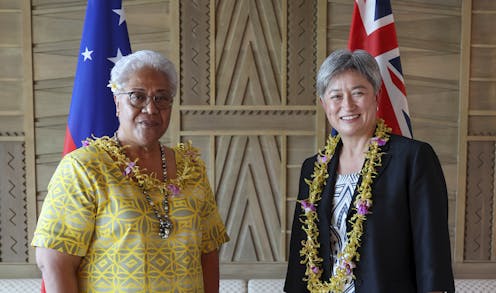
This decision reflects well on Foreign Minister Penny Wong’s tireless diplomacy with Pacific Island capitals. Since becoming Foreign Minister a little over three months ago, Wong has made four separate trips to the Pacific; to Fiji, Samoa, Tonga, New Zealand and Solomon Islands, as well as engaging with Pacific leaders during July’s Pacific Islands Forum Summit.
Read more: Foreign policy and the Albanese government’s first 100 days[2]
And these efforts appear to be paying off. Not only has PNG expressed an interest in a security pact with Australia, but Timor-Leste[3] has also just signed a defence cooperation agreement.
However, there is both much more and much less to the PNG security announcement than meets the eye.
The announcement by Justin Tkatchenko, PNG’s new foreign minister, was light on detail. Tkatchenko said the security treaty with Australia has been in the works since 2019[4] but has been spurred by the recent security agreement between Solomon Islands and China.
Read more: How should the next Australian government handle the Pacific?[5]
Filling current security “loopholes”
In 2019, Australia and Papua New Guinea signed up to a Comprehensive Strategic and Economic Partnership[6], which included a commitment to “develop a bilateral security treaty to further promote our shared security interests”. Progress then stalled.
Tkatchenko noted the proposed new agreement will “fill in the loopholes” caused by the current security situation in the region and complement the regional security agreement the two countries already have in place. He mentioned that discussions were at early stages and could be expanded to include New Zealand and the US, due to the importance of regional security.
Tkatchenko also expressed hopes an agreement could be reached by the end of the year, but didn’t provide much context of how the new agreement would complement[7] other regional security agreements.
Not surprisingly, Wong and Defence Minister Richard Marles were cautious in response. Wong confirmed talks were at a “very early stage[8]”, while Marles went to great lengths to note the initiative originated in Port Moresby rather than Canberra.
Why now?
The announcement was a signal of PNG’s strategic intent and its concern[9] over the security arrangement signed by Solomon Islands and China in April.
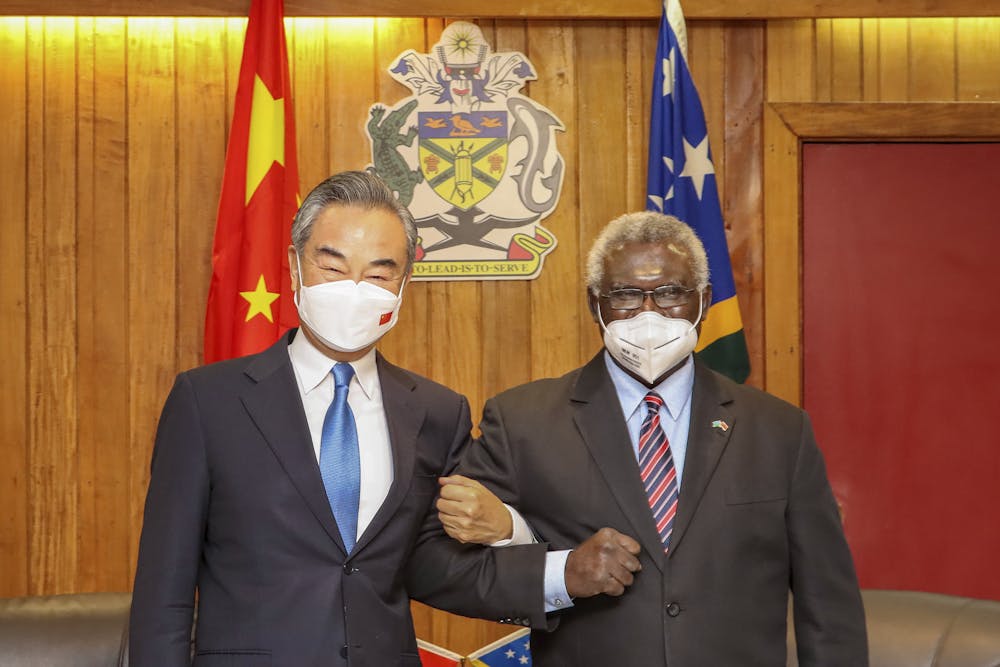
PNG is now declaring its security interests are aligned with the US and Australia, a move sure to please Canberra. But this announcement places PNG is a peculiar position.
Like Australia, China is PNG’s number one trading partner, but Port Moresby has declared its hand by siding with Australia.
Australia has been punished with hefty trade sanctions[10] by Beijing for “accusing and smearing China” in the past. However, knowledge of these actions have not (yet) dissuaded PNG’s leaders from siding against China.
History of cooperation
There is a sound basis for a security agreement between Australia and PNG. The Australian Defence Force has been the PNG military’s primary partner since PNG established independence in 1975. Through a Status of Forces[11] agreement developed at the time, the two nations have effectively conducted numerous cooperative defence activities.
Read more: If Papua New Guinea really is part of Australia's 'family', we'd do well to remember our shared history[12]
Security cooperation between the two countries was established through Australia’s Defence Cooperation Program[13]. In fact, the structure and doctrine of PNG’s military was strongly influenced by Australia’s military, and commanders of the PNG military have been trained in Australian defence colleges.
In contrast, practical defence cooperation has been longstanding and significant. Practical defence cooperation involves training at all levels in PNG and in Australia. Forces from both nations have operated together in peacekeeping operations in Bougainville and Solomon Islands.
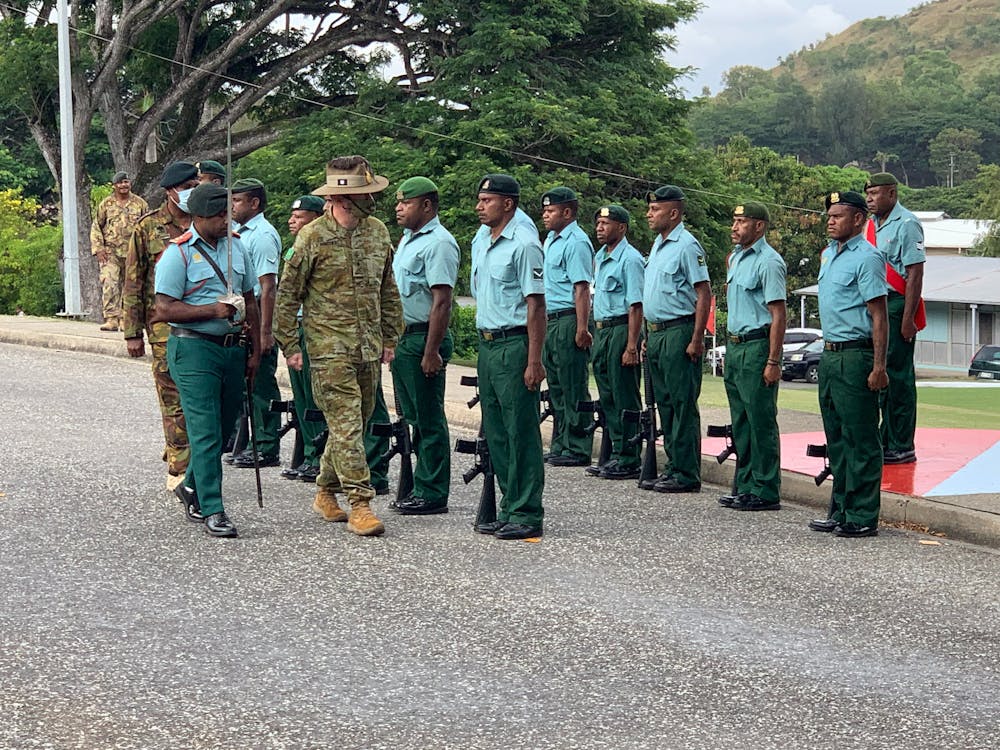 Australian Major General Scott Winter inspects Papua New Guinea Defence Force troops during a welcome parade. The structure of PNG’s military has been strongly influenced by Australia’s.
Department of Defence
Australian Major General Scott Winter inspects Papua New Guinea Defence Force troops during a welcome parade. The structure of PNG’s military has been strongly influenced by Australia’s.
Department of Defence
Australia also regularly provides humanitarian assistance after natural disasters in PNG. In June, Australian forces and aircraft were also deployed to provide security and assist during PNG’s election.
Read more: PNG elections show there is still a long way to go to stamp out violence and ensure proper representation[14]
The most significant activity at the moment is the $170 million redevelopment[15] of the Lombrum naval base on Manus Island (in cooperation with the US). Facilities are being upgraded to house patrol boats donated by Australia, but it’s important to note that Canberra’s offer only came after a Chinese attempt to rebuild Lombrum in 2018, pointing again to the importance of geopolitical considerations.
Read more: Morrison's Vanuatu trip shows the government's continued focus on militarising the Pacific[16]
A strong signal from Pacific nations
High-level support in Port Moresby and Canberra is essential to the success of this new security agreement. Pressure on Port Moresby is likely to be intense, as will inducements to change direction.
The announcement of the security pact sends a strong signal that Pacific states are making choices about where they stand in the geo-political contest between the US and China. The Solomon Islands security treaty with China showed that the contest has well and truly arrived in Australia’s backyard.
The Albanese government promised to listen to Pacific interests, and under Wong’s leadership, the Department of Foreign Affairs and Trade has responded effectively with compromises on climate change and providing additional development assistance.
And in a refreshing shift[17] in policy, Canberra has not rushed to frame any agreement between itself and a Pacific nation as part of a geo-strategic competition. Now PNG has spoken and no doubt more Pacific Island nations will follow suit.
References
- ^ announced (pina.com.fj)
- ^ Foreign policy and the Albanese government’s first 100 days (theconversation.com)
- ^ Timor-Leste (www.theguardian.com)
- ^ 2019 (www.theguardian.com)
- ^ How should the next Australian government handle the Pacific? (theconversation.com)
- ^ Comprehensive Strategic and Economic Partnership (www.dfat.gov.au)
- ^ complement (pina.com.fj)
- ^ very early stage (www.reuters.com)
- ^ concern (www.theguardian.com)
- ^ hefty trade sanctions (www.abc.net.au)
- ^ Status of Forces (www.austlii.edu.au)
- ^ If Papua New Guinea really is part of Australia's 'family', we'd do well to remember our shared history (theconversation.com)
- ^ Defence Cooperation Program (png.embassy.gov.au)
- ^ PNG elections show there is still a long way to go to stamp out violence and ensure proper representation (theconversation.com)
- ^ redevelopment (www.abc.net.au)
- ^ Morrison's Vanuatu trip shows the government's continued focus on militarising the Pacific (theconversation.com)
- ^ refreshing shift (www.thechinastory.org)