More Aboriginal and Torres Strait Islander children have ear and hearing problems – and it's easy to mistake for bad behaviour
- Written by: Letitia Campbell, Aboriginal Research Officer, School of Medicine, Western Sydney University
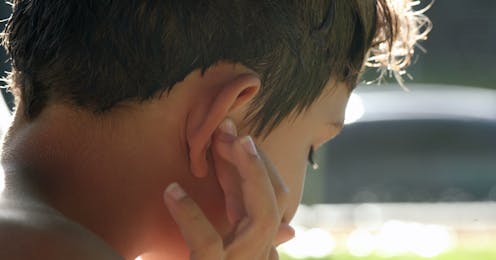
Aboriginal and Torres Strait Islander children experience ear disease – fluid build ups, perforated eardrums and ear infections that can impair hearing – more frequently than most populations in the world[1]. Rates are 8.5 times as high[2] as for non-Indigenous children in Australia.
Early childhood development related to speech, language and learning, relies heavily on being able to hear. The consequences of poor hearing can greatly disadvantage a child in the classroom[3], in the criminal justice system[4] and cause delays in other medical diagnoses[5].
While testing[6] for ear disease in the community for two clinical trials[7], we listened to what the Aboriginal and Torres Strait Islander community had to say about their experiences and committed to sharing their story. We followed Indigenist research principles[8] and interviewed 28 caregivers of Aboriginal and Torres Strait Islander children.
They described how easy it is to mistake ear disease and hearing loss for misbehaviour.
Read more: Bulging ear drums and hearing loss: Aboriginal kids have the highest otitis media rates in the world[9]
Hearing and behaviour
Middle ear disease, known medically as otitis media[10], is a common childhood condition. Fluid builds up behind the ear drum, usually with a cold of flu. When chronic, this condition is also known as “glue ear”. When fluid prevents the ear drum from responding to sound, the reduction in hearing can be severe.
Treatment options for acute ear infections include careful monitoring or antibiotics (if the body does not heal itself). Glue ear that lasts longer than three months is referred to an ear, nose and throat surgeon who can consider surgically inserting ventillation tubes. Any persistent ear problems are monitored with hearing tests.
Ear disease is often a silent disease and when it develops into a chronic condition, physical symptoms become secondary to the serious social and emotional problems[11]. Changes in behaviour, poor balance and coordination, shorter attention spans and irritability can be signs of ear disease and hearing loss.
The caregivers we spoke to noted common behaviours included children talking loudly, turning up the TV or devices, being distracted, talking in class, “not listening” or not responding. When families, teachers or carers assume this behaviour is deliberate, it causes significant distress for children. They feel like they are always in trouble, misheard and misunderstood, no matter how hard they try.
One caregiver we spoke to, whose family member had chronic glue ear and more than ten infections in two years, told us:
With her behaviour though, she wasn’t herself, but she would play up, would be a bit more than usual, [need] more attention, and [get] very frustrated […] even to this day she still gets so frustrated with us because we don’t understand her, so she cries.
Read more: My child has glue ear – what do I do?[12]
Guilty feelings
A diagnosis of chronic ear disease (fluid in the middle ear with or without being infected) in a child can be distressing for caregivers, who might experience complex feelings of guilt.
They told us they felt bad because they had misjudged their own child. They experienced self-doubt about their parenting for “not noticing” there was a medical problem or for not sticking to their “gut feeling” something was wrong when their concerns were dismissed by doctors or family members. One parent said:
I just thought that she was just a bit ignorant, you know, when I’d call out to her, she wouldn’t look at me and then I’d take her to the doctor’s, and she’s got glue ear. I felt bad afterwards.
Race adds an additional layer of complexity, with some caregivers feeling too afraid to visit a GP for fear of being reported to authorities for having a sick child.
Other caregivers said they visit the doctors office for even the most minor of concerns, afraid they would be judged and labelled as neglectful if they did not. Both are evidence of systemic racism, which tries to attribute child health disparities to poor parenting rather than the broader structural factors that affect Aboriginal and Torres Strait Islander people.
Read more: First Nations people in rural NSW lived with more anxiety and fear about COVID-19 than non-First Nations people[13]
Watching closely
Caregivers demonstrated resilience against health-care system challenges and sought greater understanding of the disease and its treatment.
Ear disease can be highly variable, with different symptoms presenting at different times. Caregivers described closely monitoring their children to detect changes and know when to seek or change treatment. Many took the time to consider the different possible treatments and advocated for better care by engaging in detailed discussion with their doctors, seeking different opinions or travelling out-of-area to receive timelier treatment (such as surgery).
I would take her to the doctors and they’d just give her antibiotics or drops and send her home. I kept taking her back to the doctors, same thing, day in, day out. I got to the point where I got fed up so, I took her to the hospital.
Our interviews revealed that a strong relationship of respect, collaboration and information-sharing between the caregiver and health professionals is a key component to successfully navigating ear disease.
The best clinical care empowers caregivers to confidently seek medical help to identify and manage ear disease in the long-term. This allows them to support children through ear or hearing problems, instead of focusing on the behavioural symptoms. As researchers and practitioners, we can focus on providing quality care and sharing knowledge – so caregivers can focus on managing their child’s symptoms, rather than managing the health system.
References
- ^ populations in the world (publications.aap.org)
- ^ 8.5 times as high (www.aihw.gov.au)
- ^ child in the classroom (pubmed.ncbi.nlm.nih.gov)
- ^ criminal justice system (search.informit.org)
- ^ medical diagnoses (onlinelibrary.wiley.com)
- ^ testing (trialsjournal.biomedcentral.com)
- ^ trials (trialsjournal.biomedcentral.com)
- ^ Indigenist research principles (www.jstor.org)
- ^ Bulging ear drums and hearing loss: Aboriginal kids have the highest otitis media rates in the world (theconversation.com)
- ^ otitis media (www.rch.org.au)
- ^ social and emotional problems (link.springer.com)
- ^ My child has glue ear – what do I do? (theconversation.com)
- ^ First Nations people in rural NSW lived with more anxiety and fear about COVID-19 than non-First Nations people (theconversation.com)